Artificial Intelligence
July 27, 2026
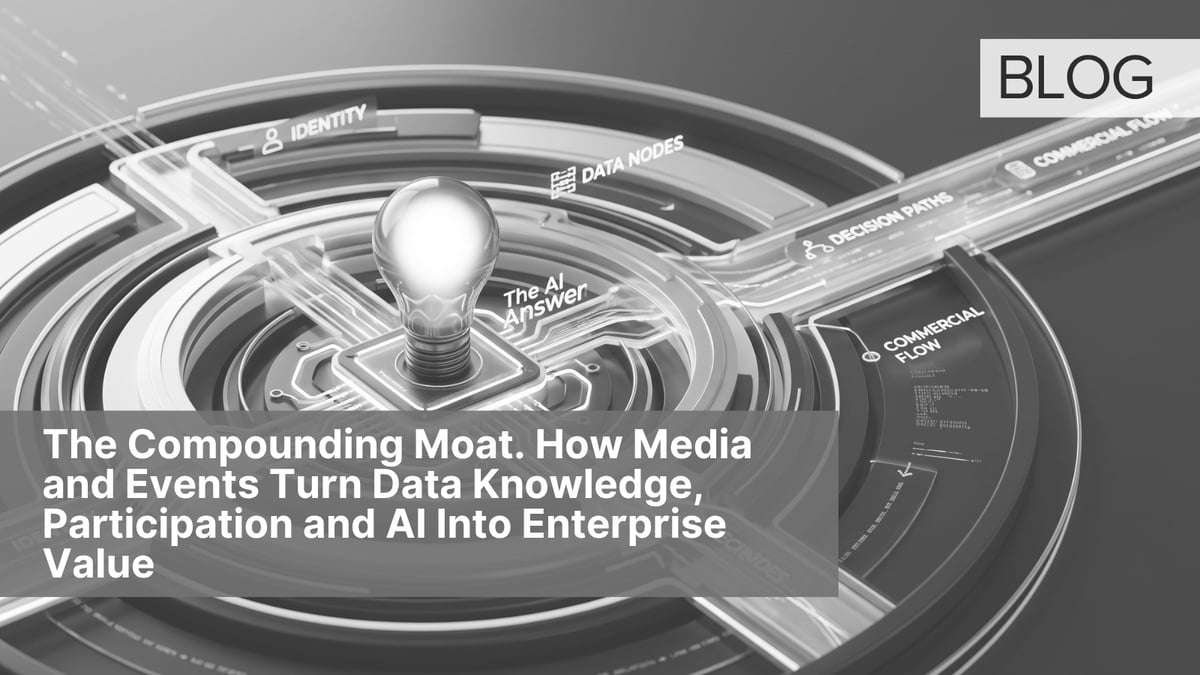
The Compounding Moat. How Media and Events Turn Data Knowledge, Participation and AI Into Enterprise Value
# Artificial Intelligence
# AI strategy
# Market-making
# Compounding Moat
# Revenue Growth
# Value Creation
# Customer profitability
# Executive Leadership
# Digital transformation
# Proprietary Data
# Customer Identity
# Commercial Intelligence
# Media Industry
# Events Industry
Why the next generation of Market-Making Platforms will compete on authority, identity, proprietary intelligence, and commercial action—not content alone.
AI Will Own More Answers. The Next Moat Is What Happens After the Answer.
AI is making answers abundant.
It can summarize research, compare products, identify suppliers, explain a market, prepare a buyer, brief a seller, generate content, analyze performance, and recommend a course of action. Increasingly, customers and audiences can get useful information without following the journeys that media, event, data, information, marketplace, association, and professional network businesses have traditionally organized.
That is a genuine strategic threat. It also changes the basis of competitive advantage.
Information will still matter. Expertise will still matter. Content will still matter. But access to an answer will become less scarce.
What remains scarce is the trusted system around the answer: who participates, what they pay attention to, whom they trust, what they compare, who they connect with, what they decide, and what commercial activity follows.
That is where the next moat will be built.
The businesses that win will not simply create more information or distribute it more efficiently. They will own the proprietary data, knowledge, identity, relationships, market context, and commercial infrastructure that determine what happens after the answer.
From portfolios to Market-Making Platforms
At Revenue Room™ CXO, we use the term Market-Making Platform to describe a business that organizes attention, participation, information, experiences, relationships, intelligence, and commercial activity around a defined market.
These businesses may be anchored in media, events, data and information services, marketplaces, associations, professional networks, broadcast/cable/streaming, and marketing services.
What unites them is not format. It is their role in shaping how a market discovers, engages, evaluates, connects, decides, and acts.
A company does not become a Market-Making Platform because it owns several products or distributes content over multiple channels. A portfolio contains multiple offerings. A Market-Making Platform creates a system in which participation makes the entire business more valuable.
That is a much higher standard.
Most companies are solving the wrong problem
The primary threat is not simply that AI will create more content or answer more questions.
The deeper threat is that companies will continue to treat content, events, audiences, customer data, research, marketplaces, and commercial relationships as separate assets while competitors connect them into one intelligent value-creation system.
Many leadership teams are responding to AI by adding tools, launching pilots, modernizing systems, or asking each department to identify use cases. Those actions may be useful, but they do not, by themselves, create a moat.
The central question is not, How much AI are we using?
It is, What proprietary advantage is AI helping us deepen, and what measurable value is it creating?
The uncomfortable reality
Most companies in these sectors already possess many of the ingredients required to build a powerful moat:
- Trusted brands and market authority
- Valuable audiences and customer relationships
- Flagship events and professional communities
- Proprietary research, content, and archives
- Behavioral, transactional, and engagement data
- Market expertise and institutional knowledge
- Subscription products, marketplaces, and commercial networks
But these assets often sit inside separate products, systems, teams, and revenue lines.
The symptoms are familiar. Event behavior disappears after the event. Content engagement is disconnected from customer records. Sales teams cannot see meaningful intent signals. Customer identity differs across products and business units. Valuable knowledge is trapped inside archives or employees. Product adoption is not connected to renewal or expansion. Acquisitions add scale, but they also add fragmentation.
These companies may have strong assets. But strong assets do not automatically create a strong system.
Without connected identity, usable proprietary knowledge, differentiated intelligence, and coordinated commercial action, the company does not have a platform.
It has an expensive collection of products.
The Compounding Moat
The strongest Market-Making Platforms build a reinforcing system across six elements.

The Compounding Moat
1. Authority
Authority is the company’s right to matter in its market.
It may come from a trusted brand, flagship event, proprietary dataset, professional standard, respected research capability, marketplace position, or deep expertise. Authority attracts attention, creates trust, and gives the business permission to interpret, convene, recommend, educate, and influence.
2. Participation
Participation is the concentration of audiences and market participants who matter.
This is not simply reach. A large anonymous audience may be less strategically valuable than a smaller group with strong engagement, verified identity, meaningful intent, and real decision authority.
The strongest platforms give buyers, sellers, members, subscribers, sponsors, creators, partners, and decision-makers repeated reasons to participate across content, products, experiences, relationships, and commercial activity.
3. Identity
Identity is the platform’s cumulative understanding of its participants.
It goes beyond an email address or account record. It includes who people are, what roles they play, what organizations they represent, what they consume, what they search for, what they compare, whom they engage with, and where they may be in a decision journey.
Anonymous activity creates analytics. Connected identity creates opportunity.
4. Proprietary Knowledge
Proprietary knowledge is what the company uniquely knows about its market, customers, products, workflows, and subject matter.
That may include research, content, taxonomies, metadata, market history, editorial expertise, customer interactions, professional standards, workflow knowledge, and institutional experience.
Owning this knowledge is not enough. It must be structured, connected, trusted, and usable by both people and AI systems.
5. Intelligence
Intelligence is created when identity, proprietary knowledge, behavior, relationships, and commercial activity are interpreted in context.
This can reveal demand, intent, renewal risk, market movement, account opportunity, product potential, pricing patterns, and commercial momentum.
Information describes. Intelligence improves a decision.
The highest-value intelligence does not always require the customer to leave their existing environment and visit another dashboard.
Increasingly, it will be embedded directly into the workflows where decisions are already being made. Proprietary data, expertise, benchmarks, campaign configuration recommendations and performance, lead intelligence, and market signals may appear inside a customer’s AI and data environment, CRM, marketing automation, campaign planning system, research process, risk platform, procurement workflow, or operating dashboard.
This matters because intelligence becomes more valuable when it is timely, contextual, and actionable. A report can inform a decision. Embedded intelligence can influence the decision as it happens.
That does not make workflow the moat by itself. Workflow integration is the mechanism that connects proprietary intelligence to commercial action. Its value depends on the authority, participation, identity, data, and expertise behind it.
6. Commercial Action
Commercial action is where the platform’s intelligence becomes part of how customers work.
The strongest Market-Making Platforms do not stop at publishing insight or reporting behavior. They place relevant intelligence into the decisions, systems, and workflows where participants can act on it.
The moat becomes economically meaningful when the system changes what happens next.
Commercial action may include better matching, stronger recommendations, pipeline creation, deal acceleration, product adoption, sponsorship value, pricing, transactions, retention, account expansion, subscriptions or new data and AI products that can be monetized and form new revenue streams.
This is the point at which the moat produces measurable economic value.
How the moat compounds
Authority attracts participation. Participation creates identity and behavioral signals. Identity and proprietary knowledge produce differentiated intelligence. Intelligence improves decisions, experiences, relationships, products, and commercial action. Better outcomes strengthen authority and attract more valuable participation.
The system then begins again from a stronger position.
That is the Compounding Moat.
A competitor may be able to copy an article format, launch an event, acquire a dataset, build software, or create a membership product. It is much harder to replicate years of trusted participation, connected identity, proprietary knowledge, behavioral context, market relationships, and demonstrated outcomes.
The strongest moat is not any single product.
It is the system through which the products improve one another.
Why proprietary data is not automatically a moat
Nearly every company now claims its data is a competitive advantage.
That is not necessarily true.
A company can own enormous volumes of data and still be unable to improve a decision, personalize an experience, retain a customer, create a product, or generate revenue.
Data becomes strategically valuable when it is:
- Connected across products and systems
- Structured and contextualized
- Governed and permissioned
- Accessible and interpretable
- Trusted by the people using it
- Embedded into decisions and workflows
The same is true of enterprise knowledge.
A media company can own decades of archives and still be unable to turn them into a differentiated intelligence product. An event company can generate millions of behavioral signals and lose most of their value when the event ends. An association can know its members deeply and still fail to convert that knowledge into stronger retention, benchmarking, learning, or commercial value.
The moat is not the raw asset.
The moat is the company’s ability to connect, interpret, and activate it.
The real management problem
Companies rarely fail because they lack initiatives.
They fail because they have too many disconnected initiatives without a shared value-creation model.
The data team modernizes infrastructure. The product team launches AI features. Marketing improves personalization. Sales buys intent data. The event team invests in matching. Editorial experiments with generative AI. The CFO asks for return.
The CEO receives multiple versions of progress.
Each initiative may make sense within its own function. Together, they may still fail to strengthen the enterprise.
That is why this cannot be delegated to one department.
The Compounding Moat exists between functions. It requires the CEO, CRO, CMO, CPO, COO, CFO, and data and technology leaders to work from a shared understanding of where value is created, where it is leaking, and what should be fixed first.
When leadership does not share the same diagnosis, the company funds multiple solutions, none of which address the full problem.
Executive alignment is not a soft issue.
It is a capital-allocation discipline.
The CEO test
Every major product, data, technology, AI, or acquisition investment should answer a harder set of questions:
- Will this strengthen our authority?
- Will it attract or retain more valuable participants?
- Will it deepen identity across products and channels?
- Will it make our proprietary knowledge more usable?
- Will it create differentiated intelligence?
- Will it improve decisions, relationships, or outcomes?
- Will it increase retention, pricing power, yield, or margin?
- Will it make the system more valuable as participation grows?
- Will it be difficult for competitors or general-purpose AI to reproduce?
If the answer is no, the company may be adding another product, system, or initiative without strengthening its right to win.
What happens after the answer
AI will continue to make information easier to create, summarize, compare, and distribute.
That does not make Market-Making Platforms less relevant. It raises the standard for what they must become.
The winners will be the companies that connect trusted authority, valuable participation, deep identity, proprietary knowledge, differentiated intelligence, and commercial action into a system that becomes stronger over time.
AI will own more answers.
The strongest Market-Making Platforms will own what happens next.
Is your company building a moat or funding fragmentation?
Most leadership teams can describe their portfolio.
Far fewer can demonstrate how the assets inside it reinforce one another to improve revenue, retention, margin, customer value, and enterprise value.
That is the gap Revenue Room™ CXO was built to address.
Revenue Room™ CXO is a year-round value-creation and capability-building system for CEOs and revenue-critical C-suite leaders building Market-Making Platforms. It helps leaders:
- Diagnose where the operating system is fragmented
- Align the executive team around a shared view of value creation
- Prioritize the three to five capabilities that matter most
- Activate those priorities through peer insight, operating use cases, and facilitated working sessions
- Build capability through focused 90-day cycles
The question is no longer whether AI will change how markets discover information and make decisions.
It is whether your company will own what happens after the answer.
Request a Confidential CEO Growth Readiness Review
Determine whether your company is building a Compounding Moat or funding fragmentation. The review will identify where value may be leaking, where executive perspectives differ, and which three to five capabilities should be prioritized next.
Apply for membership and receive your complimentary Growth Readiness Review.
About Revenue Room™ CXO
Revenue Room™ CXO , a business unit of H2K Labs , is the invite-only executive network and year-round decision system for CEOs and revenue-critical C-suite leaders in media, events, and data/information services.
Members use curated peer exchanges, proprietary Growth Readiness Scorecards, operating frameworks, and a quarterly decision cadence to identify revenue and margin exposure, pressure-test consequential decisions, improve cross-functional alignment, and convert insight into measurable action.
Revenue Room™ CXO is built for leaders managing complex, multi-revenue businesses across media, events, subscriptions, data, marketplaces, professional networks, and information services.
Sign in or Join the community
The Nexus for Data-Driven Growth Leaders

Create an account
The Nexus for Data-Driven Growth Leaders
Like
Comments (0)
Popular

Dive in
Related
Blog
Fueling Enterprise Value: The Power of Data
By Heather Holst-Knudse... • Aug 20th, 2024 • Views 27
Blog
AI Makes Scale Cheap. Human Connection Becomes the Events Moat.
By Heather Holst-Knudse... • May 28th, 2026 • Views 15
Blog
Questex's Data-Driven Approach to Media and Events
By Heather Holst-Knudse... • Feb 12th, 2025 • Views 48
55:08
Video
Why Traffic-Reliant Media is "Done For" (And Why Media + Events + Data Wins)
By Heather Holst-Knudse... • Feb 27th, 2026 • Views 11
Blog
Fueling Enterprise Value: The Power of Data
By Heather Holst-Knudse... • Aug 20th, 2024 • Views 27
Blog
Questex's Data-Driven Approach to Media and Events
By Heather Holst-Knudse... • Feb 12th, 2025 • Views 48
55:08
Video
Why Traffic-Reliant Media is "Done For" (And Why Media + Events + Data Wins)
By Heather Holst-Knudse... • Feb 27th, 2026 • Views 11
Blog
AI Makes Scale Cheap. Human Connection Becomes the Events Moat.
By Heather Holst-Knudse... • May 28th, 2026 • Views 15