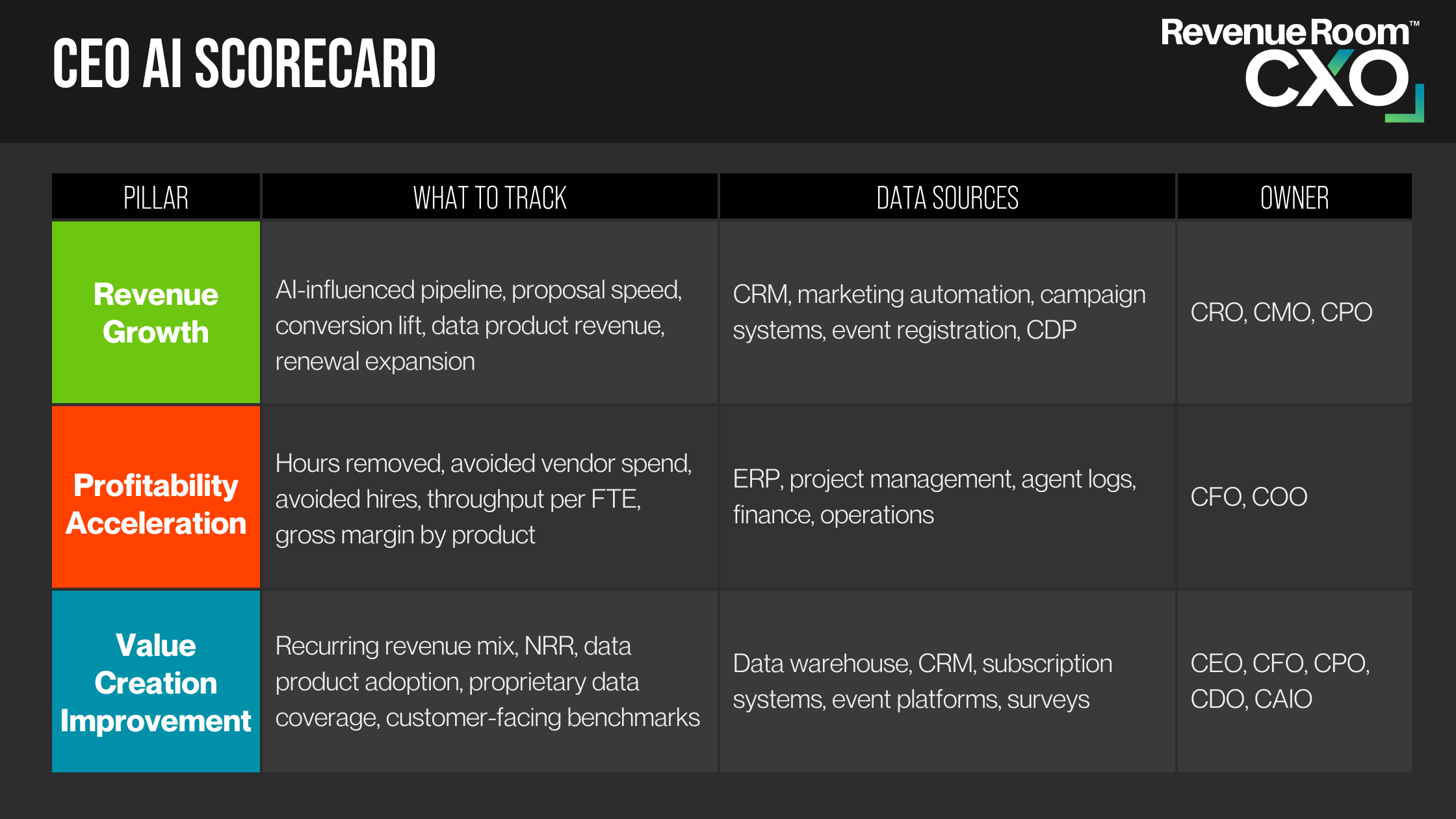
AI Is Not the Strategy. Revenue Quality Is.
The CEOs who get the most value from AI will not be the ones with the most tools.
They will be the ones who can turn proprietary data, workflow leverage, and recurring revenue into a better valuation story.
That was the sharper thread running through the May 2026 CEO Boardroom Exchange, a member-only Revenue Room™ CXO discussion among operators across media, events, and data/information businesses. The conversation was not about whether AI matters. That debate is tired. The real question was more commercial: where does AI actually change the economics of the business? The answer was not “everywhere.” It was more precise, and more useful.
AI is already changing cost structures. It is exposing weak data foundations. It is forcing harder build-versus-buy decisions. And, for companies with real proprietary data, it may create a path from episodic revenue to more durable, recurring intelligence products.
That is where the CEO agenda gets interesting.
Three Signals From the Boardroom Exchange
1. AI is moving into the expensive middle of content operations.
One B2B media CEO described an agent-based workflow designed to process several hundred incoming editorial submissions and press releases each week before human review.
The system ingests material, scores relevance, tags by audience persona, checks competitive coverage, drafts options, and routes work to editors. But the key detail was not that AI could generate copy. That is now table stakes.
The important detail was control.
Editors retained judgment, voice, assignments, deadlines, and publishing authority. AI handled the low-value intake and routing layer. Humans kept the product-defining work.
The business outcome was equally clear: two planned hires were avoided, and editorial capacity shifted toward deeper reporting, analysis, and market interpretation.
That is not “AI replacing journalism.” It is a better labor model for a media business where expert attention is scarce and expensive.
2. Proprietary data is moving from internal asset to customer-facing product.
Another CEO described a multi-year effort to combine survey data, campaign performance, customer interactions, audience behavior, and market intelligence into a predictive customer intelligence layer.
That is a different altitude from AI-assisted content production. It is the move from media product to decision infrastructure.
For media, events, and information companies, this is where AI starts to affect enterprise value. Data sitting inside Salesforce, Cvent, a CMS, an event app, a marketing automation platform, or a spreadsheet is not a moat. A workflow-embedded intelligence product that helps customers make budget, pipeline, market, partner, or category decisions might be.
The difference is monetization.
Dashboards explain what happened. Intelligence products help customers decide what to do next.
3. The generic AI vendor market is already being challenged.
The Boardroom Exchange also surfaced a blunt build-versus-buy tension. Several CEOs compared external AI implementation quotes with what internal teams were able to build themselves.
The pattern was hard to ignore: six-figure vendor quotes are difficult to defend when a motivated operator can prototype a useful workflow in days or weeks with approved tools and lightweight governance.
That does not mean CEOs should build everything internally. It means the buying rule has changed.
Use outside partners for data infrastructure, security architecture, systems integration, enterprise reliability, and industry-specific expertise the company cannot replicate. Do not overpay outsiders to automate workflows your own operators understand better than anyone else.
The vendor test is simple: are we buying expertise we lack, or outsourcing initiative?
The Org Chart Is Moving From Roles to Workflows
One useful contradiction emerged: editorial teams, often assumed to be the most resistant to AI, are moving faster than expected when the purpose is clear.
Finance appears slower.
That should bother CEOs.
FP&A, forecasting, customer cohort analysis, cash conversion, margin modeling, pricing analysis, and scenario planning are obvious AI targets. Yet finance functions often wait for AI to arrive inside ERP, planning, or BI platforms rather than building practical use cases now.
The companies moving fastest are not running giant top-down transformation programs. They are using a more surgical pattern:
- put the operator closest to the work in charge;
- give them approved tools;
- measure the before-and-after economics.
That is not chaos. It is controlled decentralization.
The better CEO question is not, “What is our AI strategy?” It is: which workflows are still being staffed as if AI does not exist?
The Data Moat Maturity Model
“Proprietary data is the moat” is true, but incomplete. Many companies have proprietary data. Far fewer have usable, monetizable, defensible data.
A practical maturity model:
Level 1: Scattered Data
Data lives across CRM, registration platforms, spreadsheets, CMS, email, event apps, ad systems, finance, and customer success. Reporting is manual. Access depends on people.
Level 2: Centralized Reporting
The company has dashboards and basic visibility. Leaders can see what happened, but the data is mostly internal and backward-looking.
Level 3: Customer-Facing Benchmarks
The business turns aggregated data into benchmarks customers will pay for: audience trends, market performance, campaign norms, pricing signals, buyer behavior, exhibitor ROI, category movement, or peer comparisons.
Level 4: Predictive Insights
The company helps customers make better decisions: where to invest, which accounts to prioritize, which segments to target, which messages convert, which events or products drive pipeline.
Level 5: Workflow-Embedded Decision Intelligence
The data product becomes part of how customers operate. It informs planning, budgeting, targeting, renewal, sponsorship, product, or market-entry decisions.
Most media and event companies are somewhere between Levels 1 and 3. The value-creation opportunity is moving to Level 4 or 5 before competitors do.
What CEOs Should Pressure-Test Now
1. The Workflow Question
Where are we still using expensive human judgment on low-value intake, routing, formatting, reporting, research, or project coordination?
2. The Data Question
Which proprietary data assets could become customer-facing intelligence within 12 months?
Look across registration, CRM, content consumption, email engagement, app behavior, session attendance, lead scans, surveys, sponsor performance, renewal history, and campaign outcomes.
3. The Revenue-Quality Question
Which AI-enabled products could move us from episodic revenue to recurring or re-occurring revenue?
Cost savings improve EBITDA. Recurring intelligence products can improve the valuation story.
4. The Vendor Question
Which AI projects are we overpaying outsiders to build because we have not empowered the operators closest to the work?
5. The Diligence Question
What would a buyer, board, or investor believe about our AI advantage 18 months from now?
They will not reward theater. They will look for margin impact, proprietary data, recurring revenue, retention, workflow adoption, and defensibility.
The practical test: can the company show how AI changes the economics of the business, not just the efficiency of a department?
The Takeaway
The CEOs who win this cycle will not be the ones with the longest list of AI experiments.
They will be the ones who connect AI to workflow leverage, proprietary data, recurring revenue, and a valuation story that survives diligence.
That is the kind of conversation Revenue Room™ CXO is designed to surface: candid, peer-level, commercially grounded, and ahead of the market’s public case studies. Not AI theory. Not vendor optimism. Not conference-stage abstraction.
It is also why the Boardroom Exchange matters. The value is not the recap. It is the pressure test: operators comparing live decisions before those decisions become polished case studies.
The question is not whether AI belongs on the CEO agenda.
It is whether the conversation inside your company is moving fast enough — and whether you are testing your assumptions against the right peers.
Ready to Step Into the Revenue Room™?
The ideas in this article are just the starting point. Revenue Room™ brings together CEOs and revenue-critical leadership teams across media, events, data, and information services to align around one growth plan, one scorecard, and one execution cadence—turning data, AI, and operator insight into measurable revenue, margin, and enterprise value outcomes.
Continue the conversation and take the next step:
Check out our event lineup including upcoming Exchange Roundtables, Revenue Room™ Salon: Women Who Accelerate & Lead, and RevvedUP 2027 Apply to Join Revenue Room™ CXO
Become part of the invite-only executive network for CEOs and revenue-critical C-suite leaders building the next era of profitable growth. Learn More About Upcoming Revenue Room™ Bootcamps
Equip your teams with practical, instructor-led programs designed to move from learning to execution.
Download Revenue Room™ Playbooks
Access frameworks, templates, and operating tools to help your team assess gaps, prioritize growth moves, and execute with greater speed and clarity.
Latest playbooks
- The Revenue Room™ GTM Prompt Playbook
- The Revenue Room™ KPI Dictionary
Step into the room where modern growth leaders align, accelerate, compound, and connect.