Revenue
May 14, 2026
Predictive Signals for Media and Events Revenue Leaders
# Predictive signals
# Gtm signals
# Early warning revenue system
# Revenue AI
# Pipeline signals
# churn signals
# B2B revenue performance
Learn how B2B media and events companies can use predictive revenue signals to identify churn, expansion, and pipeline risk before the quarter closes.

Heather Holst-Knudsen
Stop Waiting for the Quarter to Close to Find Out What Went Wrong
Most revenue teams are excellent at explaining what happened after the damage is done.
Pipeline missed. Renewal slipped. Sponsor satisfaction softened. Attendance underperformed. Sales productivity fell. The board deck has a reason for every variance.
The problem is not the postmortem. The problem is the timing.
For CROs, CMOs, COOs, and CEOs in B2B media and events, the highest-leverage revenue work now sits upstream: identifying the signals that predict commercial outcomes before those outcomes appear in the P&L.
A predictive signal is a measurable behavior, pattern, or data point that indicates a future revenue outcome is becoming more or less likely.
That definition matters. A closed-won deal is not a predictive signal. It is a result. A sponsor asking for attendee engagement benchmarks six weeks before renewal? That is a signal. A hosted buyer attending fewer qualified meetings than projected? Signal. A subscriber consuming less category-specific content before a renewal cycle? Signal. A sales rep creating late-stage pipeline without corresponding buyer engagement? Signal.
The companies that win will not be the ones with the most dashboards. They will be the ones that know which signals deserve action.
What Is a Predictive Revenue Signal?
A predictive revenue signal is an early indicator that a customer, prospect, attendee, sponsor, exhibitor, or account is moving toward a measurable commercial outcome.
That outcome might be:
- A new sale
- A renewal
- An upsell
- A churn event
- A pricing conversation
- A sponsor expansion
- A decline in engagement
- A higher-probability conversion
The key word is early.
Lagging indicators tell you what already happened. Predictive signals tell you where to intervene.
For media and events companies, that distinction is becoming a core operating advantage. These businesses generate signal-rich data every day: registration behavior, content consumption, email engagement, ad delivery, session attendance, app activity, badge scans, booth visits, hosted buyer meetings, CRM notes, sponsor feedback, renewal conversations, and payment behavior.
Most of that data already exists. The commercial challenge is that it is often trapped in disconnected systems and reviewed too late.
Why Media and Events Companies Have a Signal Advantage
B2B media and events companies are not data-poor. They are usually data-fragmented.
That is a better problem.
A SaaS company may know product usage in detail. A media or events company can often see something broader: how buyers research, gather, compare vendors, attend sessions, respond to sponsors, consume content, register interest, and move through a commercial community.
That creates three forms of advantage.
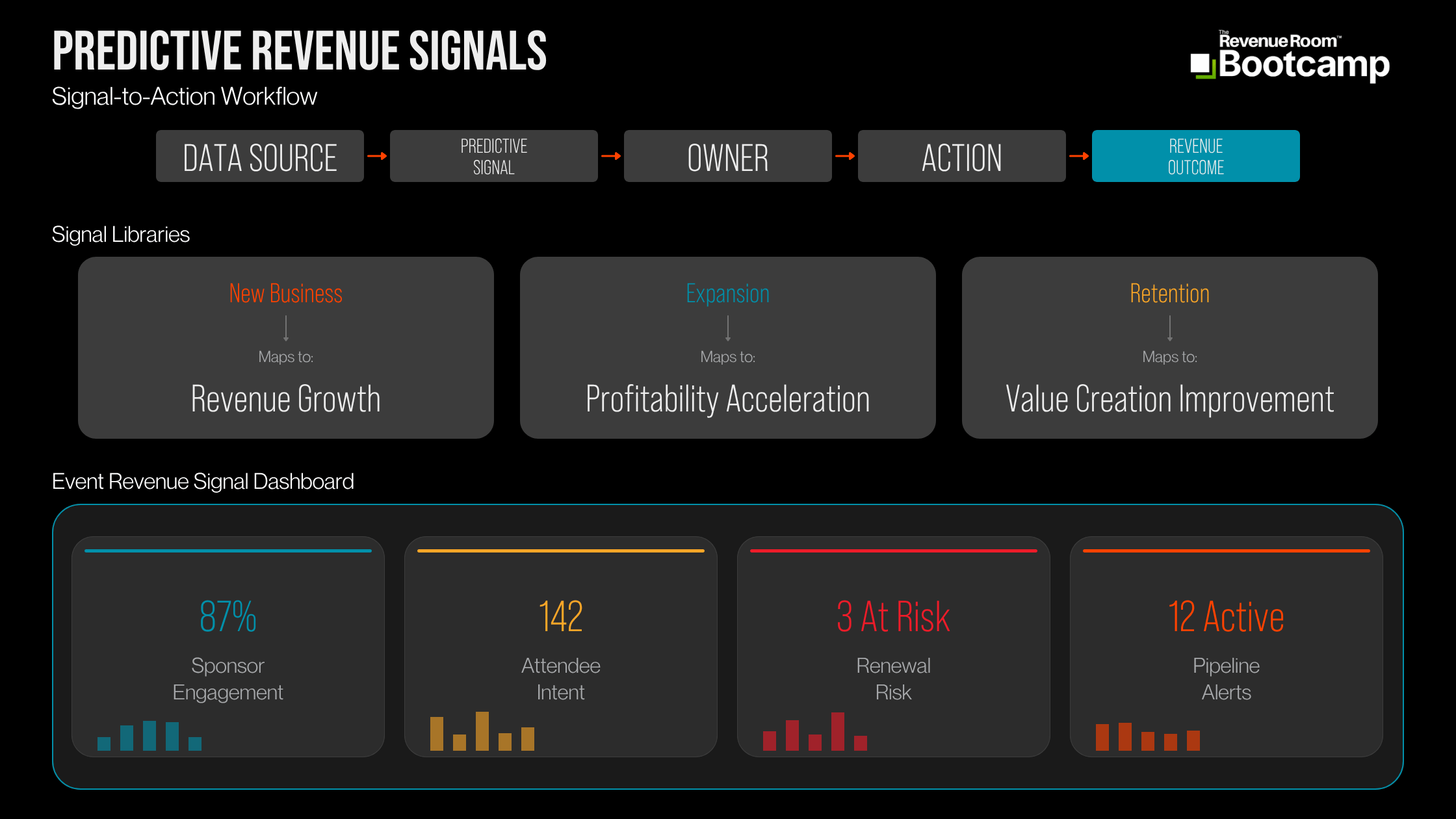
1. Revenue Growth
Predictive signals can help sales and marketing teams find in-market buyers earlier. A prospect who downloads three related reports, registers for a webinar, attends a category session, and visits a sponsor profile is showing more than “engagement.” They may be showing intent.
The revenue question is whether the organization can convert that intent into pipeline before competitors do.
2. Profitability Acceleration
Signals reduce wasted motion. Sales teams stop chasing every click. Marketing stops treating all engagement equally. Event teams can intervene before attendee or sponsor dissatisfaction becomes a renewal problem.
Better signals mean better prioritization. Better prioritization improves sales productivity, service cost, and campaign yield.
3. Value Creation Improvement
For PE-backed and enterprise media companies, predictive signal systems can become part of the valuation story. They make revenue more durable, renewals more manageable, and monetization more repeatable.
A company with clean signal libraries, clear ownership, and instrumented commercial workflows is not just “using data.” It is building a more predictable revenue engine.
The Three Signal Libraries Every Revenue Leader Needs
Revenue leaders should not start by building one giant data lake and hoping insight magically appears. Start with three commercial signal libraries.
New Business Signals
New business signals identify which accounts or buyers are more likely to enter pipeline or convert.
Useful examples include:
- Repeat visits to high-intent content pages
- Multiple contacts from the same account engaging within a short time window
- Webinar attendance tied to a specific buying category
- Event registration from target accounts
- Sponsor profile views or product directory activity
- Comparison-guide downloads
- Direct replies to editorial, event, or community emails
The practical test: would this signal help a seller prioritize outreach today?
A simple model is stronger than most teams think. For example, “two category content opens plus one event registration plus one sponsor profile visit” may be a stronger buying signal than five generic newsletter clicks.
The mistake is treating every engagement as equal. A click is not a signal until it has context.
Expansion Signals
Expansion signals identify which customers, sponsors, exhibitors, or members are likely to buy more.
Useful examples include:
- Increased usage across multiple stakeholders in the same account
- Sponsor requests for deeper attribution or audience insights
- Exhibitors asking about category exclusivity
- High attendee interaction with a sponsor’s session, booth, or content
- Repeat participation across events, webinars, and content programs
- Strong post-event lead quality scores
- New business units engaging with existing customer content
Expansion is rarely born in a quarterly business review. It usually shows up earlier as curiosity, demand, or internal stakeholder spread.
The best revenue teams capture those moments and route them quickly.
Retention Signals
Retention signals identify where renewal risk is building.
Useful examples include:
- Declining content consumption among key contacts
- Lower attendance from a historically active account
- Weak booth traffic or scan volume versus expectations
- Poor lead acceptance rates from sponsors
- Fewer stakeholder interactions before renewal
- Payment delays or contracting friction
- Negative sentiment in customer success or sales notes
- Event attendance without session participation or app activity
Retention signals should be reviewed before renewal season, not during it.
By the time a sponsor says, “We need to evaluate ROI,” the signal has probably been visible for months.
The Signal Quality Test
Not all data points deserve operational attention. A signal should pass five tests before it becomes part of a revenue workflow.
- Specificity: Does the signal point to a clear commercial behavior? A generic click is weak. A target-account buyer viewing a pricing-related sponsor package is stronger.
- Timeliness: Does the signal appear early enough to act? A churn reason after cancellation is useful for analysis. It is not useful for intervention.
- Actionability: Does someone know what to do next? A signal without a playbook becomes dashboard decoration.
- Ownership: Is one team accountable for response? Sales, marketing, customer success, event operations, or RevOps must own the next action.
- Economic relevance: Does the signal connect to revenue, margin, retention, pricing power, or customer lifetime value? Engagement is not automatically valuable. Commercially useful engagement is.
This is where many organizations get stuck. They confuse more visibility with better management.
The real goal is not to monitor everything. The real goal is to make the next best action obvious.
Build a Signal-to-Action Map
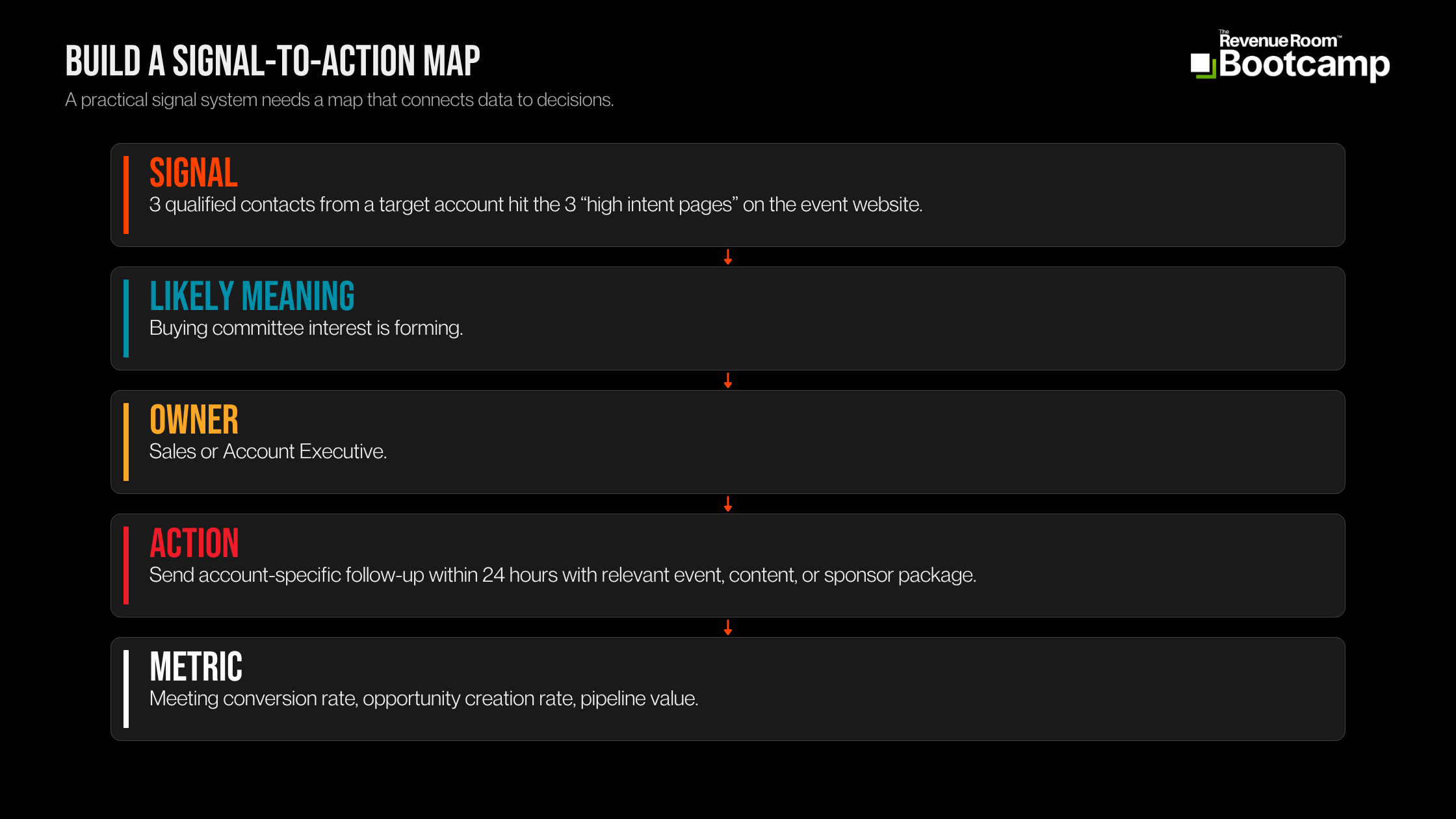
A practical signal system needs a map that connects data to decisions.
Use this simple format:
Signal: Three contacts from a target account register for the same category webinar.
Likely meaning: Buying committee interest is forming.
Owner: Sales or account executive.
Action: Send account-specific follow-up within 24 hours with relevant event, content, or sponsor package.
Metric: Meeting conversion rate, opportunity creation rate, pipeline value.
Another example:
Signal: Sponsor lead scans are 35% below the expected benchmark halfway through an event.
Likely meaning: Booth location, messaging, staffing, or audience fit may be underperforming.
Owner: Event success or sponsor success.
Action: Trigger on-site intervention: traffic recommendation, session promotion, app placement, or meeting support.
Metric: Lead volume recovery, sponsor satisfaction, renewal intent.
This is the operating muscle. Signals should not sit in reports. They should trigger action.
Metrics + Instrumentation
A predictive signal system needs clear measurement, clean data flows, and role-level ownership.
What to Track
Track signals across the full revenue motion:
- Acquisition: account engagement, content consumption, event registration, source quality
- Pipeline: signal-to-meeting conversion, meeting-to-opportunity conversion, opportunity velocity
- Expansion: sponsor engagement, multi-stakeholder activity, package upgrade interest
- Retention: renewal risk score, satisfaction indicators, event participation, lead quality
- Profitability: cost per qualified opportunity, sales cycle efficiency, service cost per sponsor or exhibitor
- Value creation: net revenue retention, renewal predictability, pricing power, repeatable revenue mix
Where the Data Comes From
The core data sources are usually already present:
- CRM
- Marketing automation
- Registration platform
- Event app
- Badge scanning
- Session attendance
- Website analytics
- Email engagement
- Ad server
- Sponsor portal
- CDP or data warehouse
- Finance and billing systems
- Customer success notes
The priority is not adding another system. The priority is connecting the right fields and defining what each signal means.
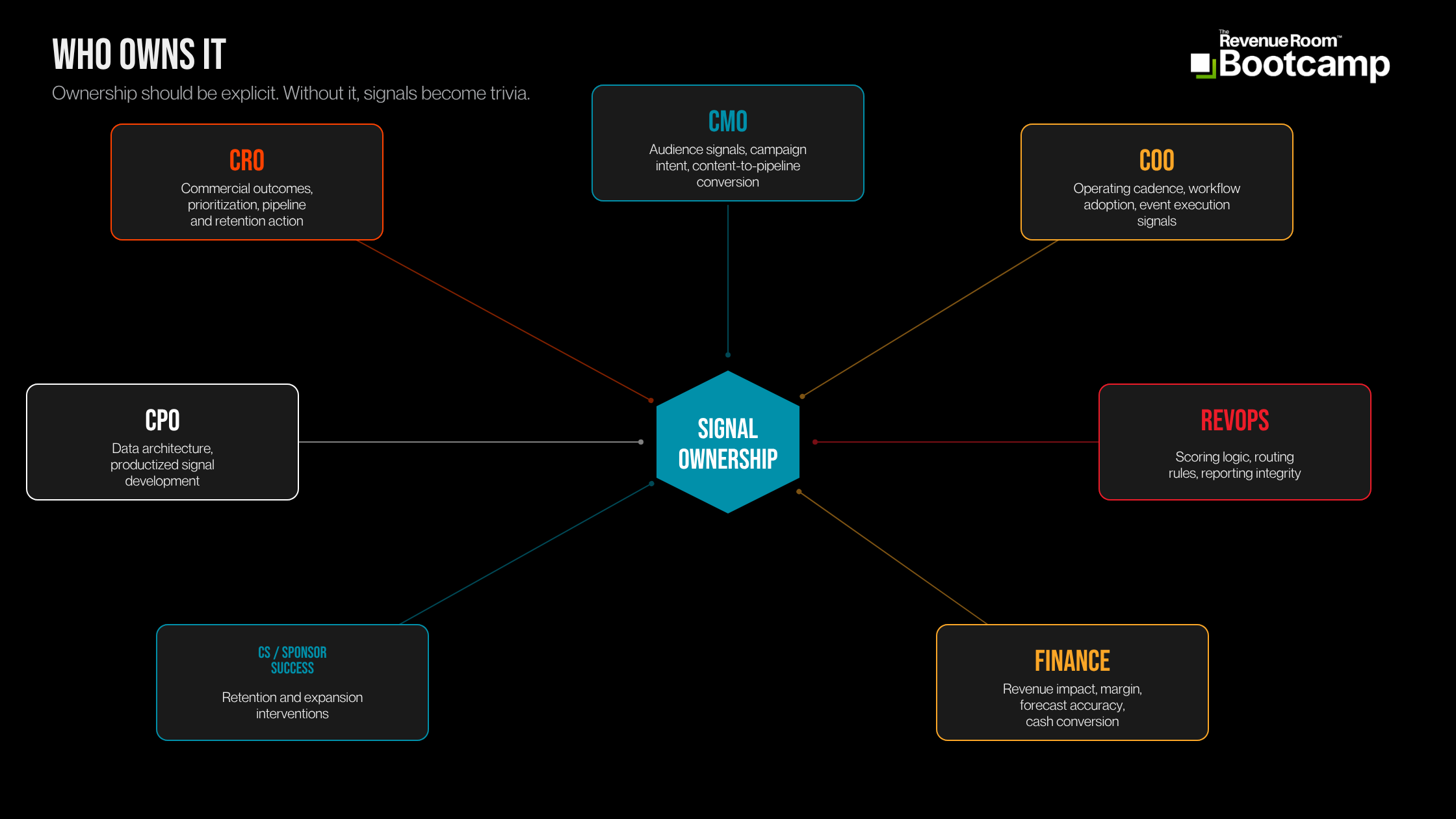
Who Owns It
Ownership should be explicit:
- CRO: commercial outcomes, prioritization, pipeline and retention action
- CMO: audience signals, campaign intent, content-to-pipeline conversion
- COO: operating cadence, workflow adoption, event execution signals
- CPO or product/data leader: data architecture, productized signal development
- RevOps: scoring logic, routing rules, reporting integrity
- Customer success or sponsor success: retention and expansion interventions
- Finance: revenue impact, margin, forecast accuracy, cash conversion
Without ownership, signals become trivia.
Three Actions to Take This Week
Revenue leaders do not need a year-long transformation to begin.
Start here.
1. Pick One Commercial Outcome
Choose one outcome that matters now: renewal risk, sponsor expansion, new business pipeline, attendee conversion, or exhibitor retention.
Do not start with “better data.” Start with a business problem.
2. Identify Five Signals That May Predict It
Pull sales, marketing, event operations, and customer success into one working session. Ask: what happens before this outcome improves or deteriorates?
Write down the five behaviors that usually appear early.
3. Build One Signal-to-Action Map
For each signal, define the owner, action, timing, and metric.
This is the bridge from insight to revenue.
It is also the kind of operating cadence Revenue Room™ CXO is built around: executive teams translating market signals, customer behavior, and revenue data into faster commercial decisions.
The Takeaway
The quarter-end report is too late to be your first source of truth.
For B2B media and events companies, the next frontier of revenue performance is not simply better reporting. It is predictive operating discipline.
The winners will know which behaviors matter, which teams own the response, and which signals create measurable revenue, margin, and enterprise value.
That is the shift: from explaining misses to preventing them.
Ready to Step Into the Revenue Room™?
The ideas in this article are just the starting point. Revenue Room™ brings together CEOs and revenue-critical leadership teams across media, events, data, and information services to align around one growth plan, one scorecard, and one execution cadence—turning data, AI, and operator insight into measurable revenue, margin, and enterprise value outcomes.
Continue the conversation and take the next step:
Check out our event lineup including upcoming Exchange Roundtables, Revenue Room™ Salon: Women Who Accelerate & Lead, and RevvedUP 2027
Apply to Join Revenue Room™ CXO
Become part of the invite-only executive network for CEOs and revenue-critical C-suite leaders building the next era of profitable growth.
Learn More About Upcoming Revenue Room™ Bootcamps
Equip your teams with practical, instructor-led programs designed to move from learning to execution.
Download Revenue Room™ Playbooks
Access frameworks, templates, and operating tools to help your team assess gaps, prioritize growth moves, and execute with greater speed and clarity.
Latest playbooks
Step into the room where modern growth leaders align, accelerate, compound, and connect.
Sign in or Join the community
The Nexus for Data-Driven Growth Leaders

Create an account
The Nexus for Data-Driven Growth Leaders
Like
Comments (0)
Popular

Dive in
Related
55:08
Video
Why Traffic-Reliant Media is "Done For" (And Why Media + Events + Data Wins)
By Heather Holst-Knudse... • Feb 27th, 2026 • Views 11
Blog
Transforming Finance in Media & Events: From Back-Office to Strategic Revenue Partner
By Heather Holst-Knudse... • Nov 24th, 2025 • Views 48
Blog
Data & AI in Media & Events – Driving Competitive Advantage & Revenue Growth
By Heather Holst-Knudse... • Mar 8th, 2025 • Views 21
Blog
Why Traffic-Reliant Media is "Done For" (And Why Media + Events + Data Wins)
By Heather Holst-Knudse... • Mar 5th, 2026 • Views 56
55:08
Video
Why Traffic-Reliant Media is "Done For" (And Why Media + Events + Data Wins)
By Heather Holst-Knudse... • Feb 27th, 2026 • Views 11
Blog
Data & AI in Media & Events – Driving Competitive Advantage & Revenue Growth
By Heather Holst-Knudse... • Mar 8th, 2025 • Views 21
Blog
Why Traffic-Reliant Media is "Done For" (And Why Media + Events + Data Wins)
By Heather Holst-Knudse... • Mar 5th, 2026 • Views 56
Blog
Transforming Finance in Media & Events: From Back-Office to Strategic Revenue Partner
By Heather Holst-Knudse... • Nov 24th, 2025 • Views 48