When leaders talk about growth inside existing accounts, the conversation usually lands on upsell or cross-sell. More licenses. More volume. More of the same buyer.
That is not revenue expansion.
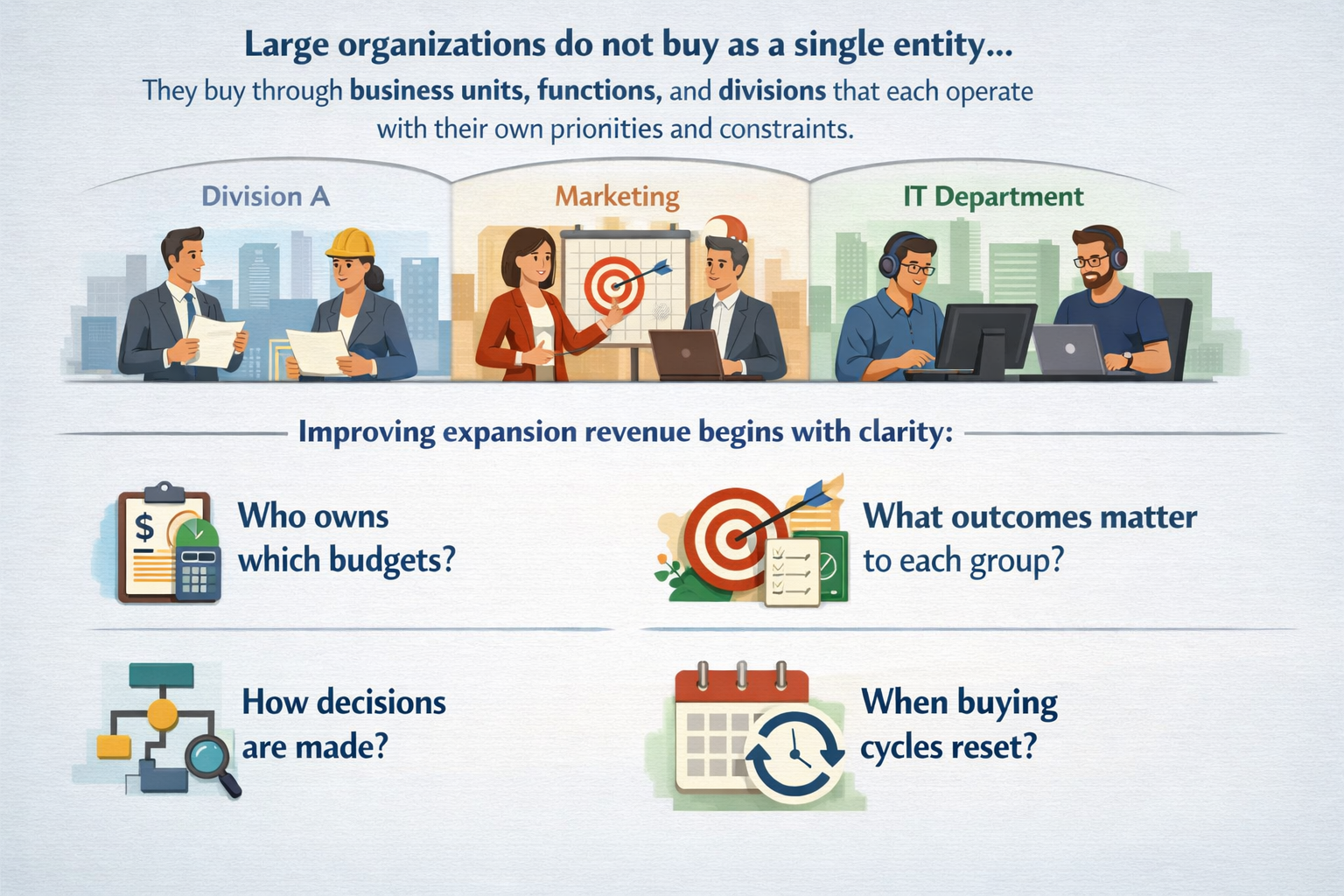
Revenue expansion happens when a seller identifies entirely different pools of budget inside an existing customer organization and earns the right to access them. Those budgets often sit in separate divisions, serve different goals, and answer to different decision-makers. Treating them like extensions of the original deal is where most teams get stuck.
True expansion requires a different mindset and a more disciplined operating model.
Expansion Revenue Starts With Understanding How Customers Actually Buy
Without this view, sellers keep returning to the same contacts and wonder why growth stalls.
Map the Organization, Not Just the Account
Expansion revenue depends on how well you understand the internal shape of the customer.
Strong teams invest time in mapping:
- Divisions and departments
- Budget owners and influencers
- Strategic initiatives by unit
This work is not administrative. It is strategic. It allows sellers to see where additional value can be created and where new conversations should begin.
Build Value Stories That Match Each Division’s Reality
What resonates with one department often falls flat with another.
Expansion revenue improves when teams stop recycling the same pitch and start tailoring value based on:
The proof points may come from existing success inside the account, but the story must be told through the lens of the new buyer.
Turn Existing Relationships Into Strategic Entry Points
Expansion rarely starts cold. It moves through trust.
Strong sellers work with existing contacts to understand internal dynamics and earn introductions to adjacent teams. This is not about asking for favors. It is about demonstrating enough value that advocacy feels earned.
When internal champions are equipped with clear talking points and results, they help shorten cycles and reduce friction across divisions.
Lower the Barrier for New Budget Owners
New divisions are often interested, but cautious.
Pilot programs, limited scope engagements, or bundled offerings give new buyers a way to engage without full commitment. These entry points allow sellers to prove relevance, deliver early wins, and build confidence before larger agreements take shape.
Expansion revenue grows faster when risk feels manageable.
Use Cross-Department Reviews to Surface New Opportunities
Expansion becomes easier when conversations shift from individual wins to enterprise impact.
Cross-department business reviews create space to:
- Share outcomes already achieved
- Highlight patterns across teams
- Connect solutions to broader company goals
These discussions elevate the relationship from vendor to strategic partner and naturally open doors to new divisions.
Align With Company-Wide Priorities
Budgets move more easily when solutions support shared initiatives.
Whether the organization is focused on growth, efficiency, transformation, or customer experience, expansion accelerates when sellers tie their value to outcomes that matter across multiple divisions.
This alignment reframes expansion from an add-on to a strategic contribution.
Make Expansion Easy to Say Yes To
Complex buying processes slow momentum.
Enterprise pricing, multi-division structures, and simplified contracting reduce friction and make it easier for new teams to engage. When adoption across divisions creates cost efficiency and operational clarity, expansion becomes a logical next step.
Expansion Revenue Is a Leadership Discipline
The teams that succeed at expansion do not treat it as opportunistic selling. They treat it as a deliberate growth motion supported by:
- Strong internal coordination
This is where meaningful growth inside existing customers comes from.
Leaders who consistently unlock expansion revenue understand that growth inside existing accounts requires clarity, discipline, and shared perspective.
That is why these conversations continue inside Revenue Room CXO and live at RevvedUP 2026, March 23–24 in St. Pete, where the future of revenue leadership takes center stage. These working sessions bring CEOs and senior leaders together to sharpen strategy, rethink operating models, and exchange real insights with peers facing the same growth pressures. If expansion revenue is a priority for your organization, this is the room where the thinking gets sharper and the path forward gets clearer.