Finance in media and events is changing fast, and teams that stick to traditional accounting risk being left behind.
The modern finance function must transform into a strategic partner that drives revenue growth and business optimization through data-driven decision-making. This transformation is not just desirable—it's essential for survival and growth in an increasingly competitive market.
The Evolution of Finance in Media & Events
Traditional finance teams in media and events companies have historically focused on basic accounting, compliance, and reporting functions. However, the industry's shift toward digital transformation, hybrid events, and complex revenue streams demands a more sophisticated approach. Today's finance teams must leverage data analytics, artificial intelligence, and cross-functional collaboration to drive strategic value.
Key Data-Driven Responsibilities
Revenue Forecasting & Financial Modeling
Modern finance teams must move beyond simple historical trend analysis. By incorporating AI and predictive analytics, they can:
- Generate more accurate revenue projections across multiple revenue streams
- Account for market dynamics and seasonal variations
- Identify emerging revenue opportunities and potential risks
- Create dynamic models that adapt to changing market conditions
Cost & Profitability Analysis
Granular profitability tracking has become essential at multiple levels:
- Event-level profitability analysis including both direct and indirect costs
- Product-level performance metrics across digital and physical offerings
- Customer-level profitability tracking to optimize relationship value
- Channel efficiency analysis to maximize return on investment
Dynamic Pricing & Yield Management
Finance teams must implement sophisticated pricing strategies that:
- Respond to real-time demand signals
- Optimize sponsorship package pricing
- Adjust ticket pricing based on attendance patterns
- Maximize advertising revenue through dynamic rate cards
Financial Reporting & Business Intelligence
Modern finance teams need to:
- Provide real-time revenue insights through interactive dashboards
- Enable data-driven decision-making across departments
- Create automated reporting systems for faster insights
- Develop predictive models for future performance
Common Skills Gaps and Challenges
Limited Analytics Capabilities
Many finance teams still rely heavily on historical data and basic Excel analysis, missing opportunities to leverage advanced analytics for:
Fragmented Data Management
Common challenges include:
- Disconnected systems across events, digital, and print operations
- Manual data consolidation processes
- Inconsistent metrics and definitions
- Limited real-time visibility into performance
Siloed Operations
Finance teams often operate in isolation from other departments, leading to:
- Missed optimization opportunities
- Poor cross-functional collaboration
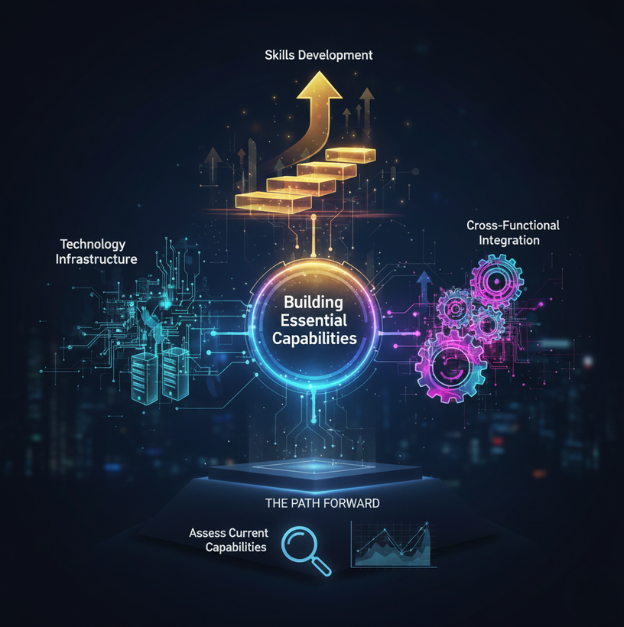
Building Essential Capabilities
Technology Infrastructure
Modern finance teams need:
- Integrated financial management systems
- Real-time business intelligence dashboards
- Automated reporting tools
- Advanced analytics platforms
Cross-Functional Integration
Success requires:
- Regular collaboration with sales and marketing
- Shared metrics and KPIs across departments
- Joint planning and forecasting sessions
- Integrated data flows between systems
Skills Development
Finance teams must develop expertise in:
- Data analytics and visualization
The Path Forward
To transform finance from a back-office function to a strategic revenue partner, organizations should:
- Assess Current Capabilities
- Evaluate existing systems and processes
- Review current collaboration models
- Develop a Transformation Roadmap
- Prioritize key initiatives
- Align stakeholders around common goals
- Invest in Technology and Training
- Implement modern financial systems
- Provide training in advanced analytics
- Build data science capabilities
- Track progress against key metrics
- Gather feedback from stakeholders
- Adjust strategies as needed
Conclusion
The transformation of finance in media and events is not optional—it's imperative for future success. By embracing data-driven approaches, developing new capabilities, and fostering cross-functional collaboration, finance teams can evolve into strategic partners that drive revenue growth and business optimization.
Organizations that successfully make this transition will be better positioned to:
- Make faster, more informed decisions
- Optimize revenue across multiple channels
- Improve profitability and cash flow
- Drive strategic growth initiatives
The journey may be challenging, but the rewards of having a truly data-driven finance function make it well worth the investment.
From Strategic Finance to Revenue Leadership: Join the Conversation at RevvedUP 2026
This shift toward a more strategic, data driven finance function aligns directly with the conversations and capabilities shaping the future of revenue and growth. Leaders who want to strengthen strategic finance, accelerate decision making, and turn AI disruption into opportunity will be able to explore these themes in depth at RevvedUP 2026. The strategies shaping the future of revenue, retention, and growth will take center stage on March 23 to 24, 2026 at The Vinoy in St. Petersburg, Florida. Hosted by H2K Labs and Outsell Inc. , RevvedUP 2026 brings together two powerhouses, Heather Holst-Knudsen of H2K Labs and Anthea Stratigos of Outsell, to deliver a unified growth platform that fuses intelligence with execution. Created and owned by H2K Labs and co produced with Outsell, Inc., it is the flagship Revenue Room CXO event that brings together two CEO networks into one platform built for speed and precision. Across two days of keynotes, Growth Design Labs, and peer led sessions, leaders will move from strategy to execution, turning AI disruption, data convergence, and business model changes into competitive advantage.
In the age of AI, speed is strategy, and RevvedUP 2026 is the place where leaders strengthen both.
Register Register Now