Artificial Intelligence
April 13, 2026
Charting The Channel Company’s AI‑Powered, Human‑Led Journey
# Digital transformation
# CEO Strategy
# AI readiness
# Artificial Intelligence
How The Channel Company’s AI‑powered, human‑led transformation drives revenue, efficiency and value across media and events.

Heather Holst-Knudsen
Charting The Channel Company’s AI‑Powered, Human‑Led Journey
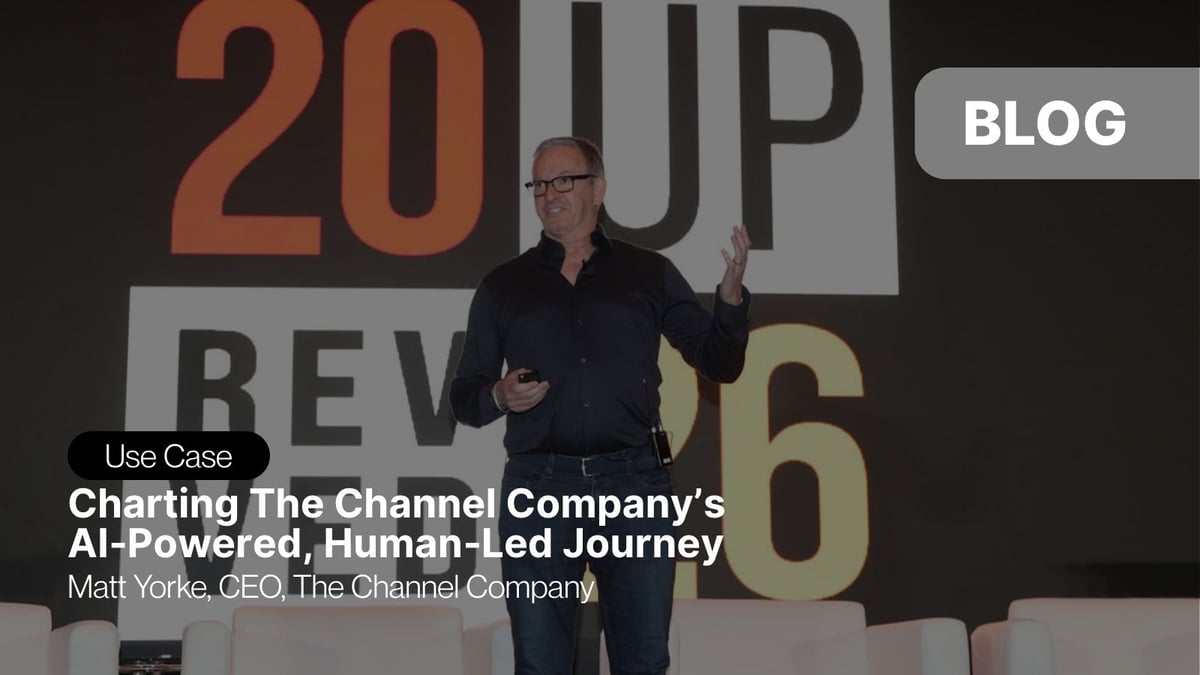
Matthew Yorke, CEO of The Channel Company (TCC), delivered one of the most talked‑about presentations at RevvedUP 26. His session—“AI‑powered, Human‑led”—wasn’t a theoretical overview of generative AI; it was a field report from a 450‑person media company racing to become “AI native.” Yorke explained how TCC has moved beyond prototypes and PowerPoint demos to embed artificial intelligence into products and workflows. He also described why the company’s strategy centers on human expertise and explained why the opportunities for channel partners are larger than the risks.
Why AI matters to the channel
Yorke opened with context that underscores why the channel can’t sit on the sidelines. The scale of AI investment is unprecedented—he noted that just six hyperscalers are spending US$700 billion this year on data‑centre infrastructure for AI, more than twice the inflation‑adjusted cost of the Marshall Plan or the Apollo programme. At the same time, sectors such as news media and events are seeing dramatic productivity gains: Reuters’ Fact Genie tool cuts news alert production time by half, while the New York Times’ editors report a ten‑fold reduction in research time when AI analyses large data sets. Yet the shift is not friction‑less. More than half of news executives struggle to hire the product and technology talent needed to implement AI, and 59 % of event professionals cite data security and privacy as their top worry. These statistics show both the promise and the pressure: AI will quickly become table stakes, but success depends on strong governance and trustworthy implementation.
From AI novice to AI native
TCC’s goal, Yorke said, is to become an AI‑native company within two years. He framed the journey as five stages and used aviation metaphors to make it relatable:
- AI Novice – build a flying machine: disconnected pilots and evaluations test where AI adds value. TCC evaluated 25 + tools, established responsible‑AI principles and formed an internal task force. The core question at this stage is “How can I use AI to complete the tasks I’ve already started?”.
- Embedded in workflows – retrofit a jet engine: human‑in‑the‑loop automation becomes part of everyday tasks such as transcription (BurkeBot, Otter.ai), reporting (BEEP, CS Genie, Uplift) and legal review. AI is used daily by teams.
- Customer‑facing differentiation – upgrade the aircraft: AI is embedded into products and services, providing scalable, repeatable value. Proof points include CRN Answers, Aurora and contextual advertising. These applications generate direct revenue and enhance user engagement.
- Insights at scale – design a plane for the AI era: AI connects datasets across departments to produce predictive insights such as propensity scoring, audience insights and forecasting. Products like DataIQ and CIO Pulse fall into this category.
- Predictive & autonomous – autonomous flight: AI recommends or executes the next‑best action and learns in closed‑loop systems. TCC expects autonomous campaign optimization, predictive content recommendations and AI‑driven planning to characterize this final stage.
Yorke admitted that TCC still has “one foot in stage 3 and another in stage 4,” but the ambition is clear: design the business around AI rather than bolt it on. Over time, he wants organizational silos to disappear and for a fleet of AI agents to retrieve information from various “stations” and deliver insights before employees even know they need them. The journey reflects a broader industry trend noted by analysts: after a year of proofs of concept, 2026 is the year AI adoption and scale will separate leaders from laggards.

Measuring adoption and impact
TCC does more than experiment; it measures results. By January the company provided Microsoft Copilot access to 80% of employees; the remaining staff work exclusively in AWS environments. TCC has developed 19 custom agents and tracked more than 70K prompts in the first two months of rollout. Users issue about 150 prompts per month on average, and the adoption rate across eligible teams is 100%. The impact is tangible:
- 6.5 hours saved per employee per month: automating tasks such as research, reporting and data aggregation frees up staff to focus on higher‑value work.
- Reduced proposal cycle time: campaign teams cut the proposal build time from 3 weeks to just 2 days, thanks to campaign agents that assemble messaging frameworks automatically.
- Greater user engagement: Aurora’s AI assistant for awards submissions increased dwell time by about two minutes and achieved a 4.35/5 average rating; CRN Answers tripled search usage and lifted average dwell time by 20%.
Monitoring adoption and impact is critical. As Yorke noted, adoption tells you who is using AI, but impact tells you what changed because of it. TCC uses dashboards to compare usage across departments and challenges managers to justify new hires by proving they cannot achieve the same results with AI augmentation.
Success stories and use cases
Yorke’s presentation went beyond theory by showcasing specific AI‑powered products that are already generating revenue and improving customer experiences.
CRN Answers – AI‑powered search
Keyword‑based search often yields broad results and forces users down time‑consuming “rabbit holes.” CRN Answers solves this by delivering contextual answers drawn from TCC’s 25‑year content archive. It stays within TCC’s environment rather than scraping the open web, providing succinct responses with links to deeper reporting. According to TCC’s blog, the tool uses a one‑click “Ask CRN” search box, a “related questions” module and a highlighted‑resources section to deliver trusted, on‑target answers. Since launch, CRN Answers has answered more than 114K queries, tripled search usage and increased dwell time on CRN.com by 20%. The system also captures intent data that improves advertising precision.
CIO Pulse – unifying disparate datasets
Tech marketers often struggle to understand what CIOs want because data lives in many silos. CIO Pulse combs zero‑party, first‑party and third‑party data—including surveys, interviews and TCC publications—to surface trends in IT strategy and investment. The agent enables sales teams to frame go‑to‑market solutions around cohort buying behavior and inspires content creators with data‑driven ideas. One strategic salesperson noted that CIO Pulse saves eight hours of proposal preparation, giving sellers more time to engage prospects.
Aurora – guiding awards applicants
The TCC events business runs dozens of awards programs. Detailed application forms led to a 25% abandonment rate, costing revenue and reducing event attendance. Aurora is a conversational agent that guides applicants through categories, sponsorships and deadlines. In its first month Aurora handled 7,700 agent loads, answered every question (100% response rate) and increased dwell time by roughly two minutes. Its average user rating is 4.35/5. The improved user experience is expected to drive higher application revenue and better event participation.
Campaign agents – accelerating go‑to‑market assets
TCC’s agency business helps vendors like Microsoft and AWS create sales and marketing programs. Previously it took up to three months to audit clients’ content and build messaging frameworks. Campaign agents now ingest raw assets, adopt the brand’s voice and automatically produce positioning documents, nurture sequences and creative concepts. The time to market has dropped from weeks to two days, and onboarding new clients has shrunk from three months to three weeks. This speed allows TCC to scale its consulting services without proportional increases in headcount.
Actionable strategies for channel partners
Yorke’s insights offer a blueprint for solution providers who want to harness AI responsibly while keeping people at the center. The following strategies—grounded in TCC’s experience and broader industry trends—can help organizations accelerate their own AI journeys:
• Start with data and trust: AI is only as good as the data it consumes. Invest in accurate, well‑governed datasets and establish responsible‑AI principles early. Yorke emphasized that “garbage in, garbage out”—robust data is essential for useful AI outcomes.
• Solve small problems first: Instead of trying to build a super agent for every task, identify repetitive workflows that drain time. Use AI to generate research summaries, draft outlines or create reports. Small wins build confidence and reveal bottlenecks.
• Embed human oversight: AI should augment—not replace—people. Human‑in‑the‑loop processes ensure that outputs are accurate, contextual and aligned with brand voice. TCC’s mantra is AI‑powered but human‑led.
• Provide widespread access and training: Democratize AI tools across the organization. TCC’s decision to give Co‑pilot access to most employees and to build training agents illustrates how building skills internally accelerates adoption. Remind employees that AI won’t take their jobs—someone more adept with AI might.
• Measure adoption and impact: Track usage metrics such as prompt counts and active users, but also measure business outcomes—cycle‑time reduction, revenue lift and customer experience. Use dashboards to surface lagging teams and to challenge managers to optimize before requesting new hires.
• Think beyond search: CRN Answers shows that AI‑powered search can generate new revenue streams. Partners should explore building contextual answer engines trained on their own IP, which can deepen engagement and generate first‑party data.
• Prepare for governance and accountability: As the ChannelPro report notes, the channel is shifting from experimentation to adoption, and ROI, governance and security now outrank flashy demos. Ensure that AI deployments are transparent, auditable and aligned with emerging regulations. Compliance and security expertise will be billable services in the next phase.

The road ahead: opportunity outweighs risk
Yorke concluded with a balanced perspective. The technology is no longer the limitation; our relationship with it is. Building a culture of learning and experimentation is more important than seeking a silver bullet. Responsible adoption requires robust data, governance and human oversight, but the opportunities are greater than the threats. The Channel Company’s results—measurable productivity gains, new revenue streams and improved customer experiences—show that AI can be both a growth lever and a competitive moat.
Channel partners who embrace an AI‑powered, human‑led mindset stand to benefit most. By focusing on actionable use cases, investing in people and building trust with customers, partners can transform AI from an experimental project into a core driver of differentiation and value.
____________________________________________
Matt Yorke is an Executive Advisory Board member of Revenue Room™ CXO, the fastest growing professional network and growth operating system for CEOs and revenue-critical C-suite leaders navigating change in media, events, and data businesses. Through peer exchange, practical frameworks, and real-world use cases, members align faster, execute smarter, and turn AI and data into measurable growth. Apply now to join Revenue Room™ CXO.
Sign in or Join the community
The Nexus for Data-Driven Growth Leaders

Create an account
The Nexus for Data-Driven Growth Leaders
Like
Comments (0)
Popular

Popular
Blog
The CEO's AI Readiness Assessment: 25 Critical Questions Every Board Should Ask
By Heather Holst-Knudsen
Dive in
Related
Blog
How the Channel Company is Transforming B2B Media with Data and AI
By Heather Holst-Knudse... • Feb 12th, 2025 • Views 31
Blog
Stop Being AI-Fragile: The Foundation RevOps Built for the AI Age
By Heather Holst-Knudse... • Oct 31st, 2025 • Views 45
Blog
Monetizing Data Through AI-Powered Solutions with GovExec
By Heather Holst-Knudse... • Feb 12th, 2025 • Views 22
Blog
The Revenue Room™ - The Journey to Revenue Excellence
By Heather Holst-Knudse... • Nov 13th, 2023 • Views 16
Blog
How the Channel Company is Transforming B2B Media with Data and AI
By Heather Holst-Knudse... • Feb 12th, 2025 • Views 31
Blog
Monetizing Data Through AI-Powered Solutions with GovExec
By Heather Holst-Knudse... • Feb 12th, 2025 • Views 22
Blog
The Revenue Room™ - The Journey to Revenue Excellence
By Heather Holst-Knudse... • Nov 13th, 2023 • Views 16
Blog
Stop Being AI-Fragile: The Foundation RevOps Built for the AI Age
By Heather Holst-Knudse... • Oct 31st, 2025 • Views 45