The Executive Chair
January 5, 2026
The CEO's AI Readiness Assessment: 25 Critical Questions Every Board Should Ask
# data
# Leadership
Why the right boardroom questions determine whether companies scale AI into transformation—or fall into irrelevance.

Heather Holst-Knudsen
The CEO's AI Readiness Assessment: 25 Critical Questions Every Board Should Ask

Why Your Board's AI Questions Determine Your Company's Survival
Your quarterly board meeting is underway. The AI agenda item arrives, and the usual suspects weigh in: "Our competitors are using AI," "We need a strategy," and "What's our ROI?" But behind these surface-level questions lurks a more uncomfortable truth: most boards are asking the wrong questions entirely.
According to recent Deloitte research, 76% of executives report conducting AI ethics training, yet only 27% have comprehensive ethical frameworks in place. Meanwhile, McKinsey studies reveal that boards focusing solely on ROI miss 73% of AI's strategic implications. The result? Companies implementing AI without understanding whether they're architecturally ready for transformation.
The difference between boards that govern AI effectively and those that merely supervise it lies in the questions they ask. Surface-level questions produce surface-level results. The CEOs who will lead their industries ask questions that reveal readiness gaps before they become competitive disadvantages.
What Boards Get Wrong About AI Assessment
Most board AI discussions follow a predictable pattern: management presents pilot results, discusses cost savings, and requests budget approval. But this approach treats AI as a departmental project rather than an enterprise architecture decision.
Research from NACD reveals that only 8% of boards avoid AI discussions with management, but two-thirds of board members admit limited AI expertise. This creates a dangerous dynamic: boards asking operational questions when they should be asking architectural ones.
The fundamental misunderstanding? AI readiness isn't about technology, it's about transformation capability. Companies with robust AI governance frameworks see measurably different outcomes than those treating AI as an IT initiative.
The 25-Question Board Assessment Framework
This assessment transforms board oversight from reactive to architectural. Each question reveals whether your organization can sustain AI-driven transformation, not just deploy AI tools.
Strategic Architecture (Questions 1-5)
1. How specifically does our AI strategy connect to enterprise valuation metrics tracked by our board?
What this reveals: Whether AI is treated as growth architecture or operational expense
2. What measurable competitive advantages have we identified that only AI can deliver?
What this reveals: Strategic clarity versus technology adoption for its own sake
3. How do we benchmark our AI maturity against industry leaders, not just direct competitors?
What this reveals: Whether leadership understands the scope of transformation required
4. What legacy business processes are we proactively eliminating before AI disrupts them?
What this reveals: Transformation leadership versus reactive adaptation
5. How does our board evaluate the enterprise risk of not investing in AI architecture?
What this reveals: Whether AI is understood as strategic imperative or optional enhancement
Data and Infrastructure Readiness (Questions 6-10)
6. What percentage of our data is currently accessible for AI training and deployment?
What this reveals: Actual readiness versus theoretical capability
7. How do we ensure data quality meets AI requirements without disrupting current operations?
What this reveals: Integration planning versus bolt-on approaches
8. What data governance frameworks protect competitive advantage while enabling AI innovation?
What this reveals: Strategic data thinking versus compliance-only approaches
9. How quickly can we scale AI infrastructure without compromising security or compliance?
What this reveals: Architectural readiness versus pilot-limited thinking
10. What specific data partnerships or acquisitions would accelerate our AI competitive positioning?
What this reveals: Strategic AI investment thinking versus internal-only development
Governance and Risk Management (Questions 11-15)
11. Who has direct accountability to this board for AI strategy execution and results?
What this reveals: Leadership clarity versus distributed responsibility
12. How do we identify and mitigate AI-specific risks that traditional frameworks don't address?
What this reveals: AI-native risk management versus adapted traditional approaches
13. What AI governance policies ensure innovation speed without compromising ethical standards?
What this reveals: Balanced governance versus bureaucratic constraint or unchecked deployment
14. How do we monitor AI model performance and business impact in real-time?
What this reveals: Operational AI management capability versus periodic review approaches
15. What regulatory compliance strategies address evolving AI legislation across our markets?
What this reveals: Proactive regulatory planning versus reactive compliance
Organizational Transformation (Questions 16-20)
16. What specific cultural changes are required for employees to embrace AI-augmented workflows?
What this reveals: Change management readiness versus technology-only focus
17. How do we upskill current leadership teams versus recruiting external AI expertise?
What this reveals: Transformation leadership development versus talent acquisition dependence
18. What new roles and organizational structures does AI-first operation require?
What this reveals: Organizational architecture thinking versus current structure preservation
19. How do we measure employee AI adoption and productivity impact beyond efficiency metrics?
What this reveals: Comprehensive transformation measurement versus narrow productivity focus
20. What resistance to AI transformation have we identified, and how are we addressing it?
What this reveals: Honest change management assessment versus optimistic assumptions
Market Position and Future Readiness (Questions 21-25)
21. How are we using AI to create new revenue streams, not just optimize existing ones?
What this reveals: Growth architecture versus cost optimization focus
22. What AI capabilities would our customers pay premium prices to access?
What this reveals: Value creation understanding versus internal efficiency focus
23. How do we prepare for industry convergence where B2B/B2C distinctions disappear?
What this reveals: Strategic architecture thinking for converging markets
24. What acquisitions or partnerships would accelerate our AI competitive timeline?
What this reveals: Strategic portfolio thinking versus organic-only development
25. How do we ensure our AI investments remain relevant as technology capabilities evolve?
What this reveals: Sustainable architecture planning versus point-solution thinking
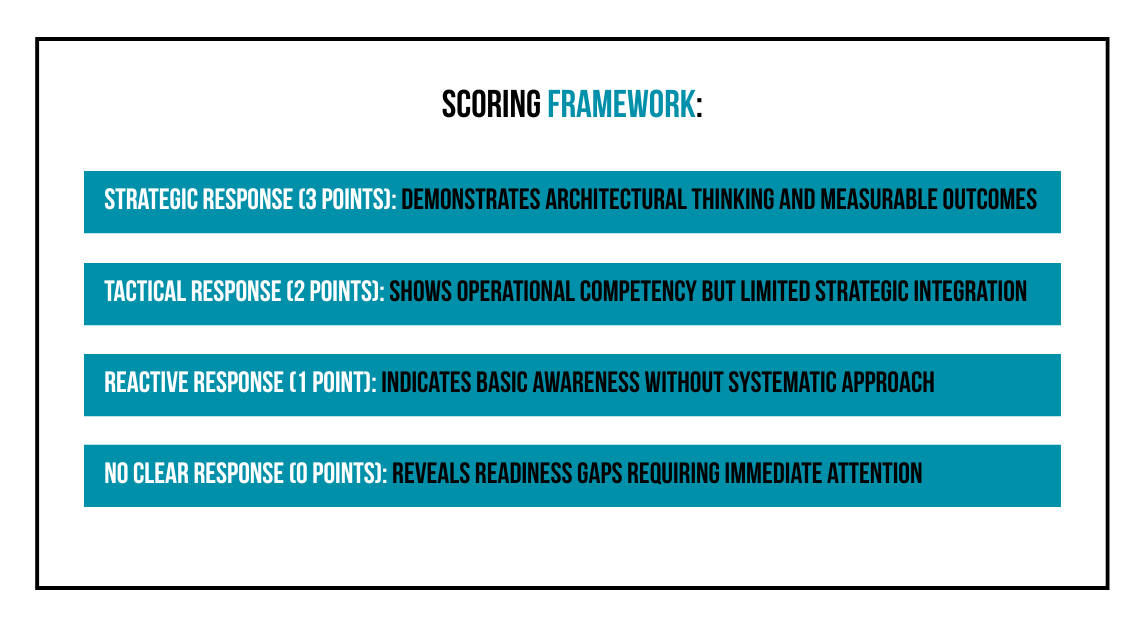
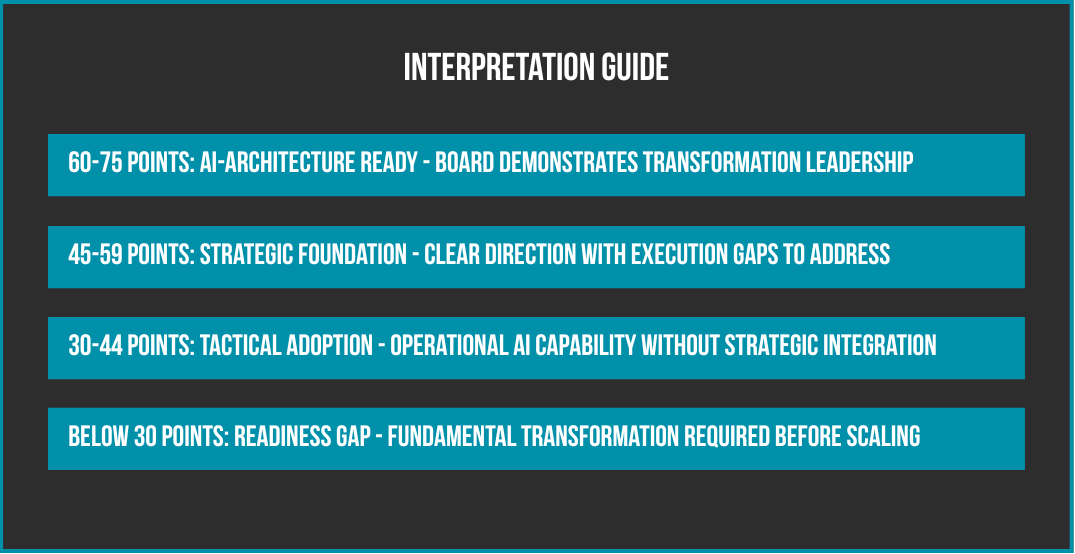
How to Score Your Board's AI Readiness
What High-Performing Boards Do Differently
Research from Harvard Corporate Governance reveals that boards excelling at AI oversight share three characteristics:
- They Ask Architecture Questions, Not Feature Questions
Instead of "What AI tools are we using?" they ask "How is AI reshaping our competitive moat?"
- They Focus on Transformation Capability, Not Technology Capability
Rather than "Do we have enough data scientists?" they ask "Can our organization adapt to AI-driven change?"
- They Measure Strategic Impact, Not Operational Efficiency
Beyond "How much did AI reduce costs?" they ask "What new value is AI creating for customers?"
Frequently Asked Questions: Board AI Assessment
Q: How often should boards conduct AI readiness assessments?
A: Quarterly strategic reviews with annual comprehensive assessments. AI transformation moves too quickly for annual-only evaluation.
Q: Should we bring external AI experts to board meetings?
A: Yes, but focus on governance and strategic experts rather than technical specialists. Board members need strategic context, not technical training.
Q: What if our board members lack AI expertise?
A: The assessment questions are designed for business leaders, not technical experts. Focus on business implications rather than technical specifications.
Q: How do we balance AI innovation with risk management?
A: Use the governance questions (11-15) to create frameworks that enable controlled experimentation rather than blanket restrictions.
Q: What's the biggest mistake boards make in AI oversight?
A: Treating AI as an operational tool rather than a strategic architecture decision. This leads to pilot programs that never scale into transformation.
The Board Assessment Self-Evaluation Tool
Instructions for Board Chairs:
- Distribute questions 1-5 before your next board meeting
- Score management responses using the framework above
- Identify the three lowest-scoring areas for focused discussion
- Schedule follow-up sessions to address readiness gaps
- Assign specific board members to oversee improvement in weak areas
Management Preparation Guidance:
- Prepare specific, measurable responses for each question
- Include competitive benchmarking data where available
- Present implementation timelines for addressing identified gaps
- Connect AI initiatives to existing board-tracked metrics
Why This Assessment Matters for RevvedUP 2026
The uncomfortable truth facing today's boards is that AI readiness cannot be delegated or deferred. Companies that lag in architectural AI thinking won't gradually fall behind. They'll face sudden irrelevance as industry boundaries collapse and AI-native competitors emerge.
This 25-question framework is not theoretical. It is the practical foundation that separates boards governing transformation from those merely supervising technology adoption. The CEOs and board chairs gathering at RevvedUP 2026 (March 23–24, The Vinoy Resort, St. Petersburg, FL) understand this distinction. They are not coming to debate whether AI matters. They are coming to pressure-test how it reshapes governance, enterprise value, and long-term competitiveness.
RevvedUP is where these conversations move from abstraction to application. Leaders share how they are structuring AI oversight, aligning data strategy to valuation, and building operating models that can absorb continuous disruption, not just survive it.
For many of those leaders, the work does not end when the event does. The dialogue continues inside Revenue Room™ CXO, a private peer community for CEOs and senior executives who want an ongoing forum to sharpen their thinking, compare real-world governance decisions, and turn strategic insight into operating discipline. CXO is where board-level questions become leadership habits.
Sign in or Join the community
The Nexus for Data-Driven Growth Leaders

Create an account
The Nexus for Data-Driven Growth Leaders
Like
Comments (0)
Popular

Popular
42:43
Video
The Data-Driven Magic Behind EasyFairs' Success with Anne Lafère, Group CEO, Easyfairs
By Heather Holst-Knudsen
Dive in
Related
Blog
The 10 KPIs Every CEO and Revenue Leader Should Obsess Over in 2026
By Heather Holst-Knudse... • Jan 15th, 2026 • Views 188
Blog
Zero Trust for AI Agents: Six Guardrails Before MCP Scales
By Heather Holst-Knudse... • Jun 5th, 2026 • Views 1
Blog
The New AI Attack Surface: Agents, MCP, and the Toolbelt Problem
By Heather Holst-Knudse... • Jun 5th, 2026 • Views 1
Blog
Agent Governance Is an Operating Model, Not a Policy
By Heather Holst-Knudse... • Jun 5th, 2026 • Views 2
Blog
The 10 KPIs Every CEO and Revenue Leader Should Obsess Over in 2026
By Heather Holst-Knudse... • Jan 15th, 2026 • Views 188
Blog
The New AI Attack Surface: Agents, MCP, and the Toolbelt Problem
By Heather Holst-Knudse... • Jun 5th, 2026 • Views 1
Blog
Agent Governance Is an Operating Model, Not a Policy
By Heather Holst-Knudse... • Jun 5th, 2026 • Views 2
Blog
Zero Trust for AI Agents: Six Guardrails Before MCP Scales
By Heather Holst-Knudse... • Jun 5th, 2026 • Views 1