Revenue
June 5, 2026
Agent Governance Is an Operating Model, Not a Policy
# AI operating model
# Mcp governance
# Ai agents
# Artificial Intelligence
# Cmo strategy
# Ai compliance
# Revops
# Customer retention
# Finance integration
# B2b media
# Enterprise ai
How media, events, and data CEOs can move from unmanaged pilots to risk adjusted production discipline without slowing the business

Heather Holst-Knudsen
Nobody Owns the Messy Middle

Most companies will not fail at agent governance because they forgot to write a policy.
They will fail because no one owns the messy middle.
A sales team tests an agent for renewal prep. Product connects it to usage data. RevOps wants it to update CRM. Finance wants margin controls. Legal wants customer-facing outputs reviewed. Security wants logs. Marketing wants campaign speed. The pilot starts to work, so more people use it.
Then the owner leaves. Permissions expand. The agent gets connected to another MCP server. The workflow quietly becomes production.
Nobody notices until there is a customer-facing mistake.
That is the real governance failure: not a lack of enthusiasm, and not even a lack of controls. It is unclear ownership.
The previous posts covered the arc: Part 1 named the new risk unit, agent + toolbelt. Part 2 showed the guardrails. This final piece is about the management system: owners, decision rights, cadence, lifecycle, metrics, and board evidence.
NIST’s AI Risk Management Framework is useful here because it defines four core functions—Govern, Map, Measure, and Manage—that can be used to structure AI risk work across an organization. ( arXiv )
For agents, that means: decide who owns them, know where they run, measure what they do, and manage the risk and value over time.
What Good Looks Like
A mature agent program can answer five questions quickly:
❓Who owns this agent?
❓What business result is it supposed to create?
❓What systems and data can it reach?
❓What actions can it take?
❓How do we stop it?
If those answers are scattered across Slack threads, old tickets, and one engineer’s memory, the company does not control the workflow. It is hoping the workflow behaves.
Good looks like this:
👉Every production agent has a business owner and technical owner.
👉Every MCP server in production is approved and registered.
👉Every material workflow has scoped access, logs, approval rules, and a shutdown path.
👉Every high-risk use case has a value case and a risk case.
👉Every CXO review includes both business impact and control evidence.
That last point matters.
A CEO does not need governance theater. A CEO needs risk-adjusted speed: faster execution without blind spots that damage revenue, trust, or valuation.
The Three-Layer Ownership Model
1. Board and CEO: Set Risk Appetite and Demand Evidence
The board and CEO should not approve every agent. That would slow the business and create false comfort.
Their job is to set boundaries.
- Which agent actions are unacceptable?
- Which data is restricted?
- Which workflows are material enough for board reporting?
- Which decisions require human approval?
- What level of incident or near miss must be escalated?
The board should expect evidence, not reassurance.
For media and events businesses, the evidence should connect directly to revenue and trust: sponsor data use, attendee privacy, subscriber behavior, pricing, renewal workflows, margin controls, and customer-facing communications.
The board question is not, “Are we using AI?”
The better question is: Are governed agents improving growth, margin, and enterprise value without creating unmanaged exposure?
2. CXO Council: Make the Tradeoffs
The CXO layer is where the hard calls belong.
Security wants tighter access. Sales wants speed. Marketing wants campaign volume. Finance wants margin discipline. Product wants usage intelligence. Legal wants review. Data wants clean classification. Operations wants fewer manual steps.
Those are not obstacles. They are the tradeoffs.
A useful CXO council includes the CISO, CIO or CTO, CDO, CFO, CRO, CMO, COO, and the agent program lead or Chief AI Officer where that role exists.
The council should approve production standards, prioritize high-value workflows, resolve conflicts, review incidents, and decide where to invest.
Without decision rights, this group becomes a talking shop. Give it authority over production approval, high-risk use cases, data exceptions, and funding for shared controls.
3. Execution Teams: Run the Controls
Execution teams make the system work.
Security owns control design, monitoring, and incident response. IT owns architecture and MCP standards. Data teams own classification and access rules. RevOps owns instrumentation for sales, sponsor, attendee, and customer workflows. Business leaders own use-case approval and ROI.
The agent program lead or center of excellence should keep the playbook consistent: intake forms, review gates, test criteria, approved MCP servers, reusable patterns, and retirement rules.
Shared responsibility is fine as a cultural slogan. It is weak as an operating model.
Every production agent needs one accountable business owner and one accountable technical owner.
The Agent Lifecycle
Agent governance should follow the workflow from idea to retirement.
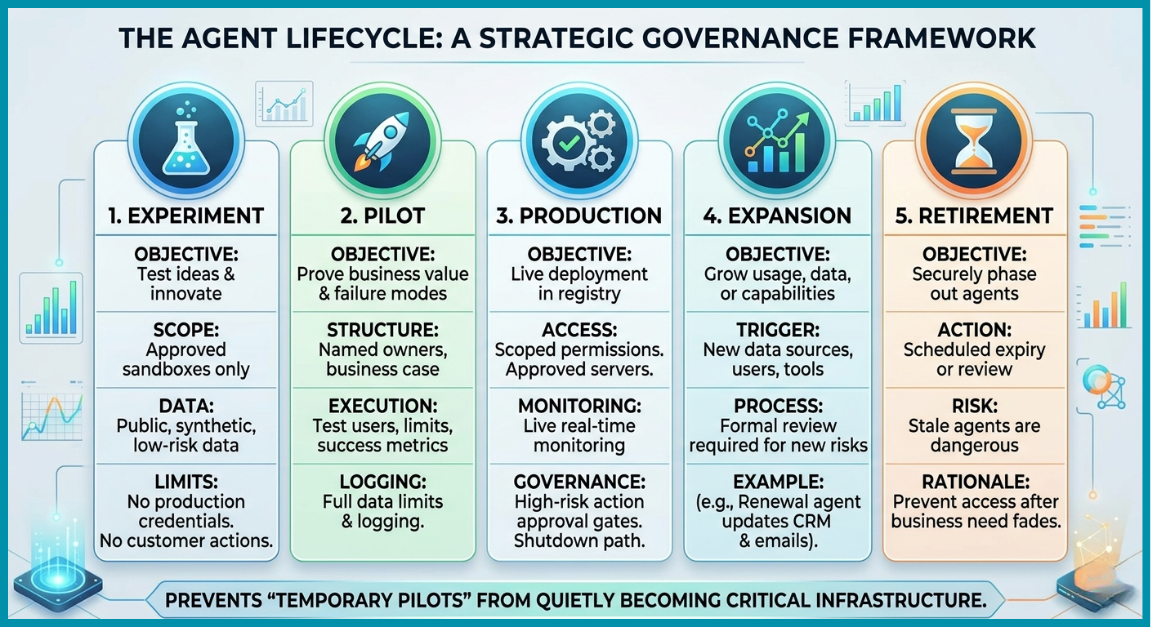
Experiment: Teams can test ideas in approved sandboxes with public, synthetic, or low-risk data. No production credentials. No customer-facing actions.
Pilot: The agent gets named owners, a business case, test users, logs, data limits, and success metrics. The goal is to prove value and expose failure modes.
Production: The agent enters the registry. Permissions are scoped. MCP servers are approved. Monitoring is live. High-risk actions have approval gates. A shutdown path exists.
Expansion: New data sources, users, tools, or actions require review. A renewal-prep agent that later updates CRM, sends emails, or recommends discounts is no longer the same risk profile.
Retirement: Agents should expire or be reviewed. Stale agents are dangerous because access remains after the business need fades.
This lifecycle prevents the “temporary pilot” from quietly becoming critical infrastructure.
The Operating Cadence
Governance works when it has a rhythm.
A monthly CXO review should cover:
- Agent and MCP inventory
- New production workflows
- Permission changes
- High-risk actions
- Incidents and near misses
- Containment time
- Business value created
- Workflows to scale, fix, or retire
The quarterly board update should be shorter:
- Top agent use cases
- Value created
- Material risks
- Major control gaps
- Incidents or near misses
- Changes to risk appetite
- Investment needed to govern at scale
The meeting standard should be simple: no vague status updates. Bring evidence.
Metrics + Instrumentation
This blog should not repeat Blog 2’s operational scorecard. At the CXO and board level, the metrics should show control, value, and direction.
👉 Control evidence: percentage of production agents with owners, approved tools, scoped access, logs, approval gates, and shutdown paths.
👉 movement: high-risk actions, sensitive data access, incidents, near misses, and permission drift.
👉Speed: time from use-case request to approved pilot, pilot to production, and incident to containment.
👉Value: cycle time saved, cost avoided, pipeline influenced, renewal prep reduced, sponsor reporting accelerated, margin protected.
👉Portfolio health: agents scaled, fixed, paused, or retired.
Data should come from IAM, MCP gateways, SIEM, DLP, CRM, CDP, warehouse logs, finance systems, collaboration tools, ticketing, and RevOps dashboards.
The goal is a single executive view: what agents are live, what they can do, what value they create, and what risk they carry.
Board Questions for MCP and Agents
Boards should ask plain questions:
- Where are MCP-connected agents in use today?
- Which agents can take action across systems?
- Who owns each material agent workflow?
- Which agents touch sensitive customer, financial, employee, sponsor, or legal data?
- Which actions require human approval?
- How fast can management suspend an agent or disable an MCP server?
- What incidents or near misses occurred this quarter?
- What value did governed agents create?
- Which workflows should be scaled, fixed, or retired?
- Does management have the talent, budget, and authority to govern this properly?
Those questions move the conversation from AI enthusiasm to enterprise control.
From Pilots to Infrastructure
Agents are moving from experiments into the workflows that shape pipeline, retention, sponsor value, pricing, customer experience, and margin.
That makes them infrastructure.
The companies that win will not be the ones with the longest policy or the most pilots. They will be the ones that can answer, plainly and quickly:
- Who owns the agent?
- What can it do?
- What value does it create?
- What risk does it carry?
- How do we stop it?
That is agent governance executives can actually use.
Ready to Step Into the Revenue Room™?
The ideas in this article are just the starting point. Revenue Room™ brings together CEOs and revenue-critical leadership teams across media, events, data, and information services to align around one growth plan, one scorecard, and one execution cadence—turning data, AI, and operator insight into measurable revenue, margin, and enterprise value outcomes.
Continue the conversation and take the next step:
Check out our event lineup including upcoming Exchange Roundtables, Revenue Room™ Salon: Women Who Accelerate & Lead, and RevvedUP 2027
Apply to Join Revenue Room™ CXO
Become part of the invite-only executive network for CEOs and revenue-critical C-suite leaders building the next era of profitable growth.
Learn More About Upcoming Revenue Room™ Bootcamps
Equip your teams with practical, instructor-led programs designed to move from learning to execution.
Download Revenue Room™ Playbooks
Access frameworks, templates, and operating tools to help your team assess gaps, prioritize growth moves, and execute with greater speed and clarity.
Latest playbooks
Step into the room where modern growth leaders align, accelerate, compound, and connect.
Sign in or Join the community
The Nexus for Data-Driven Growth Leaders

Create an account
The Nexus for Data-Driven Growth Leaders
Like
Comments (0)
Popular

Dive in
Related
Blog
Your Revenue Team Is Not Broken. Your Model Is Too Slow.
By Heather Holst-Knudse... • May 28th, 2026 • Views 42
43:26
Video
How the Next Audience Is Rewriting the Media Business Model
By Heather Holst-Knudse... • Mar 18th, 2026 • Views 47
Blog
AI Is Not the Strategy. Your Revenue Strategy Is.
By Heather Holst-Knudse... • May 12th, 2026 • Views 36
Blog
How the Next Audience Is Rewriting the Media Business Model
By Heather Holst-Knudse... • Dec 31st, 2025 • Views 86
Blog
Your Revenue Team Is Not Broken. Your Model Is Too Slow.
By Heather Holst-Knudse... • May 28th, 2026 • Views 42
Blog
AI Is Not the Strategy. Your Revenue Strategy Is.
By Heather Holst-Knudse... • May 12th, 2026 • Views 36
Blog
How the Next Audience Is Rewriting the Media Business Model
By Heather Holst-Knudse... • Dec 31st, 2025 • Views 86
43:26
Video
How the Next Audience Is Rewriting the Media Business Model
By Heather Holst-Knudse... • Mar 18th, 2026 • Views 47