Revenue
May 28, 2026
Your Revenue Team Is Not Broken. Your Model Is Too Slow.
# RevvedUP 2026
# Revenue Model
# Media revenue strategy
# Revenue growth
# Data strategy
# Revenue Room CXO
# Buyer journey
# Data valuation
# Sales AI strategy
At RevvedUP 2026, 1mind founder Amanda Kahlow made the case that agentic AI is not about replacing salespeople. It is about redesigning slow, expensive, handoff heavy revenue motions around speed, memory, and measurable unit economics.

Heather Holst-Knudsen
Your Revenue Team Is Not Broken. Your Model Is Too Slow.
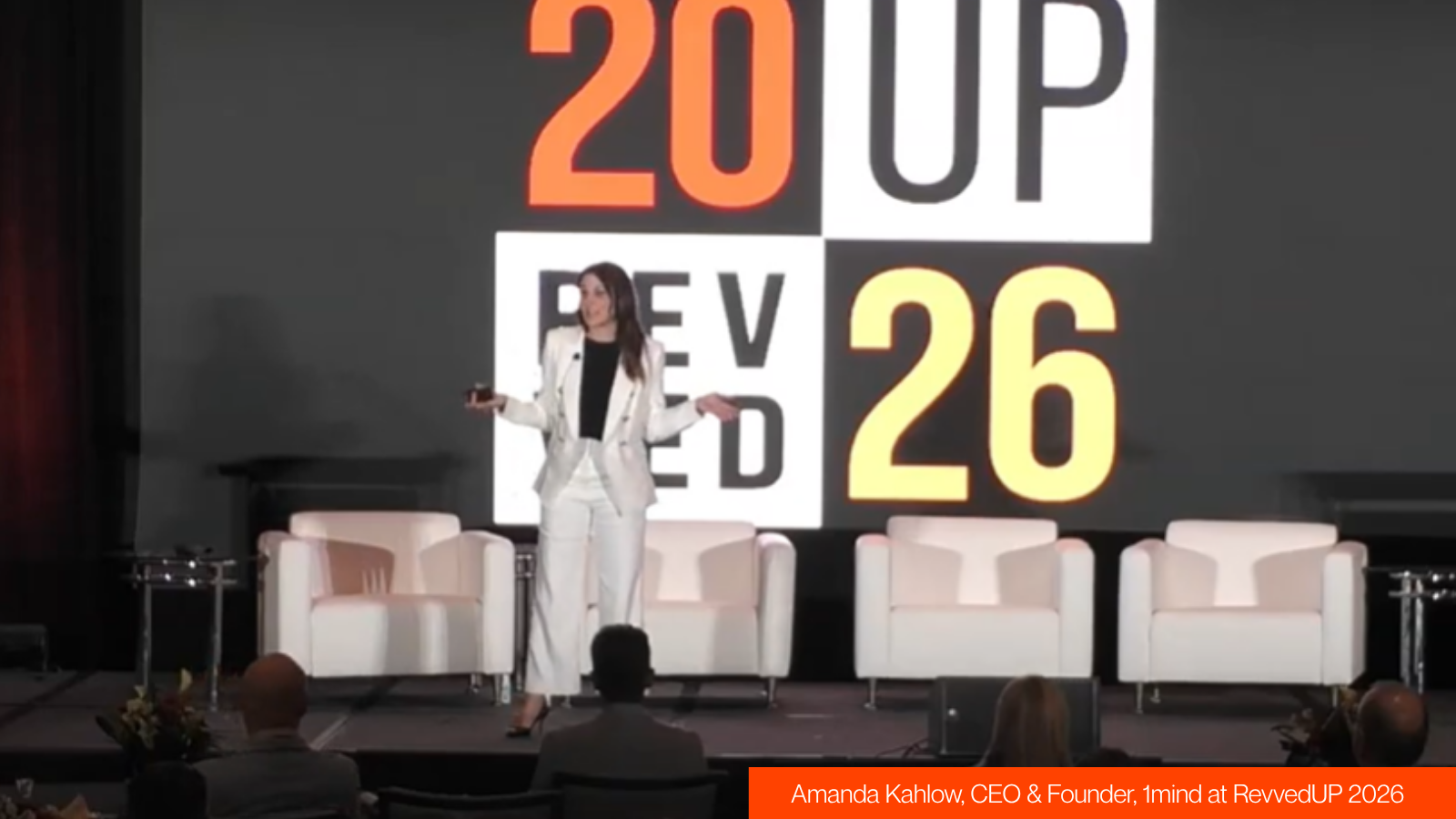
She came to attack the revenue model.
Kahlow, founder and CEO of 1mind and previously founder of 6sense, framed the current go to market challenge as the "Impossible Paradox": boards want more growth, teams are being asked to do it with less, and the old playbooks are no longer scaling. Her line to the room was direct: "your old playbooks are no longer working."
For CEOs and CXOs in media, events, and data/information services, this is the right altitude. The question is not whether agentic AI can produce an impressive demo. The question is where your revenue engine is too slow, too expensive, or too inconsistent to remain human first.
That is a very different conversation.
The Buyer Has Changed. The Revenue Process Has Not.
Most B2B buying experiences still look absurd when viewed from the customer's side.
A buyer searches. They land on your site. They dig through pages of content. They fill out a form. They wait. A junior rep qualifies them. An AE books another call. A solutions expert joins later. Then, if the deal closes, customer success inherits a partial version of the buyer's actual needs.
Kahlow described that process at RevvedUP as exhausting. She was right.
And in media, events, and data businesses, the drag is especially expensive because the products are nuanced.
A media company is selling more than impressions. It is selling audience quality, context, content adjacency, first party data, brand safety, and measurable campaign outcomes.
An event company is selling more than booths and badges. It is selling access, meetings, category authority, buyer intent, lead quality, onsite activation, and renewal confidence.
A data/information business is selling more than subscriptions. It is selling workflow integration, proprietary insight, benchmarks, decision support, and sometimes mission critical intelligence.
These sales require trust and expertise. But too often, companies use their most expensive human talent to handle low value friction: answering repetitive questions, qualifying basic fit, routing buyers, finding the right deck, scheduling the next step, and reconstructing lost context.
That is not a talent problem. It is an operating model problem.
Agentic AI Is a Coverage Model, Not a Chatbot
The least useful way to think about 1mind is as "a better chatbot."
Kahlow's bigger idea is AI led growth: agentic AI that can own defined revenue roles across the buyer experience. In 1mind's language, its "Superhuman" can qualify, pitch, answer questions, present relevant proof points, support demos, book next steps, and retain memory across interactions.
She also described a newer capability called Ride Along, designed to place an AI sales engineer directly into live calls on Zoom, Teams, or Google Meet, not just as back channel coaching, but as a visible participant that can answer buyer questions, present slides, and support technical selling in real time.
That does not mean CEOs should accept every startup proof point at face value. 1mind is still a startup. Some of the claims shared from stage may be customer reported, early stage, or not yet independently verifiable at the level a public company CFO would require.
That skepticism is healthy.
The mistake would be to dismiss the model because the category is early. The more productive CEO response is: Where could this change the economics of coverage?
Because coverage is where media, events, and data companies have a structural problem.
There are many buyer segments that are valuable but hard to serve profitably: small sponsors, long tail exhibitors, emerging advertisers, trial users, inactive subscribers, past attendees, dormant accounts, and lower ACV data buyers. Human coverage is often too costly. Automation is often too limited.
Agentic AI sits in the gap.
What Amanda Claimed from the RevvedUP Stage
The proof points from Kahlow's presentation should be read as stage claims from 1mind's CEO, not as independently audited results. But they are still worth examining because they point to what buyers of this technology are trying to measure.
Kahlow said HubSpot deployed a Superhuman named Fiona for its SMB and commercial line of business, a segment where the economics previously did not support putting a human seller into the motion. According to Kahlow, 88% of visitors who saw Fiona engaged with her, those who engaged spoke with her for an average of eight minutes, free trial conversion increased by 75%, and revenue for that line of business increased by 25%. She also said HubSpot estimated it would have taken 89 SDRs and 19 sales engineers to do the work of one Fiona.
Kahlow also said 1mind's own Superhuman, Mindy, had created $35 million in pipeline for the company, while 1mind operated without SDRs or sales engineers. She described a recent Alteryx example in which the CRO spoke with Mindy for 45 minutes over a weekend, the CMO later had a 30 minute conversation, and the opportunity moved into a one call, six figure close.
Again: these are not third party verified proof points. They are the vendor CEO's claims from stage. But for a media, events, or data CEO, the underlying question is still highly practical: what would happen if your highest intent buyers could get qualified, educated, routed, and advanced in minutes rather than days?
Clara Made the Argument Local
The most relevant moment for the Revenue Room™ audience was not HubSpot or Alteryx. It was Clara.
At RevvedUP, Kahlow showed Clara, the Superhuman built for H2K Labs / Revenue Room™. In the demo, Clara welcomed a visitor, asked what brought them to the site, connected the visitor's interest to RevvedUP, explained the event's focus on AI, data, and business model shifts, qualified the person's seniority and industry, and moved toward business email capture.
The interaction was not a full sales cycle. It was not presented as proof that AI can close every sponsorship or ticket sale. But it made the argument concrete: Revenue Room™'s own audience development and event growth motions include exactly the kind of high intent, repetitive, qualification heavy interactions that agentic AI could support.
Kahlow's stated goal for Clara was clear: move beyond answering questions into selling sponsorships and tickets.
That is the real test.
Not whether the AI can sound impressive. Whether it can improve conversion, reduce human load, and preserve buyer quality in the motions that matter.
The CEO Case: Speed, Memory, and Margin
The strategic promise of agentic AI comes down to three mechanisms.
First: speed. High intent buyers should not wait for follow up. If someone is on your sponsorship page, pricing page, demo page, attendee registration path, or data product page, the revenue motion should begin immediately.
Second: memory. Most companies lose context constantly. A sponsor's goals sit in CRM notes. Attendee behavior sits in registration and event apps. Content engagement sits in analytics. Campaign performance sits in ad systems. Renewal risk sits in customer success. Finance sees the invoice but not the intent.
That fragmentation kills expansion.
Kahlow's strongest idea was not the AI avatar. It was persistent memory across the lifecycle. The ability to carry context from first inquiry to qualification to proposal to delivery to renewal is where agentic AI becomes more than a front end addition.
Third: margin. AI should be judged on whether it improves revenue per FTE, reduces human touches per qualified opportunity, lowers cost to serve, shortens time to meeting, or improves conversion in segments that were previously under covered.
That is where this becomes CEO level.
Where Agentic AI Will Fail
Agentic AI will fail when CEOs treat it as a shiny demo instead of a revenue operating model.
It will fail when the AI is trained on messy content, vague qualification rules, outdated product information, and unclear escalation paths.
It will fail when companies deploy it on the homepage and declare victory because people clicked on it.
It will fail when revenue leaders do not define what the AI is allowed to do, when it must hand off to a human, what counts as a qualified interaction, and how performance will be measured.
And it will fail if the company does not have the operational discipline to connect the data sources that matter: CRM, marketing automation, registration systems, website analytics, product usage, ad delivery, event engagement, customer success, and finance.
The skeptical CEO objection is fair:
"This sounds like another AI demo that works on stage and breaks in the real sales environment."
The answer is not faith. It is instrumentation.
The Monday Test: Pick One Revenue Motion
Do not "try agentic AI."
Pick one revenue motion where speed, consistency, and cost to serve matter.
For a media company, start with advertiser inbound, content led lead capture, subscription upgrade paths, or agency brief intake.
For an event company, start with sponsor inquiry, exhibitor qualification, hosted buyer screening, attendee upsell, or post event renewal.
For a data/information company, start with demo requests, trial conversion, product onboarding, enterprise license qualification, or renewal prep.
The best starting point has five traits:
Meaningful buyer intent
- Clear qualification rules
- Repetitive questions
- High human-touch cost
- Measurable conversion economics
Do not start where trust is most fragile. Start where the current process is slow, expensive, and easy to benchmark.
Metrics and Instrumentation
A CEO should not approve an agentic AI deployment without a scorecard.
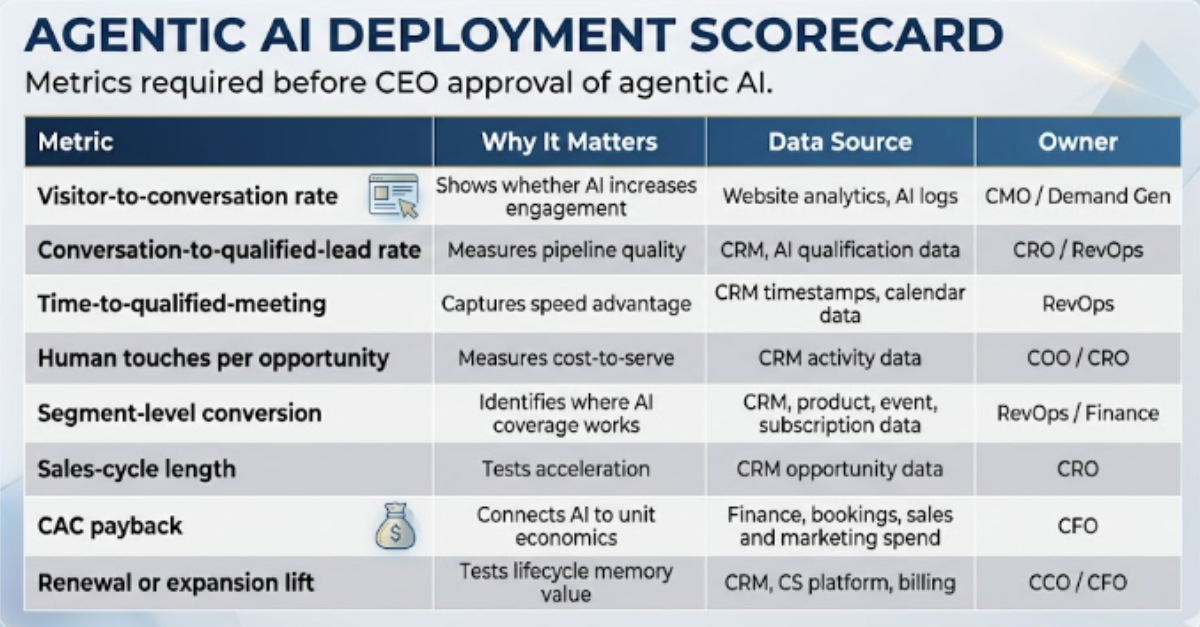
RevOps should run the measurement system. Finance should validate the economics. The CEO or COO should sponsor the operating model change.
This cannot be left to individual reps to "figure out AI." Kahlow made that point directly at RevvedUP: transformation has to be led from the top, not delegated to individual contributors experimenting with tools.
What This Means for Value Creation
The valuation argument is not that AI sounds innovative.
It is that better revenue architecture changes the financial profile of the business.
For an events company, imagine sponsor inquiry conversion improves while human touches per qualified opportunity fall. The same sales team can cover more demand without adding headcount, improving contribution margin on sponsor revenue. If the AI also preserves context from initial sponsor goal to onsite activation to post event ROI reporting, the renewal conversation becomes more specific and more defensible.
For a media business, better qualification and faster routing can improve advertiser conversion without expanding the sales team. For a data business, AI supported onboarding and expansion can reduce low value support load while giving account teams better insight into usage, intent, and renewal risk.
Those improvements matter because valuation is ultimately tied to growth quality: lower CAC, faster payback, higher revenue per FTE, stronger retention, cleaner forecasting, and more durable pricing power.
That is the difference between experimenting with AI and building a more valuable company.
The Takeaway
Amanda Kahlow's RevvedUP 2026 session was valuable because it moved the AI conversation out of the productivity drawer and into the CEO agenda. Watch the full session here .
The strongest version of the argument is not "AI will replace your sales team."
It is this: your best people are spending too much time compensating for a slow system.
The next advantage in media, events, and data/information services will come from revenue models built around speed, memory, and measurable buyer outcomes. Humans will still matter enormously, especially for trust, negotiation, strategic packaging, and executive relationships. But they should not be the default answer for every repetitive, high intent, low context interaction.
The CEO mandate is straightforward: pick one revenue motion, instrument it, and find out whether agentic AI can improve the economics. Not the demo. The economics.
Ready to Step Into the Revenue Room™?
The ideas in this article are just the starting point. Revenue Room™ brings together CEOs and revenue-critical leadership teams across media, events, data, and information services to align around one growth plan, one scorecard, and one execution cadence—turning data, AI, and operator insight into measurable revenue, margin, and enterprise value outcomes.
Continue the conversation and take the next step:
Check out our event lineup including upcoming Exchange Roundtables, Revenue Room™ Salon: Women Who Accelerate & Lead, and RevvedUP 2027
Apply to Join Revenue Room™ CXO
Become part of the invite-only executive network for CEOs and revenue-critical C-suite leaders building the next era of profitable growth.
Learn More About Upcoming Revenue Room™ Bootcamps
Equip your teams with practical, instructor-led programs designed to move from learning to execution.
Download Revenue Room™ Playbooks
Access frameworks, templates, and operating tools to help your team assess gaps, prioritize growth moves, and execute with greater speed and clarity.
Latest playbooks
Step into the room where modern growth leaders align, accelerate, compound, and connect.
Sign in or Join the community
The Nexus for Data-Driven Growth Leaders

Create an account
The Nexus for Data-Driven Growth Leaders
Like
Comments (0)
Popular

Dive in
Related
Blog
AI Is Not the Strategy. Your Revenue Strategy Is.
By Heather Holst-Knudse... • May 12th, 2026 • Views 36
Blog
The Revenue Room™ - Building Your Revenue Operating Plan
By Heather Holst-Knudse... • Dec 7th, 2023 • Views 33
Blog
Agent Governance Is an Operating Model, Not a Policy
By Heather Holst-Knudse... • Jun 5th, 2026 • Views 45
Blog
Your Strategy Is Stuck in 2020—and It’s Stalling Your Revenue
By Coleen Thomson • May 15th, 2025 • Views 102
Blog
AI Is Not the Strategy. Your Revenue Strategy Is.
By Heather Holst-Knudse... • May 12th, 2026 • Views 36
Blog
Agent Governance Is an Operating Model, Not a Policy
By Heather Holst-Knudse... • Jun 5th, 2026 • Views 45
Blog
Your Strategy Is Stuck in 2020—and It’s Stalling Your Revenue
By Coleen Thomson • May 15th, 2025 • Views 102
Blog
The Revenue Room™ - Building Your Revenue Operating Plan
By Heather Holst-Knudse... • Dec 7th, 2023 • Views 33