Industry in Motion at RevvedUP: The Market Is Moving Faster Than the Operating Model
At RevvedUP, the early message from the Industry in Motion research session was blunt: the industry does not have a vision problem. It has an execution gap.
Jaime Schultheis, Head of Global Data Partnerships, Bombora, and I presented an early view into Industry in Motion: Benchmarking Media & Events in the Data & AI Era to show how these businesses are adapting as revenue models shift, AI accelerates change, and data becomes a larger commercial asset. The headline: ambition is outrunning capability.
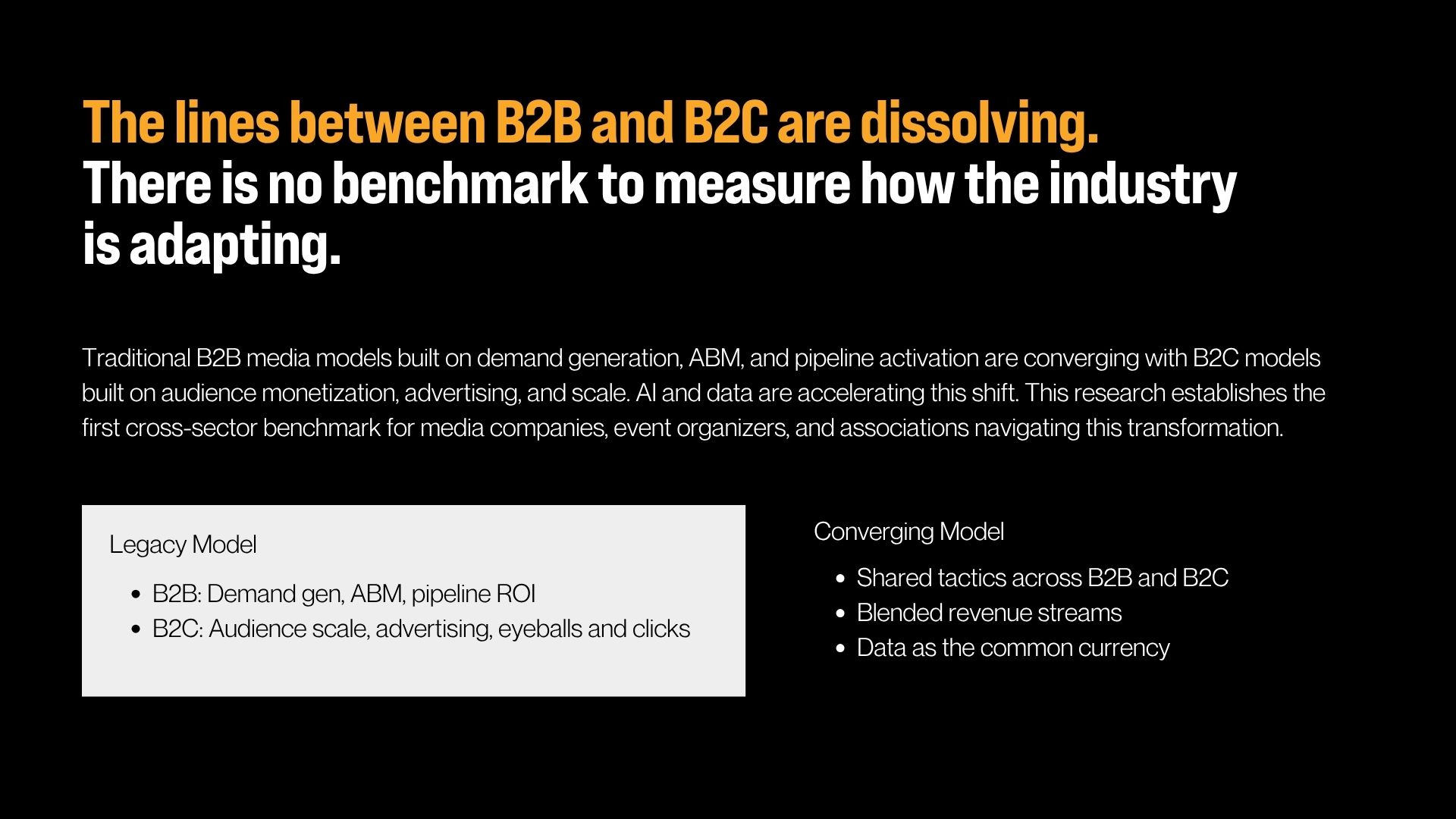
The industry is converging, and the benchmark is overdue
One of the session’s clearest points was that the old B2B/B2C divide is no longer a helpful way to understand the market. B2B organizations are adopting monetization models once associated with consumer media. B2C businesses are using audience intelligence to build more targeted commercial offerings. Across both, data is becoming the asset that links audience, product, and revenue.
That is why this benchmark matters now. Leaders are making real bets on AI, audience intelligence, and new revenue lines without much shared visibility into how prepared their peers actually are.
Data monetization expectations are rising fast
Executives said they expect data monetization to grow from about 10.5% of total revenue today to 23% by 2028. But most organizations are not yet built for that shift: 41% place themselves at Level 3 data maturity, and only 15% say they have reached predictive or transformative levels.
That is the core tension. The industry expects a much larger share of future revenue to come from data, while most companies are still operational rather than predictive.
For CXOs, that has implications across all three value levers:
- Revenue growth: new data products underperform when the underlying data is fragmented
- Profitability acceleration: teams spend too much time reconciling systems instead of monetizing insights
- Value creation: weak maturity limits pricing power and makes revenue diversification less durable
The biggest barriers are foundational
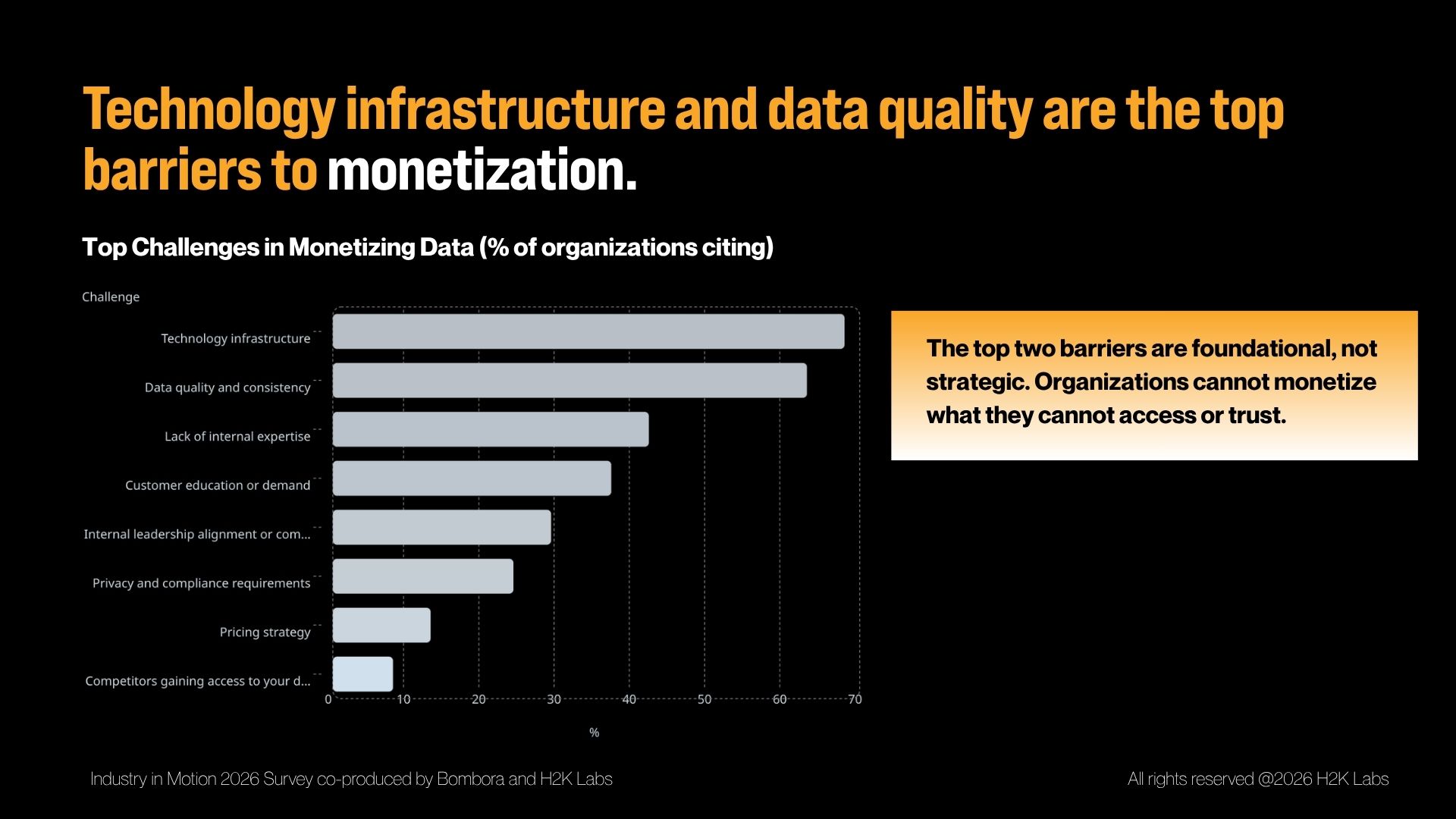
When leaders were asked what is blocking data monetization, the top issues were not demand or pricing. They were technology infrastructure, data quality and consistency, and structural constraints like legacy tech, budget limits, and lack of talent.
That is a useful corrective. This is not mainly a market-readiness problem. It is an operating-model problem.
If customer, audience, and behavioral data live in separate systems, everything downstream gets weaker: product, sales, analytics, and AI. The session made that point clearly: you cannot monetize what you cannot access, and you cannot scale what you do not trust.
AI is the top disruptor, but most investment is still defensive
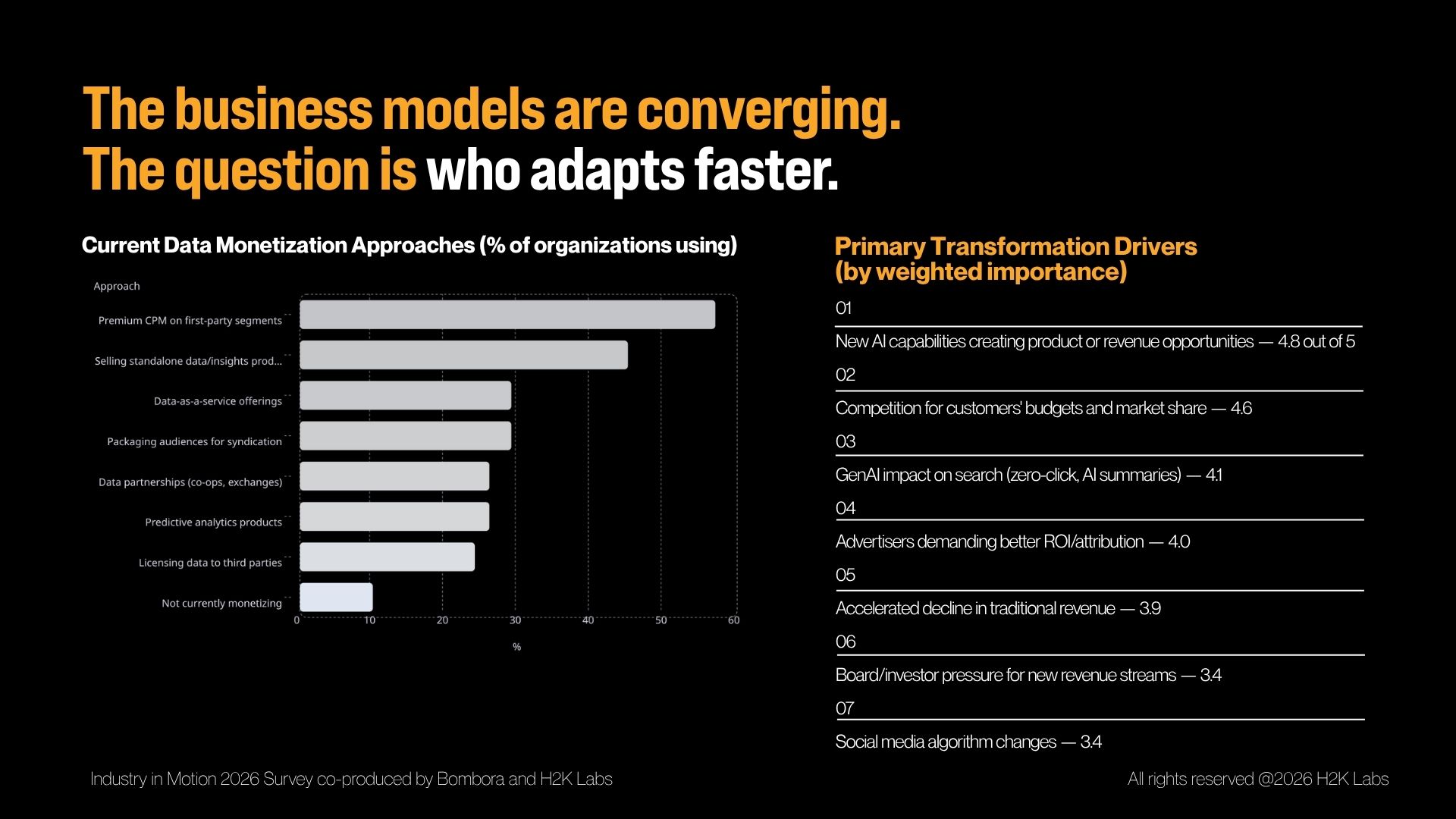
The research found that every respondent is investing in AI, and leaders ranked new AI capabilities as the top transformation driver. But most of that spending is still going toward defense rather than offense: 78% are focused on operational efficiency, while only 28% are building AI-powered products for external sale.
That is rational in the short term. Efficiency pays back faster.
But it also reveals where the sector is still underdeveloped. The long-term upside is not just using AI to cut cost. It is using AI to create new products, improve advertiser ROI, strengthen audience intelligence, and build more valuable monetization models.
Capital is moving faster than accountability
Another important finding: 90% of leaders plan to increase data and analytics investment, but ownership remains fragmented across the C-suite, and 14% of organizations have no clear owner for data strategy at all.
That matters more than it sounds. When data is expected to become a material revenue stream, unclear ownership becomes a growth constraint. This is not just a technology issue. It is a governance issue.
The most useful tension for executives
The most interesting signal in the added benchmark notes is this: the organizations furthest along are the ones most alert to the next disruption, especially GenAI’s impact on search and discovery. Less mature organizations are more focused on the decline of traditional revenue.
That is a sharp framing for media and event leaders. The companies already moving beyond legacy models can see what is coming next. The ones still dependent on older economics may be spending too much time reacting to the last disruption.
What leaders should do now
The RevvedUP session was not bearish. It was clarifying.
The opportunity is real. But most of the industry is still building the machine required to capture it.
The immediate priorities are clear:
- treat data monetization as a business model shift, not a side project
- fix infrastructure, trust, and ownership before chasing more ambitious AI use cases
- move AI investment beyond efficiency toward monetizable products
- close the capability gap in data science, engineering, and change management
Metrics + Instrumentation
Leadership teams should track:
- data monetization as a percent of total revenue
- revenue mix shifts across events, subscriptions, advertising, print, and data products
- gross margin for data and AI offerings
- percent of decisions that are actually data-driven
- dashboard adoption outside technical teams
- AI investment split between efficiency and new revenue creation
- ownership and accountability for data strategy
Primary sources: CRM, CDP, registration systems, finance, product analytics, ad and sponsorship reporting, and the warehouse/BI layer.
Primary owners: CEO, CFO, CRO, CPO, and CIO/CDO/CTO.
Why the survey matters
The benchmark is still being built, and that is part of the opportunity. The Industry in Motion: Benchmarking Media & Events in the Data & AI Era survey is open through the end of May, and participants will receive the full results and benchmarking. For leaders making decisions now on data strategy, AI investment, and revenue diversification, participating is not just supportive. It is useful. Final takeaway
The industry knows where it wants to go: more data monetization, stronger revenue diversification, and smarter use of AI.
What the Industry in Motion session made clear at RevvedUP is that most organizations are still closing the gap between strategy and readiness. The winners will not be the ones with the loudest AI narrative. They will be the ones that can turn data into durable revenue.
Take the survey by May 24th to receive the full findings and see how your organization benchmarks against peers.