Artificial Intelligence
October 22, 2026
Don't License the Archive. Own the Interface or Meter the Access.

# AI content licensing
# Data monetization
# Metered data access
# AI agents as customers
# Proprietary data moat
Four decisions before signing any AI content licensing deal. AI licensing deals are multiplying.

Heather Holst-Knudsen
The licensing offer is not the strategy
On October 15, Google announced that CNN, Axios, the Financial Times, and others had joined its paid AI news program, which now spans more than 400 publications. Participating publishers grant content rights for generative AI features and Google pays for them. For a CEO watching search referrals fall, the offer is hard to ignore.
It is also the wrong place to start. AI content licensing converts a compounding asset into a transaction. For most media, events, and data businesses, the stronger position is to own the interface through which AI reaches your content, or to meter continuous access to data that changes, so the value of every query stays with you. That is the conclusion a recent Revenue Room™ CEO Boardroom Exchange reached after members compared what has, and has not, worked.
Business consequence: a one-time sale of a recurring asset
The economic problem with licensing an archive is structural. A proprietary archive is valuable because it is deep, trusted, and hard to rebuild. Once licensed into a model, that depth becomes part of someone else's product. The buyer does not need to buy it again.
Early terms reinforce the concern. Digiday reported in September that Google's pilot pays on a "pay-per-value" basis, when Google judges content to have "meaningfully contributed" to an AI response, with payouts shown as a monthly figure. Publishers described the mechanics as "quite black box" and early payouts as "peanuts" relative to advertising. Some participants still prefer being inside the program to being excluded. Both views can be true, which is exactly why the decision belongs to the CEO and not to a business development team optimizing for a signed deal.
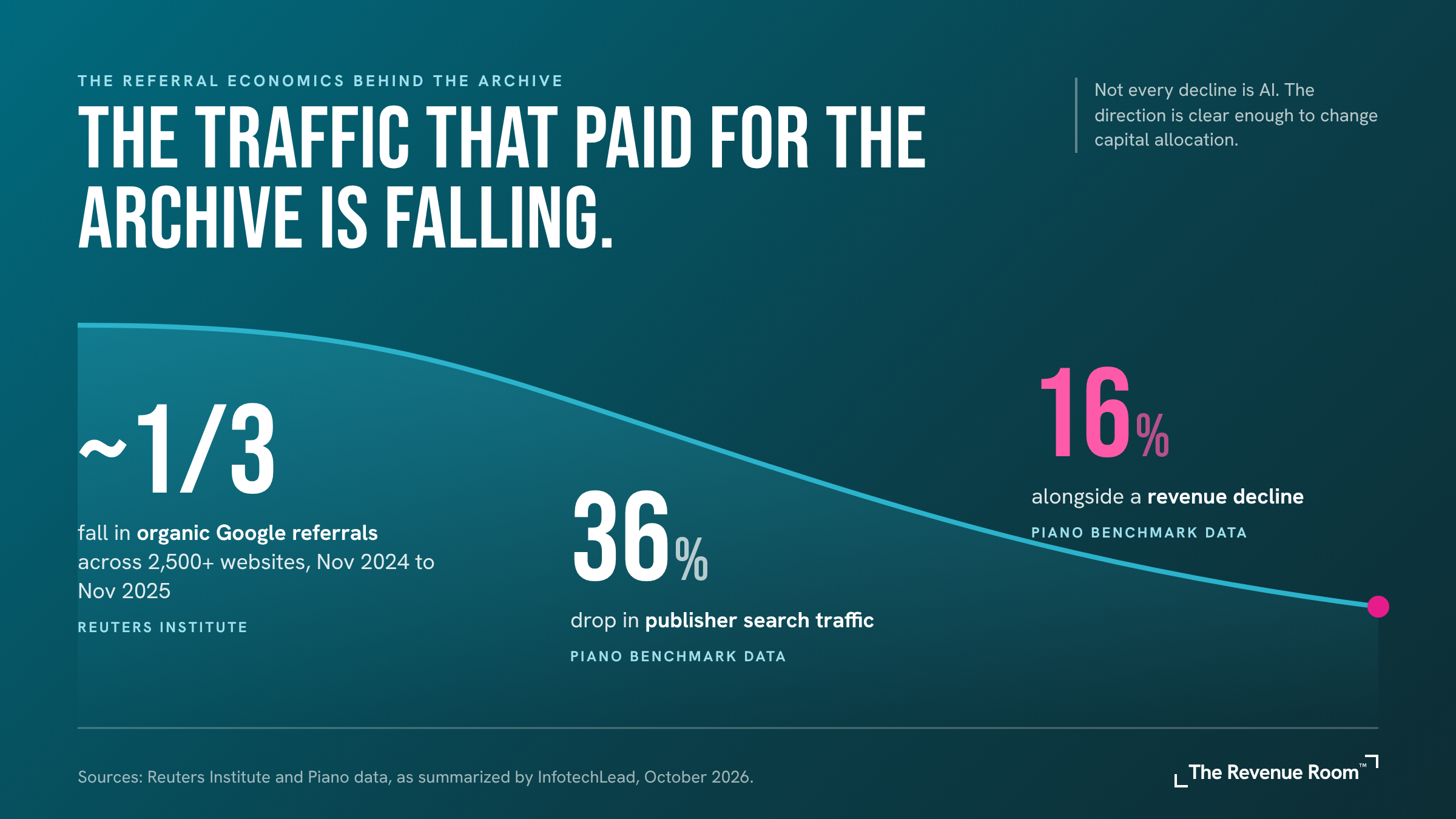
Meanwhile the referral economics that made archives profitable are weakening. InfotechLead's October summary of industry data cites a Reuters Institute finding that organic Google referrals fell about a third across more than 2,500 websites between November 2024 and November 2025, and Piano benchmark data showing a 36 percent drop in publisher search traffic alongside a 16 percent revenue decline. Not every decline is attributable to AI, but the direction is clear enough to change capital allocation. If the archive no longer earns through traffic, how it earns next is an enterprise-value question.
Operating diagnosis: why the licensing decision gets made by default
Members described four patterns that push companies toward licensing without a deliberate choice.
The archive is treated as a finished product. Content, awards entries, research, and attendee data are produced for one use and then shelved. When an AI buyer calls, the archive looks like inventory to clear rather than a platform to build on .
The buyers set the pricing model. One member selling content into legal technology noted that buyers want usage-based pricing rather than a flat fee, which asks the seller to trust measurement it does not control. Another, with experience selling database access to investment firms, found buyers would purchase portions of a dataset but rarely all of it, and rarely came back.
Early licensing can cannibalize the core. One member described an iconic trade brand that licensed early and lost business, because models absorbed its content through excerpts and quotations anyway. The company now plans to hold back further participation until related litigation resolves.
No one owns the cross-product signal. Editorial, events, research, and data teams each hold part of the asset. Without an executive accountable for the combined signal, the archive is priced as the sum of its parts, if it is priced at all.
The two alternatives that kept the value
Own the interface
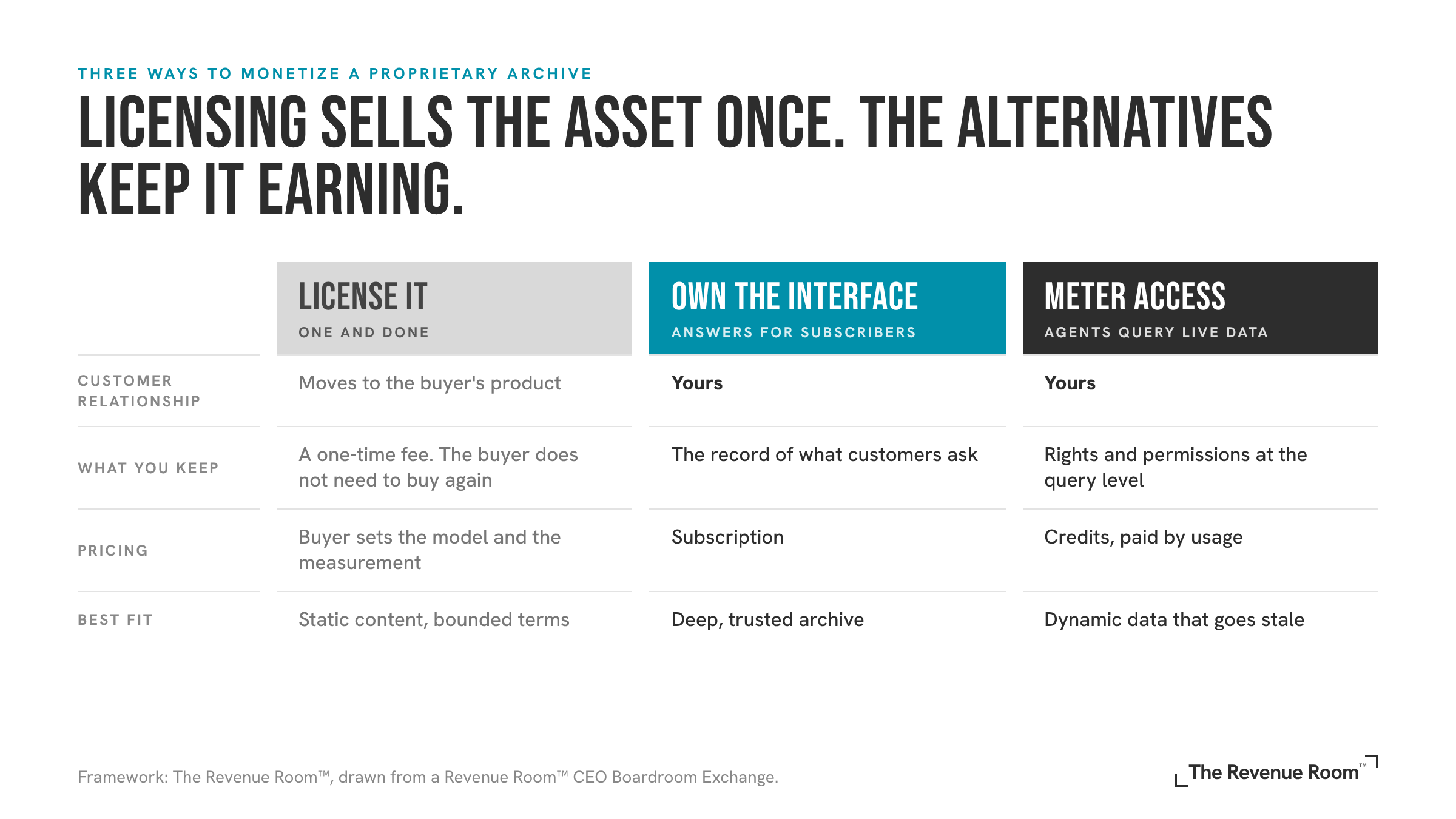
One member, a publisher serving higher education, chose not to sell its content into the AI market. Instead it built a walled garden over its archive back to the 1990s, with a language model that queries the content and returns answers to subscribers. The reasoning was direct: selling the content is one and done, so own the interface instead. Other members are moving the same way, including companies building generative search over their own trade archives.
Owning the interface keeps three things a license gives away: the customer relationship, the record of what customers are actually asking, and the ability to price access as a subscription rather than a single fee.
Meter access to dynamic data
A second member had built a data intelligence product whose architecture turned out to be unusually friendly to AI agents. Customers building their own AI engines wanted the data, and the company did not want to hand over a bulk license. It built an access layer using the Model Context Protocol, so customers' agents can query the data directly, and customers buy credits and pay by usage.
The commercial logic is the part to study. Permanent data, once licensed, is gone. Dynamic data is not. Procurement signals, intent data, and people changing roles go stale quickly, so an agent working from an old copy produces old answers. Continuous need creates recurring revenue, and metered access lets the seller enforce rights and permissions at the query level. The member reported steady new-customer growth at an average value well above the company's typical account, with little sales effort, while being candid that protocols, model behavior, and competitors could all change.
The compounding mechanism
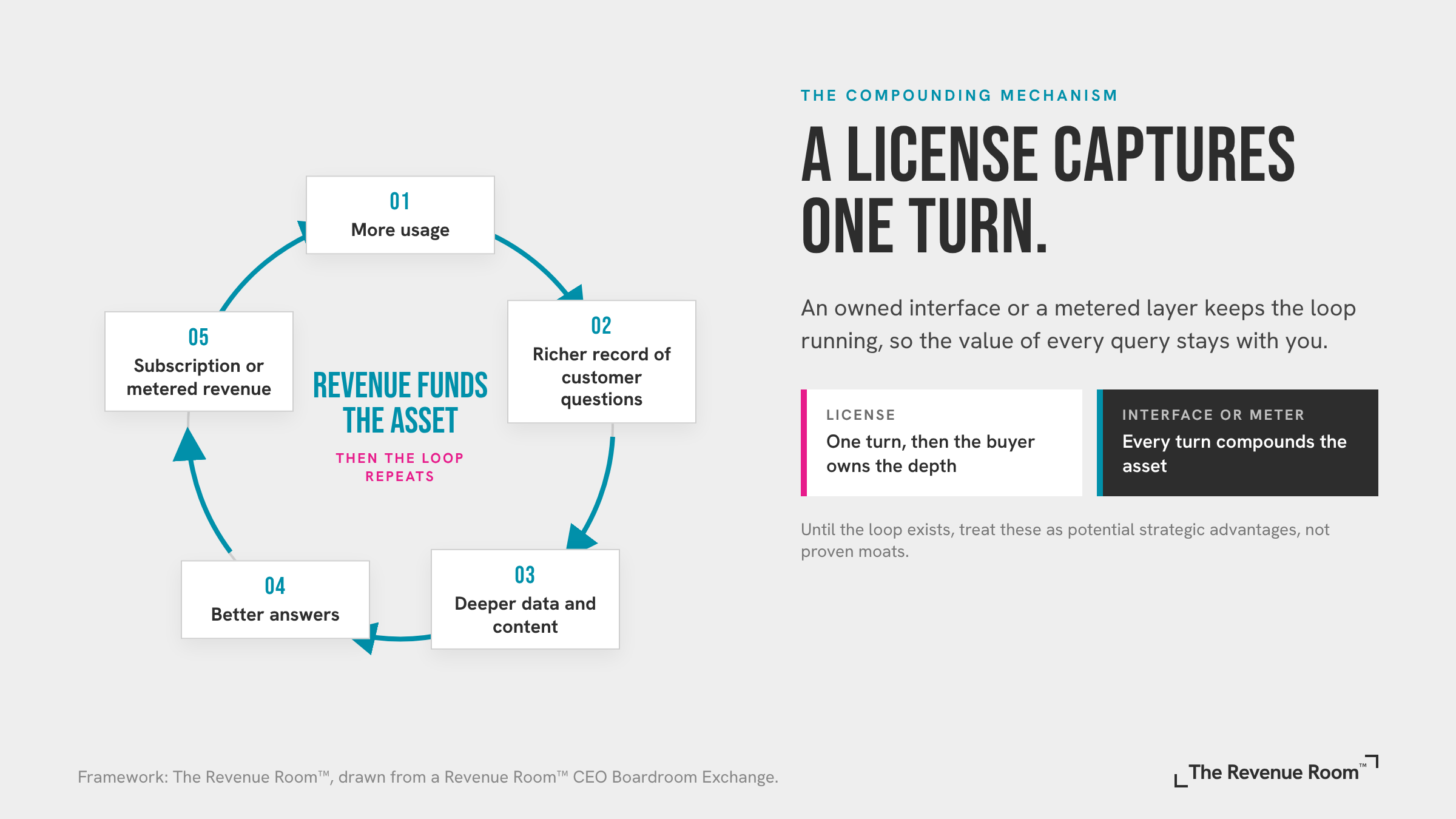
Both alternatives create a loop that licensing does not. More usage generates a richer record of customer questions. Those questions show which data and content to deepen. Deeper data improves answers, which increases usage and justifies subscription or metered pricing, which funds further investment in the asset. A license captures one turn of that loop. An interface or a metered layer keeps it running. Where that loop does not yet exist, these are potential strategic advantages, not proven moats, and leadership should treat them that way.
Four decisions before signing any AI licensing deal
- Classify the asset. Separate static archives from dynamic data. Static content may justify a bounded license with tight terms. Dynamic data almost always argues for metered access.
- Decide who owns the interface. If customers will increasingly reach your content through an AI layer, decide whether that layer is yours, a partner's, or a platform's, and what you give up in each case.
- Set your own pricing logic before the buyer does. Define whether access is priced by subscription, by query, or by outcome, and what measurement you require visibility into before accepting usage-based terms.
- Name one owner for the combined signal. Assign an executive accountable for content, events, research, and data as one monetizable asset, with authority over AI licensing decisions.
90-Day Management Focus
Days 1 to 30. Inventory every proprietary content and data asset by source, refresh rate, rights status, and current use. Flag which assets are dynamic and which are static. List every inbound AI licensing conversation and its proposed terms.
Days 31 to 60. For the two most valuable dynamic assets, scope a metered access option and estimate demand from existing customers. For the most valuable static archive, scope an owned answer interface for subscribers. Compare both against the best licensing offer on the table.
Days 61 to 90. Make a documented decision on each asset: license, own the interface, meter access, or hold. Recheck at day 90 whether any license under discussion would limit a future interface or metered product.
Questions for the leadership team
- Which of our assets lose value once licensed, and which keep generating value only if we control access?
- If our customers stopped visiting our websites, through what interface would they reach our content, and who would own it?
- Who in our company has authority to sign an AI licensing deal, and are they accountable for the long-term value of the asset?
- What data do we hold that a customer's AI agent would need to query continuously?
- What would we need to know about measurement before accepting usage-based pricing?
Continue the conversation
This question came out of a Revenue Room™ CEO Boardroom Exchange, where members compare live decisions under Chatham House Rule. It connects to The Revenue Room™ point of view on what happens after AI owns more of the answer, and to the compounding moat work published with members. Revenue Room™ CXO is an invite-only executive peer network and year-round decision system for profitable growth. Monetizing intelligence and data as a competitive moat are also on the agenda at RevvedUP 2027 .
Sign in or Join the community
The Nexus for Data-Driven Growth Leaders

Create an account
The Nexus for Data-Driven Growth Leaders
Like
Dive in
Related
44:13
Video
Lose Slowly or Lose Suddenly: The Uncomfortable Truth About Relevance
By Heather Holst-Knudse... • Jan 8th, 2026 • Views 79
Blog
Lose Slowly or Lose Suddenly: The Uncomfortable Truth About Relevance
By Heather Holst-Knudse... • Dec 9th, 2025 • Views 45
Blog
The Event CEO’s New Job: Stop Selling Space. Start Selling Access.
By Heather Holst-Knudse... • May 19th, 2026 • Views 50
Blog
The Registration Wall Dilemma: How to Balance Access, Data, and Audience Growth
By Heather Holst-Knudse... • Aug 21st, 2025 • Views 156
44:13
Video
Lose Slowly or Lose Suddenly: The Uncomfortable Truth About Relevance
By Heather Holst-Knudse... • Jan 8th, 2026 • Views 79
Blog
The Event CEO’s New Job: Stop Selling Space. Start Selling Access.
By Heather Holst-Knudse... • May 19th, 2026 • Views 50
Blog
The Registration Wall Dilemma: How to Balance Access, Data, and Audience Growth
By Heather Holst-Knudse... • Aug 21st, 2025 • Views 156
Blog
Lose Slowly or Lose Suddenly: The Uncomfortable Truth About Relevance
By Heather Holst-Knudse... • Dec 9th, 2025 • Views 45