Artificial Intelligence
November 20, 2026
How to Industrialize Content Operations Without Industrializing the Content

# AI content operations
# AI editorial workflow
# Human judgment in AI
# AI manager bottleneck
# Engagement metrics for media
Lessons from MJH Life Sciences on turning AI into operating infrastructure while keeping human judgment, expert insight, and audience trust at the center.

Heather Holst-Knudsen
How to Industrialize Content Operations Without Industrializing the Content
Most media companies are asking how AI can help them produce more content. That is the wrong first question. More output is now cheap, for you and for every competitor. The harder question is how to redesign AI content operations so the work behind the content gets faster while the content itself becomes more trusted, more original, and more worth returning to.
Allie Karas, Senior Vice President of Content at MJH Life Sciences , is working through that question with a team of more than 140 people across oncology, specialty healthcare, managed care, pharmacy, and industry sciences brands. Her stakes are higher than most. In general media, a hallucination is a credibility problem. In healthcare media, it can become a patient safety problem.
The short answer: AI should become infrastructure, not a shortcut . Let AI handle assembly, standardize what "good" means, keep judgment human, and reinvest the time saved in the expert insight that audiences cannot get anywhere else.
The Business Consequence: Volume Is No Longer the Product
On The Revenue Room™ Podcast, Karas described how MJH's paying customers, largely pharma and biotech, are changing what they buy. "It's not just impressions anymore, but it's which specialists are engaging with you, what topics are they interested in, what formats are they consuming."
That shifts the economics of content in three ways that apply well beyond healthcare.
Output stops predicting value. MJH was historically "very volume driven," with pageviews as the core KPI and output as the lever. With AI overviews and zero-click search, Karas called pageviews "a worse proxy every month." A content operation that uses AI mainly to produce more may grow its cost base while its sellable asset, an engaged and identifiable audience, stays flat.
Trust becomes the asset that holds the revenue up. "If the clinicians stop trusting us, they stop engaging and the insight disappears along with them." Every sponsor deliverable, event audience, and data product downstream depends on that.
Content can open new revenue lines when it is run as product. MJH's KOL-hosted podcasts and video series started as a content play. Some brands that sold almost no podcast inventory two years ago now sell it. Gated content adds first-party data with every unlock.
The Operating Diagnosis: Why AI Content Efforts Stall
Standards live in people's heads. If brand style, structure, and sourcing rules are tribal knowledge, AI cannot follow them and reviewers cannot enforce them consistently.
"Review the AI output" is not a standard. Karas was candid that MJH started there. "A couple of months in, we're like, well, what does that mean exactly?" Without a shared definition of good, quality depends on who happens to look at the piece.
The bottleneck moves to managers. When everyone can produce three times as much, all of it lands on whoever decides what is good and worth doing. Karas's example is familiar to any executive: ask for a quick idea and receive a ten-page document with an executive summary and risk matrix. "The work didn't go away. It just moved."
Junior talent never builds judgment. If new hires start with AI, they cannot tell whether the AI version is any good.
The scoreboard still rewards volume. Teams optimize for what they are measured on.
This is not only an editorial issue. It involves content leadership, operations, talent, data, and the commercial team, each of which owns part of the result.
A Framework: Five Design Decisions for AI Content Operations
1. Divide the work by the judgment it requires
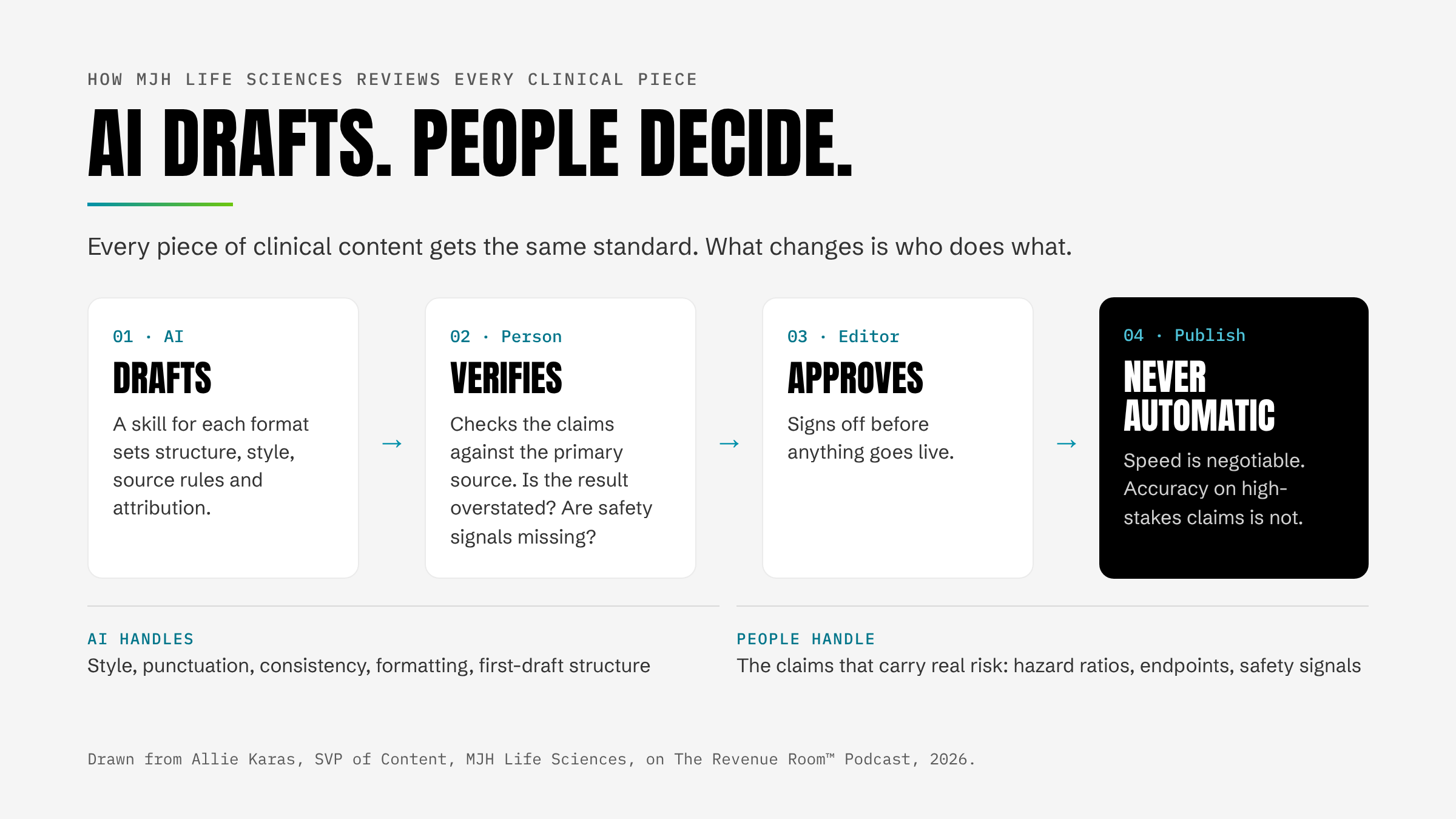
MJH does not tier controls by use case. Every piece of clinical content gets the same standard. What changes is who does what. AI handles style, punctuation, consistency, formatting, and first-draft structure. Karas noted it is "probably better than a tired editor who's on hour 10 of a very long on-site conference day." People handle the part that carries the real risk: is the hazard ratio right, is that a primary or secondary endpoint, are we overstating the result, are we leaving out safety signals.
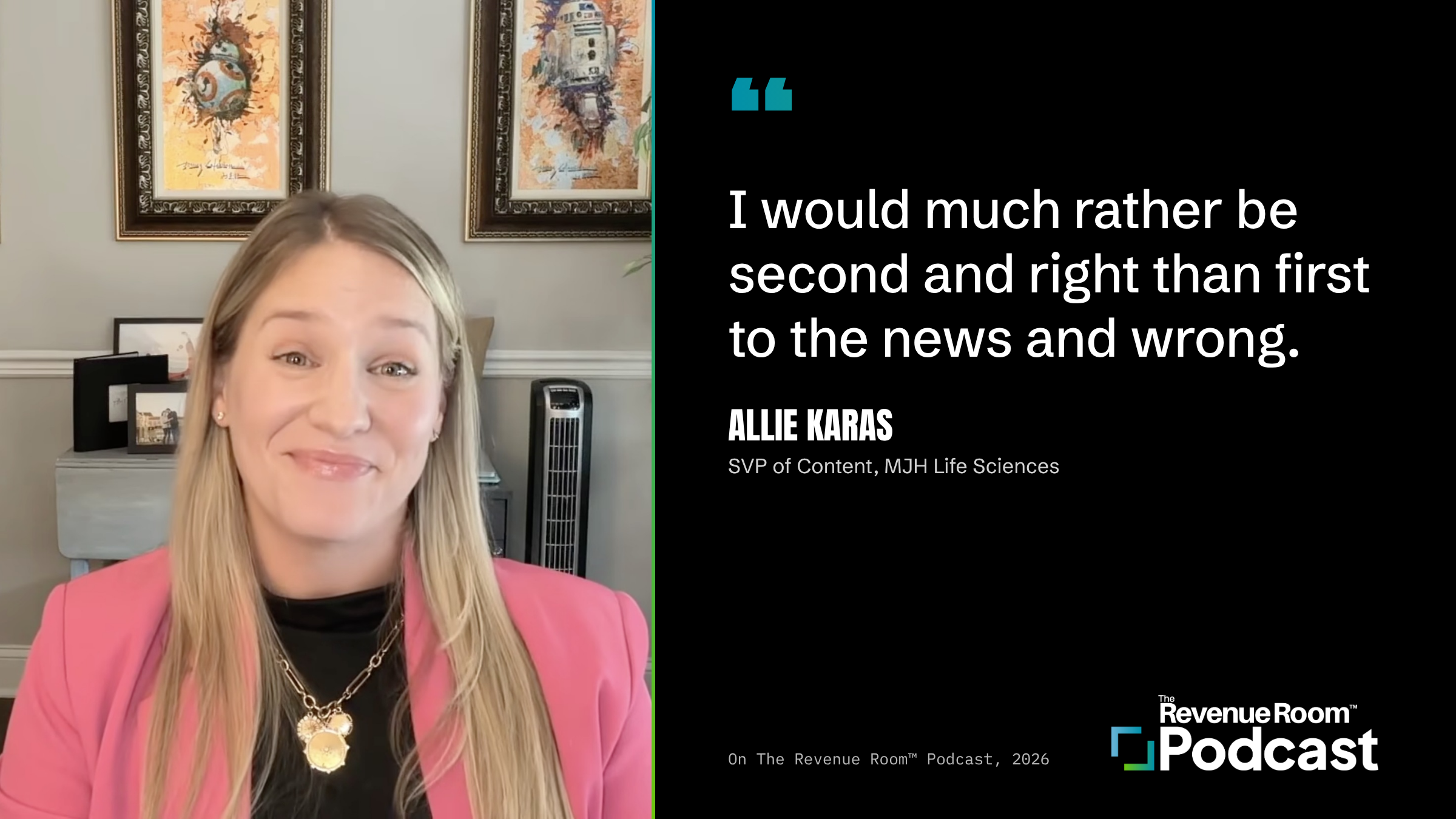
Her rule: "I would much rather be second and right than first to the news and wrong." Speed is negotiable. Accuracy on high-stakes claims is not.
Beyond healthcare: every Revenue Room™ business has its own version of a clinical claim. It is the market forecast a buyer budgets against, the pricing benchmark a member cites internally, the regulatory interpretation a subscriber acts on. Identify those claims and put them behind the same non-negotiable human check.
2. Codify the standards into the tools
MJH's first step was "getting standards out of somebody's head and into the tools." Each content format (news brief, conference recap, Q&A, feature) has its own AI skill encoding structure, style, source rules, and attribution requirements. Then come explicit QA criteria and explicit review stages: AI drafts, a person verifies against the primary source, an editor approves, and nothing publishes automatically.
Karas's point is useful for any operator: the "boring infrastructure stuff" is what lets the more exciting AI work scale.
3. Reinvest the time saved in what differentiates
Before AI, most news-brief time went to reading, summarizing, and structuring. Now the time saved goes to two places: verification and original perspective, ideally a key opinion leader explaining what results mean for practice on video or in a podcast clip.
"Clinicians can get the headlines anywhere. They're gonna come to us for what that means and from a source that they trust." Expert relationships also strengthen quality control, since MJH puts content in front of its experts to fact-check. Efficiency that is not reinvested is just cost cutting. Efficiency reinvested in insight is a strategy.
4. Redesign the people system, not just the workflow
- Spread decision rights. MJH rebuilt its career ladder this year so ownership does not cluster at the top. Associates own AI-assisted production, producers build expert relationships and launch programming, and senior strategists make the big coverage calls.
- Learn by hand first. New hires do the work manually for their first month before touching AI. The same logic applies on the revenue side. A new seller who lets AI write client emails before learning the pitch will be exposed on the first live call.
- Drive adoption workflow by workflow. Resistance often looks like unfamiliarity. MJH works one-on-one to find where AI saves each person time, framing it the way her team does: "We call it AI powered content. It's not just AI content." Blanket mandates do less than giving people agency within their own workflow.
Hiring changes too. Writing tests make less sense. Karas now looks for storytellers who can work across formats: edit short video, go on camera, interview well. And leaders have to resist being the fixer. Asking "what do you think we should do?" feels slower but builds the judgment the whole model depends on.
5. Change the scoreboard
MJH has "hitched our wagon to engagement." The metrics underneath: identified clinicians engaging, how often and with what; gated content unlocks; newly identified audience; 30/60/90-day engaged audience; and traffic earned from LLMs. "We don't need every click."
Each format also needs its own measure. "Different formats do different jobs." Articles still win search. Video measured by pageviews can look like it is failing while it builds expert relationships, social reach, and a face for the brand.
When Karas presents to the executive team, the case is not "look how much faster we are." It is whether the audience that matters is growing, and whether it is growing efficiently. Two AI wins make that case concrete: LLM referral traffic growing after content was restructured to answer the question in the first hundred words, and AI-refreshed evergreen pages on one brand outperforming the originals. The metric she still cannot measure well is the one she cares about most: whether expert-insight content outperforms straight news. MJH is building a dashboard to test it, and Karas frames the strategy itself the same way: "We are making a hypothesis, we're running experiments and we'll adjust if needed."
Where This Leads: A Netflix-Style Experience Built on Trust
Get the operations right and the audience experience can change. MJH named its ambition to build " the Netflix of healthcare video " back in 2021. The operating model above is what makes that ambition sustainable.
The parallels are practical. Netflix reported in 2022 that its Skip Intro button was pressed about 136 million times a day. Karas's team debated the same thing for talking-head interviews: "Nobody needs 30 seconds of, welcome and thanks so much for joining us. Just tell me what the data mean."
Clinicians scroll between patients, browse LinkedIn at night, and listen to podcasts in the car, so MJH now runs a native short-form video feed across its sites alongside expert-led shows. The principle is "fewer, better videos," not more of them.
Netflix wins on originals with talent people follow and on knowing what each viewer engages with. MJH's version is expert-led programming and identified clinician engagement. AI makes the production economics work. Human judgment and expert relationships make the experience worth returning to.
90-Day Management Focus
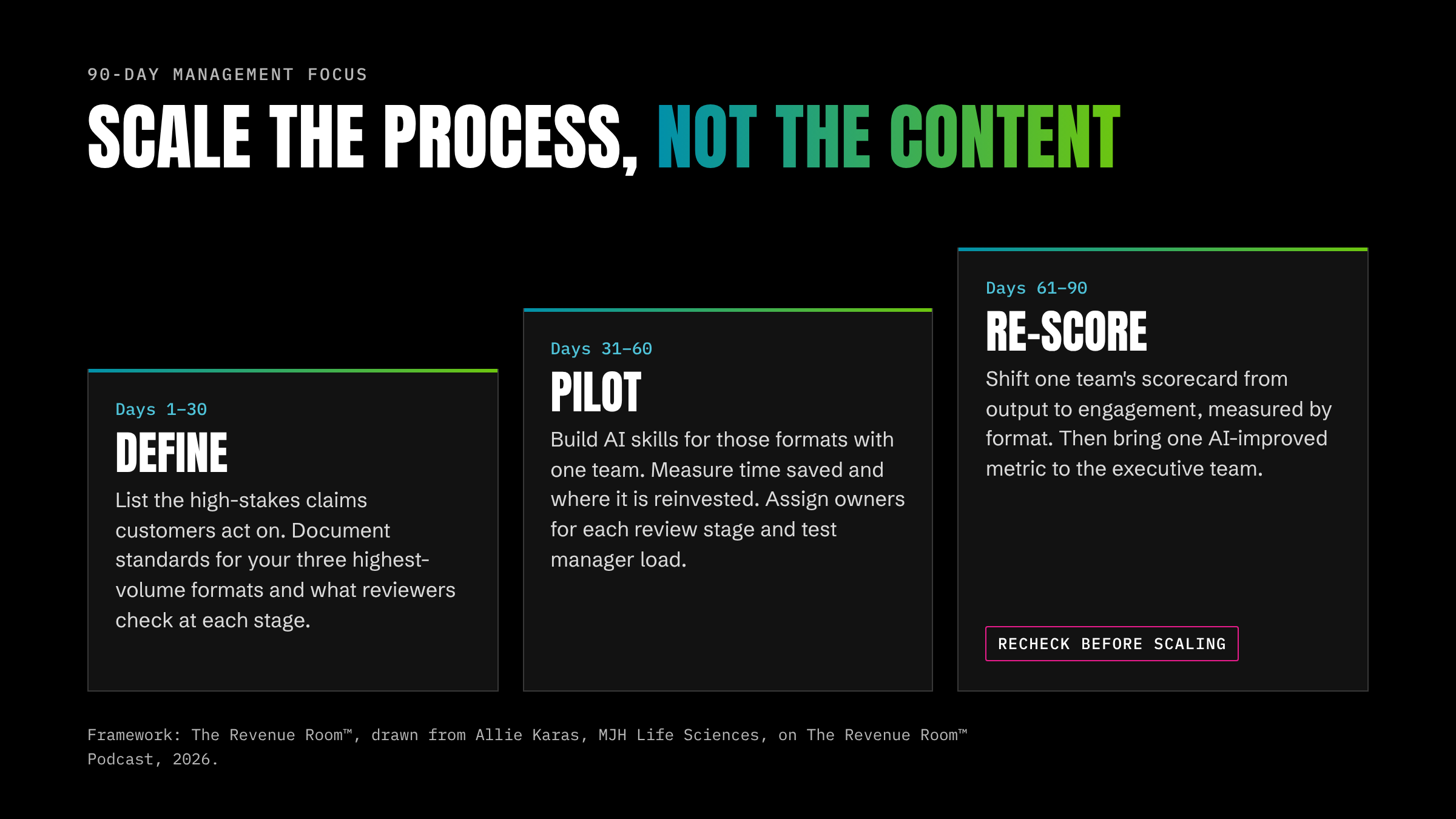
Days 1 to 30. List the high-stakes claims in your content that customers act on. Document format standards for your three highest-volume content types and define what reviewers check at each stage.
Days 31 to 60. Build AI skills for those formats and pilot them with one team. Measure time saved and where it is reinvested. Assign owners for each review stage and test whether the manager layer is absorbing the new volume.
Days 61 to 90. Shift one team's scorecard from output to engagement, with format-specific measures. Bring one AI-improved metric to the executive team. Recheck adoption, quality, and manager load before scaling.
Questions for the Leadership Team
- Which claims in our content would cause real harm to a customer if they were wrong, and who checks them today?
- Can each reviewer say exactly what they are checking, or is quality depending on who looks?
- Where has AI moved the bottleneck to our managers, and what decision rights should move down?
- How much of the time AI saves is reinvested in original insight versus absorbed as more output?
- Which formats are we judging on a metric that does not reflect the job they do?
Continue the Conversation
Listen to the full episode with Allie Karas on The Revenue Room™ Podcast. Members of Revenue Room™ CXO, the invite-only executive peer network and year-round decision system for profitable growth, work through these AI operating model and governance questions with peers who face the same tradeoffs. Continue the discussion in person at RevvedUP , March 14 to 16, 2027, at the Vinoy in St. Petersburg, Florida.
Sign in or Join the community
The Nexus for Data-Driven Growth Leaders

Create an account
The Nexus for Data-Driven Growth Leaders
Like
Comments (0)
Popular

Dive in
Related
Blog
How Industry Dive Leverages Data, AI, and Content to Drive Revenue
By Heather Holst-Knudse... • Feb 12th, 2025 • Views 118
51:20
Video
Beyond the Booth: How to Engineer Ecosystems that Compound Revenue
By Michelle Metter • Feb 24th, 2026 • Views 59
Blog
How Event Leaders Use AI Without Killing Creativity and Connection
By Heather Holst-Knudse... • Feb 24th, 2026 • Views 93
41:08
Video
How Event Leaders Use AI Without Killing Creativity and Connection with Doug Emslie
By Heather Holst-Knudse... • Feb 24th, 2026 • Views 114
Blog
How Industry Dive Leverages Data, AI, and Content to Drive Revenue
By Heather Holst-Knudse... • Feb 12th, 2025 • Views 118
Blog
How Event Leaders Use AI Without Killing Creativity and Connection
By Heather Holst-Knudse... • Feb 24th, 2026 • Views 93
41:08
Video
How Event Leaders Use AI Without Killing Creativity and Connection with Doug Emslie
By Heather Holst-Knudse... • Feb 24th, 2026 • Views 114
51:20
Video
Beyond the Booth: How to Engineer Ecosystems that Compound Revenue
By Michelle Metter • Feb 24th, 2026 • Views 59