Events
March 25, 2025
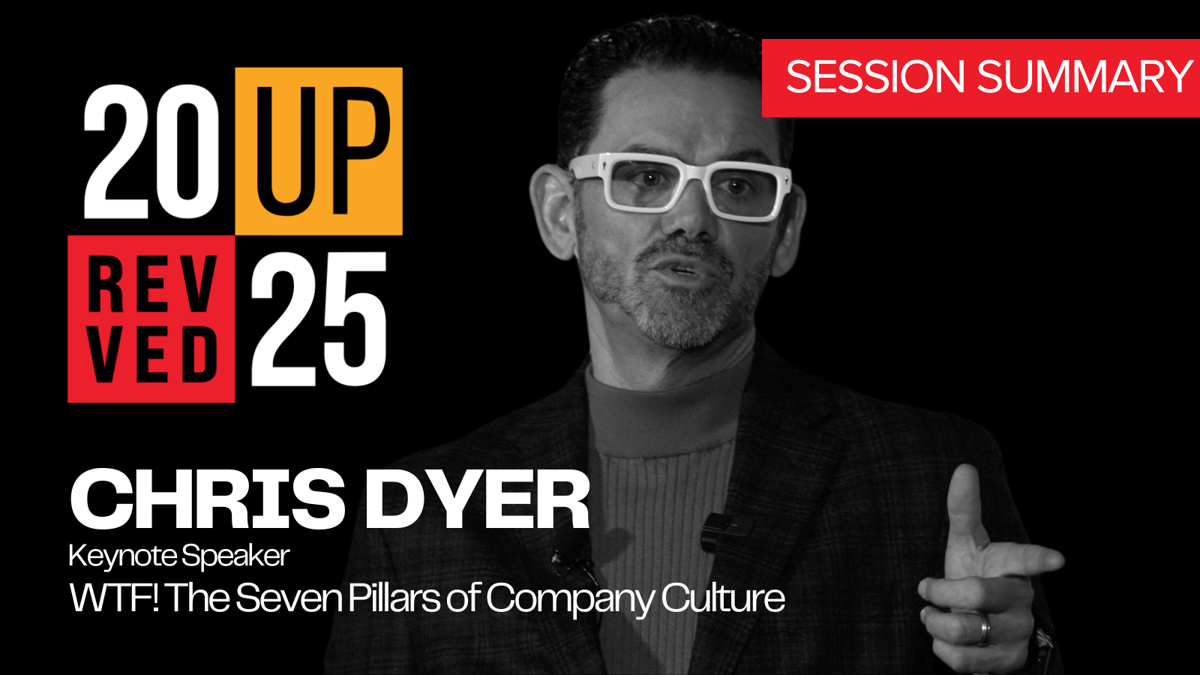
RevveUP 2025 Keynote Day 1: WTF! The 7 Pillars of Company Culture by Chris Dyer
# Leadership
Unlocking Performance and Innovation Through Cultural Transformation

Heather Holst-Knudsen
RevvedUP Recap: Four Pillars of Culture Driving High‑Growth Success
RevvedUP Session Recap – Chris Dyer on Building a Winning Culture
To view Chris Dyer's full keynote, click here.
In today's fast-moving business landscape—especially in dynamic sectors like media, events, and data—one factor separates companies that thrive from those that merely survive: company culture. At RevvedUP, CEOs and C-suite leaders heard this message loud and clear from culture expert Chris Dyer, who has dedicated his career to understanding what truly drives engagement, collaboration, and performance. Dyer, founder and CEO of PeopleG2, famously led his own company from struggling through the 2008 recession to being named one of Inc.'s fastest-growing businesses and a best place to work. His turnaround playbook? A people-first culture built on a framework of seven key pillars that accelerate productivity, performance, and profitability.
In his RevvedUP session (provocatively titled “WTF: The Seven Pillars of Culture”), Dyer shared a roadmap for leaders to transform workplace culture into a competitive advantage. He focused on four foundational pillars that fast-growth companies can implement immediately for outsized impact. These insights come at a critical time: hybrid work and AI-driven innovation are reshaping industries, compressing innovation cycles to mere years. In such an environment, cultivating a strong, adaptable culture is not a “soft” endeavor—it’s a strategic imperative for staying agile and innovative. Below, we break down the session’s key themes and how each pillar empowers organizations to excel in a rapidly changing market.
Culture as a Catalyst in High-Growth, High-Change Environments
Why should busy executives prioritize culture? Dyer’s message to the RevvedUP audience was that culture isn’t just an HR concern—it’s a CEO-level strategic lever. In high-growth companies facing constant disruption, technology and tactics can be copied, but a strong culture is inimitable and provides sustainable advantage. When markets shift or a crisis hits, culture is what determines if your team rallies and innovates or stalls out.
Dyer illustrated this with his own story. In 2008, amid a recession, his firm lost 40% of its clients virtually overnight. Exhausted and overwhelmed, he nearly quit. Instead, he used the crisis as an opportunity to reset his company’s culture. He doubled down on transparency and positive leadership at a time when fear could have taken over. The result? His employees became more engaged and solution-oriented, helping the company cut costs and spark growth even in tough times. Within a few years, that cultural overhaul had directly contributed to record growth and national recognition.
The lesson for leaders in fast-moving industries: when the only constant is change, your people—and how you lead them—are your true differentiator. As Dyer noted, innovation cycles are getting shorter (what used to take decades now happens in a few years), and roles are continually evolving. By building a culture that values trust, optimism, recognition, and learning, leaders create an organization that can adapt quickly, innovate consistently, and sustain high performance despite the chaos of a dynamic market. In short, culture is the engine that keeps a high-growth company running at full throttle.
Four Pillars of a High-Performance Culture
Dyer’s research identified seven pillars of effective workplace culture, but he honed in on four in particular during the session—because these four are game-changers for immediate impact. Transparency, Positivity, Recognition, and Embracing Mistakes emerged as the must-have pillars for organizations aiming to scale successfully in fast-paced environments. Below, we explore each pillar and how it translates into practical leadership actions:
Transparency
Transparency is more than a buzzword; it’s the foundation of trust and agility. For leaders, this means sharing information openly and broadly—from high-level goals to key financial metrics—so that every team member understands the bigger picture. Dyer emphasized that most employees simply don’t know their company’s goals or numbers, and that ignorance stifles their ability to contribute. He recounted asking one executive team, “What would happen if you doubled your revenue?” only to find that employees first needed to ask, “What’s our current revenue?” This highlighted a common blind spot.
By pulling back the curtain, leaders empower their teams. Dyer’s own company began sharing monthly P&L summaries with every employee, despite initial discomfort from leadership. The payoff was immediate: people at all levels started acting like owners. Front-line employees spotted inefficiencies and suggested cost savings that leadership had overlooked. In one year, this radical transparency helped reduce operating costs by 30% without a top-down mandate—employees themselves identified the solutions once they had the data. Transparency also means moving discussions out of siloed one-on-ones and into the open. When team goals and challenges are discussed together, it creates accountability and mutual support, not whispered frustrations. For a fast-growth business, an open-flow of information ensures that problems are surfaced early, ideas come from everywhere, and everyone rallies around the same North Star. The culture shifts from “management knows best” to “we’re in this together,” which is exactly the mindset needed in a complex, evolving market.
Positivity
The next pillar, positivity, is about cultivating an optimistic, solution-focused mindset throughout the organization. Importantly, positivity is not about ignoring problems or enforcing fake cheerfulness. It’s about leaders setting a tone of “Yes, we can” that encourages innovation and forward momentum. Dyer described positivity as looking for what’s working and building on it. When employees bring ideas or raise issues, how leaders respond makes all the difference. A dismissive “We tried that before” or “No, that won’t work” will shut people down. Over time, a pattern of “no” kills creativity—team members learn it’s safer to stay quiet.
In contrast, a culture of positivity says “Yes, and…”. Borrowing from improv comedy’s golden rule, leaders at high-performing companies try to find the merit in new ideas and keep the conversation going. Dyer shared how he personally adopted a “Year of Yes” approach to break out of his comfort zone, leading him to unexpected opportunities and connections that paid off hugely in his career. In a business context, consistently responding to proposals with openness (even if it’s “Yes, and here’s what we’d need to make it work…” or “Yes, but let’s adjust it this way.”) tells employees their contributions are valued. This positive environment directly fuels innovation. In fact, neuroscience research shows that when people feel safe and supported, their brains are more creative and primed for problem-solving. Teams that celebrate wins, highlight strengths, and tackle challenges with optimism tend to out-innovate and outpace those stuck in a blame or fear cycle. For executives, the takeaway is clear: lead with a positive, can-do attitude—especially in uncertain times. It builds the confidence and resilience your organization needs to conquer the next big challenge.
Recognition
High-growth companies often run at a breakneck pace, but pausing to say “thank you” might be one of the most strategic moves a leader can make. The third pillar, recognition, is about creating a culture where contributions are noticed and appreciated constantly. Dyer is adamant that a great recognition program doesn’t have to cost a dime. While some firms spend lavishly on bonus schemes or prizes, what truly drives engagement is much simpler: genuine appreciation. Employees who feel valued are motivated to go the extra mile; those who feel invisible will eventually disengage or leave.
Dyer shared how his team implemented a peer-driven recognition ritual using a simple Slack channel. They created a “watercooler” chat room where anyone could post a kudos with a green flag emoji to celebrate a colleague’s good work in real time. Managers intentionally stepped back so that praise came authentically from peers, not only from the top. The result was a groundswell of daily positive reinforcement—colleagues cheering each other on for wins big and small. This practice cost nothing, yet it built camaraderie and made people feel seen. Importantly, recognition was kept separate from compensation or performance reviews; in Dyer’s experience, once you attach rewards or punishments, people start gaming the system or holding back. The goal was to make gratitude part of the everyday culture, not a managed metric.
For leaders, the lesson is to embed recognition into the fabric of your company. Encourage shout-outs in team meetings, internal newsletters highlighting successes, or platforms where anyone can offer praise. In industries driven by creativity and innovation, this constant positive feedback loop fuels morale and fosters an environment where people are eager to contribute. As Dyer noted, there are many ways to do it right—what matters is that you do something. Whether it’s an informal Slack shout-out or a structured “employee of the month” program (as some companies do successfully), make thanking people a habit. In a fast-paced enterprise, that burst of recognition might be what keeps your top talent energized and on board when competitors come courting.
Embracing Mistakes
The final pillar Dyer highlighted was the art of embracing mistakes. In an innovative culture, mistakes aren’t punished or hidden—they’re leveraged as learning opportunities. This pillar is especially vital in high-growth, fast-changing businesses, where taking risks is part of staying ahead. Dyer was careful to distinguish well-intentioned mistakes from negligent errors. Errors caused by apathy or incompetence (like repeated sloppy mistakes or ignoring protocols) must be addressed and corrected. But when someone tries a new approach, pilots a bold idea, or stretches beyond their comfort zone and it doesn’t work out, that’s the kind of “failure” savvy organizations should encourage – because it’s how progress happens.
Leaders need to set up systems to capture and learn from these valuable missteps. In practice, this could mean adopting rituals like Agile software teams’ retrospectives, where after each project or sprint the team openly discusses what went wrong and how to improve. Dyer noted that without an explicit process, employees will be inclined to hide their mistakes or avoid taking risks, fearing blame or career damage. That’s a recipe for stagnation. Instead, by normalizing discussion of failures, you create a safe space for innovation. For example, some companies hold “fail forums” or have Slack channels dedicated to sharing lessons learned when an experiment flops. When leadership, too, is transparent about their own missteps, it sends a powerful signal.
Dyer recounted an adventure on a giant zipline that went awry due to a miscalculation—an apt metaphor for workplace snafus. The operators gave him a parachute that was too large, leading to a scary outcome, but ultimately nobody was harmed and the mistake was acknowledged and remedied (with a free do-over offer). The takeaway for the workplace is similar: if a well-meant initiative falls short, don’t instill fear—fix the issue and let the team try again. Organizations that embrace this pillar often talk about “failing fast” and “failing forward.” By extracting the lessons and sharing knowledge from every stumble, you build a culture of continuous improvement. Over time, employees become more willing to experiment and share ideas, knowing they won’t be shamed for an honest mistake. In an era of rapid change, that willingness to boldly iterate can be the difference between a company that leads and one that lags.
Key Takeaways for Leaders
- Culture is a strategic asset: In fast-paced, high-growth industries, a strong people-first culture is a primary competitive edge. It drives agility, innovation, and resilience amid constant change.
- Transparency breeds trust and action: Share goals, performance data, and decisions openly. When employees have line-of-sight into the business, they make smarter decisions and actively contribute solutions (as seen when sharing financials led front-line teams to save 30% in costs).
- Positivity fuels innovation: Cultivate a leadership style that says “Yes, and…” to new ideas. Encouraging a positive, solution-oriented mindset keeps morale high and unlocks creative thinking, even when challenges arise.
- Recognition is powerfully simple: Create routines for frequent, genuine praise and thank-yous. Whether through peer shout-outs on Slack or public kudos in meetings, regular recognition boosts engagement and retains top talent – without requiring costly incentives.
- Make mistakes OK (when they’re in pursuit of improvement): Signal that taking calculated risks and learning from failures is not just allowed but expected. When teams aren’t afraid of honest mistakes, they’ll innovate faster and continuously improve, which is critical in rapidly evolving markets.
By focusing on these four cultural pillars, CEOs and C-suite leaders can build organizations that don’t just keep up with change but drive it. Chris Dyer’s RevvedUP insights reinforce that cultivating the right workplace culture will position your company to seize opportunities, weather disruptions, and sustain high performance over the long haul. For executive leaders in media, events, data and beyond, the mandate is clear: make culture a centerpiece of your growth strategy – your future success depends on it.
_______________________________________________
Sign in or Join the community
The Nexus for Data-Driven Growth Leaders

Create an account
The Nexus for Data-Driven Growth Leaders
Like
Comments (0)
Popular

Dive in
Related
Blog
RevvedUP 2025 Keynote Summary: The CEO's Survival Code in an Age of Perpetual Transformation: Peak Performance Hacks From the Front Lines
By Heather Holst-Knudse... • Mar 25th, 2025 • Views 36
21:32
Video
Brands in the Fast Lane Redefining Growth in the AI Powered Marketing Era
By Charisse Hughes • Aug 25th, 2026 • Views 0
23:31
Video
CEO Stories from the Frontlines Driving Transformation Under Pressure When the Rules Keep Changing
By Tim Hartman • Aug 25th, 2026 • Views 0
Blog
RevvedUP 2025 Keynote Summary: The CEO's Survival Code in an Age of Perpetual Transformation: Peak Performance Hacks From the Front Lines
By Heather Holst-Knudse... • Mar 25th, 2025 • Views 36
21:32
Video
Brands in the Fast Lane Redefining Growth in the AI Powered Marketing Era
By Charisse Hughes • Aug 25th, 2026 • Views 0
23:31
Video
CEO Stories from the Frontlines Driving Transformation Under Pressure When the Rules Keep Changing
By Tim Hartman • Aug 25th, 2026 • Views 0