Signal without workflow is just another dashboard. Dashboards tell you something. Workflows actually trigger action.
That distinction is the reason most AI revenue initiatives quietly stall. The data is there. The signals are firing. But nothing happens. No one owns the next step. No automation kicks off. No alert reaches the right person in time. The insight sits in a dashboard that gets reviewed once a week, maybe, and by the time someone acts, the window has already closed.
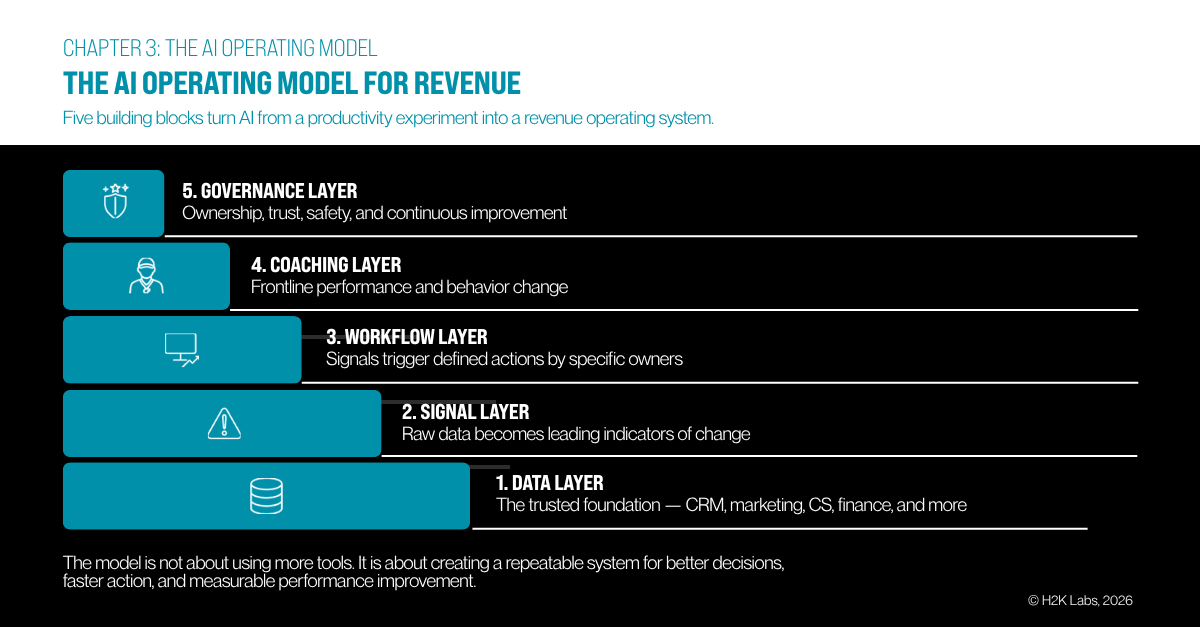
The AI Operating Model I teach in the Revenue Performance Accelerator™ Bootcamp is built to fix that. It is five layers. And I will tell you right now: I am building this in my own business as I teach it.
Layer 1: The Data Layer — Good Enough to Trust, Connected Enough to Use
I want to say something that I think liberates a lot of leaders: the goal is not perfect data. The goal is enough trusted data to make better decisions.
If you are waiting for perfect, you will never start. What you need to aim for is connected rather than siloed, quality rather than volume, and data your team actually believes in. Because if the team does not trust the data, they will not trust the AI and adoption will stall entirely.
The data sources feeding this model are the ones you already own. CRM. Marketing automation. Website analytics. Event registration. Campaign performance and fulfillment. Customer success. Finance and billing. Every one of these is a signal source. And one I am especially pointed about: campaign performance. In my experience it is the number one reason clients do not renew. And it is entirely in your sandbox. Quality, timing, quantity. You have to have it connected and visible.
Layer 2: The Signal Layer — Where Data Becomes Intelligence
This is where raw data becomes early indicators of change. And it is the layer most organizations are not thinking about systematically enough.
At Revenue Room™ CXO, we use what I call three plus open, two plus click. If someone opens our emails three or more times, or clicks two or more times, that automatically becomes a high intent signal. Especially if that person attended RevvedUP and we sent them a bootcamp email. Very simple. But that signal is now actionable. That is someone we would cross sell to.
For expansion signals more broadly, we collect behavioral data. What companies are hitting on our website, what high value pages they are landing on. And we feed that into an agent we have built in ChatGPT. We upload the signals and say: here is what we are seeing from this list of companies. Score them in terms of most likely to close, by product. That gives our team a prioritized action list instead of a gut feeling.
The signal layer also has to work at the account level and the contact level. I use a concept I call multi threading, which is tracking how many buyer personas you have connected to each account and what those people are doing. At Revenue Room™ CXO, there are about ten titles that influence a buying decision: CEO, CRO, Chief Customer Officer, Head of Rev Ops, Head of Customer Success, CMO, CPO, CDO, CFO, Head of Events. I want to know how many of those I have connected to an account and what signals they are generating.
From Session 1 of the Revenue Performance Accelerator™:
The AI Operating Model Bootcamp © H2K Labs, 2026
Layer 3: The Workflow Layer — The Signal Has to Trigger Something
This is where I get most passionate. Because this is where most organizations have the biggest gap.
Let me give you a real example from my own business. We use HubSpot Service Hub for customer success. We have a kickoff call scheduled. Ten people on the client team are expected. Only two show up. That is a signal. Eight people did not engage at the start of the relationship. What happens next?
In a workflow connected system, that triggers an automatic task for someone to reach out to all eight, share the recording, and track whether they log in. If they do not log in, that triggers a follow up task in ClickUp. That connects to a Slack alert for the team. That maps to our red flag dashboard. The signal becomes action and the action is documented, trackable, and owned.
We are a HubSpot house. We run our workflows through HubSpot connected to ClickUp and Slack, and we are now expanding into Claude Cowork to connect more of those automations. The specific tools matter less than the principle: every signal needs a defined next step, a specific owner, and a system that makes inaction visible.
Layer 4: The Coaching Layer — AI That Reaches the Frontline
This layer is underused and underappreciated. AI in the coaching layer surfaces patterns that managers would never catch at scale. Which reps perform better on which types of accounts, which skills need reinforcement, which deal behaviors are predicting risk before it shows up in the numbers.
I am still building this layer in my own business. But I believe it is one of the highest leverage applications of AI for revenue leaders who are willing to invest in it properly.
Layer 5: The Governance Layer — What Keeps the System Alive
I will be honest: we fell into the trap here. We were building workflow after workflow, and some of those workflows were no longer being used. We kept them alive. And they were actually breaking other workflows.
Governance is not a once a year audit. It is an ongoing discipline. Who owns each workflow? Who is accountable for data quality, not just when something breaks but on a rolling basis? How do you know a workflow is actually being used? If it is not, get rid of it.
Without this layer, everything above it degrades. Signals lose accuracy. Workflows become orphaned. The team stops trusting the outputs. And by Q2, the AI initiative has quietly become another line item no one talks about.
The Question I Leave Every Leader With
How do we use AI to turn trusted signals into action every single week?
Not someday. Not everywhere at once. This week. Pick one revenue motion. Build the five layers. Get it right in one place, one brand, one event, one channel. Then scale it.
That is the operating discipline that separates the revenue leaders who win with AI from the ones who are still waiting for it to work.
Want to See This Operating Model in Action?
The five layers do not live in a slide deck. They live in the conversations, decisions, and real world execution happening inside the Revenue Room™ CXO every single week. Members are CEOs and revenue critical C suite leaders across media, events, and data businesses who are actively building their AI operating models, comparing notes on what is working, and holding each other accountable to outcomes not just intentions. If you want to be in a room where the signal actually triggers action, apply now to join Revenue Room™ CXO