Revenue
October 21, 2026
Why Growth Strategy Stalls Without Operating Discipline
# Operating discipline
# Non-dues revenue
# KPI ownership
# RACI model
# Revenue operations
Naylor COO Laura Taylor on the ownership, data trust, and investment choices that turn a revenue strategy into results.

Heather Holst-Knudsen
The strategy is set. The handoff is where it stalls
Most executive teams can name their growth priorities. Fewer can say, with confidence, who owns each one on Monday morning. That gap is where strategy stalls, and closing it is a matter of operating discipline.
Laura Taylor , Chief Operating Officer at Naylor Association Solutions and a Revenue Room™ CXO member, described the pattern plainly on a recent episode of The Revenue Room™ Podcast: "I can't count how many times I've gotten on a call. We've had a really great strategic discussion, and we get off the call, we even get the AI recap now of it, but it's like, okay, I thought this person was running with it. They thought I was running with it. And it's a week later and nothing's been done."
Operating discipline is what converts a growth strategy into results: agreed metrics with a single named owner, explicit decision rights for every initiative, and investment choices tied to company goals rather than across-the-board cuts. Without it, data gets interrogated instead of acted on, and initiatives drift between functions until the window to act has closed.
Business consequence: lost weeks become lost revenue
Naylor is a useful lens because its model is anything but simple. The company partners with associations to drive member engagement and non-dues revenue through print and digital media, managed events, career centers and job boards, association management software, and an association management company that runs associations directly. Each line carries its own buyers, its own go-to-market motion, and its own customer success obligations. Many clients buy more than one.
Its clients face the same execution problem at a different scale. Naylor's 2026 Association Benchmarking Report , based on 665 responses from senior association professionals, found that generating non-dues revenue remains the top challenge, cited by 51.9% of respondents. Data and strategy is the most understaffed function, at 38.5%. Meanwhile, frequent or daily use of AI-powered communication tools rose from 12.5% to 33.5% in a single year.
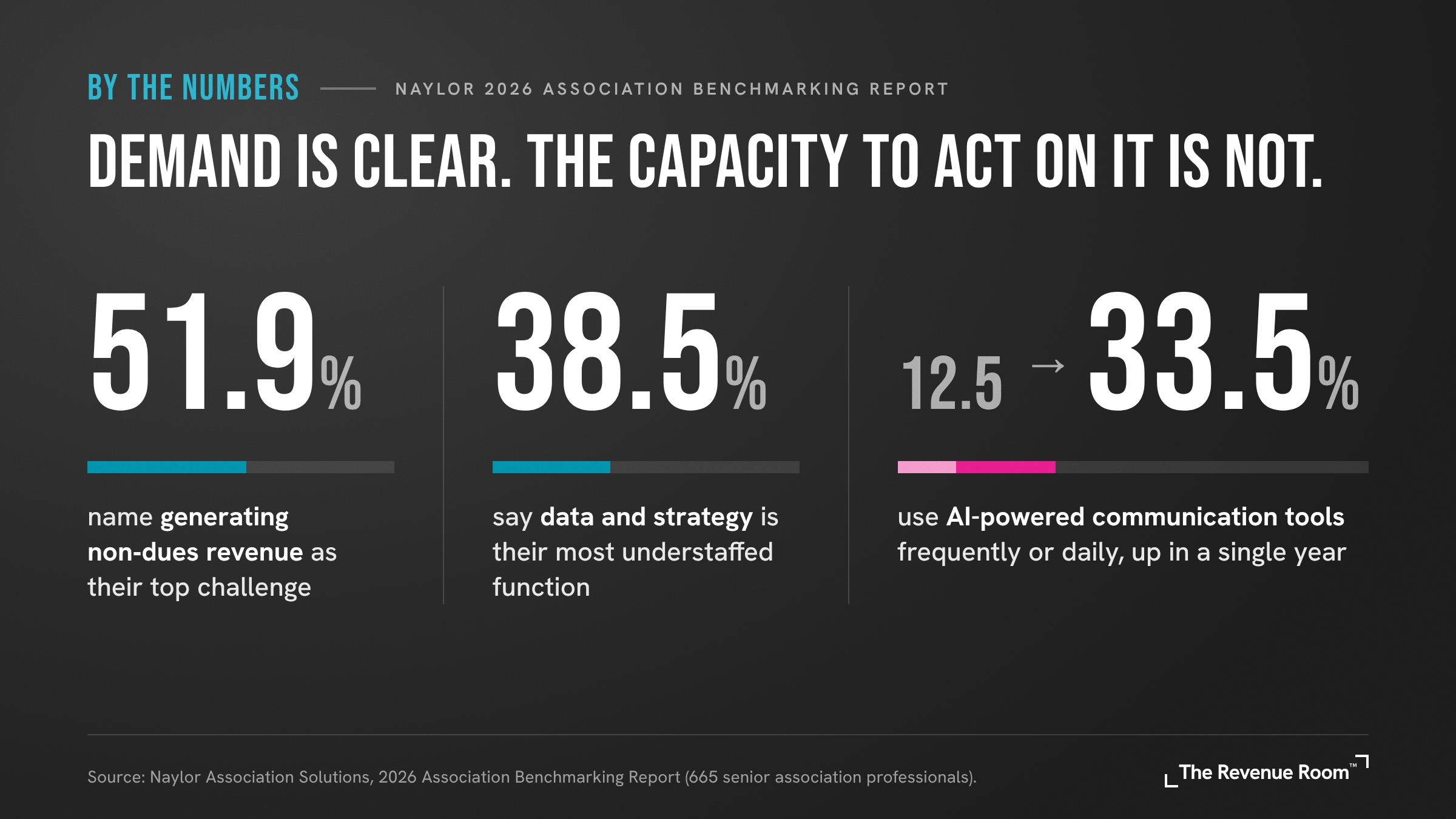
Read together, those numbers describe organizations adopting tools faster than they are building the capability to act on what the tools produce. The economic cost shows up in three places:
- Decision speed. When teams do not trust the data, they spend cycles reconciling it, and decisions wait.
- Margin. When cost reduction is handled as a spreadsheet exercise, organizations often keep revenue-generating activity and cut the delivery work that makes it renewable.
- Retention. When client experience is underfunded to protect short-term revenue, the model stops compounding.
Operating diagnosis: where vision meets friction
This is not a sales issue or an operations issue. It sits in the handoffs between them.
Taylor's own career gives her an unusual view of those handoffs. She joined Naylor nearly 18 years ago as a sales representative selling advertising, moved through sales management, online project and customer service roles, and product and service leadership, and was named COO in 2023. She has sat in most of the seats she now oversees.
Three friction points came through clearly in the conversation.
Siloed functions build friction quietly. "Oftentimes, sales and ops are very siloed in the day-to-day," Taylor said. "When you don't have that understanding, friction does build. And productivity drops." When a deal is lost, the easy explanation is sales effort. The harder and often more accurate explanation may involve a process break, a product gap, or a campaign reporting issue outside the seller's control.
Data without trust does not remove emotion. Naylor CEO Christine Shaw has spoken publicly about data removing emotional volatility from decision making. Taylor's job is to make that true on the ground. "We can have the best data in the world, but if we're not grounded to consistency in what data we're looking at and what that data is telling us, you're going to still have emotion in it. If you don't believe in the data, you're going to interrogate it."
Matrix organizations default to decision by committee. Shared clients across multiple solutions mean shared accountability, which often means no accountability. AI-generated meeting recaps can make this worse by creating the impression that a record of the discussion is the same as an assignment of the work.
Five moves that build operating discipline
1. Make data decision-grade before asking it to settle debates
Naylor's approach is to agree on the metrics that matter, define each one, maintain one source of truth that every function views through its own lens, and assign an owner to every KPI. "Data alone doesn't remove the friction," Taylor said. "It's really the trust in the data and the confidence of how to interpret that data." The owner's job is not only to report the number. It is to understand it well enough to act on it.
2. Assign ownership before the meeting ends
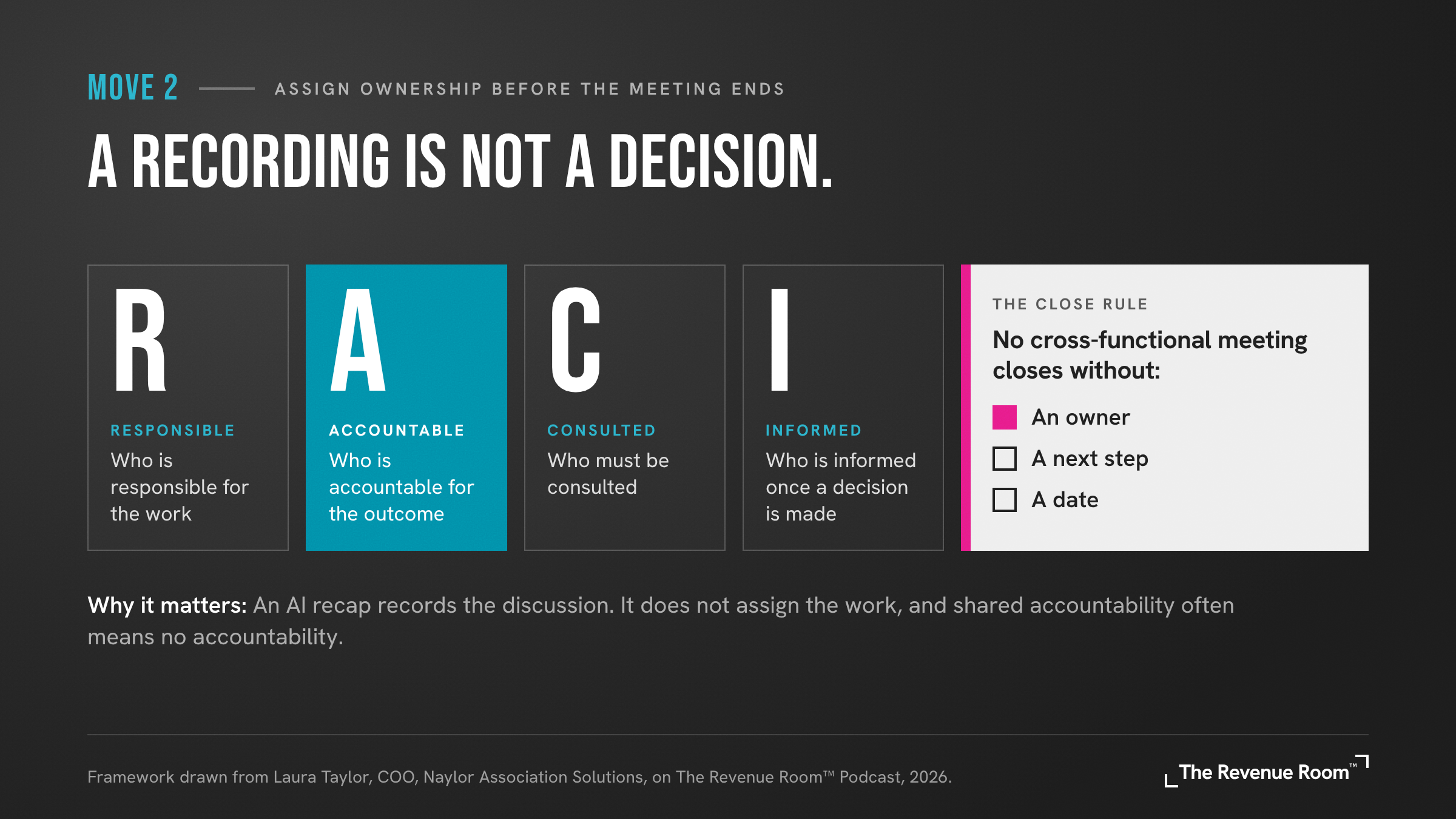
Naylor has leaned into the RACI model, naming who is responsible, who is accountable, who must be consulted, and who is informed once a decision is made. The discipline is simple and frequently skipped: a cross-functional discussion does not close until someone owns the next step and a date is attached. A recording is not a decision.
3. Close the distance between sales and operations
Laura intentionally re-engages with the sales team, even years after leaving it, because the selling environment has changed. Her prescription is empathy and transparency on both sides about where the pain points are. For leaders, the practical move is to examine lost deals and stalled renewals jointly, with operations and sales in the same room, before assigning a cause.
4. Separate quick wins from multi-year builds by where engagement already exists
Laura’s rule for associations applies to any business monetizing audience, content, and events. Quick wins come from places with high existing engagement that are not yet monetized. Events are a common example: even as a top revenue source, they often carry untapped sponsorship potential before, during, and after the core program. Content marketing is another, allowing industry experts to contribute thought leadership that sponsors value and that the organization does not have to write itself.
Multi-year builds are different. Online communities, a first webinar series, or a reinvented career center require building engagement before monetizing it. "You can't just stand up a webinar tomorrow and expect everybody to throw their dollars at it," she said. Career centers illustrate the point: they now compete with Indeed and LinkedIn, so their differentiation has to come from the membership itself, through career planning, job market data, and member expertise that draw passive as well as active job seekers. Both timelines start with the same step: direct conversations with advertisers, sponsors, and members about what they value.
5. Treat cost reduction as an investment decision
Asked where she would look first to cut operating costs by 15% without touching anything client-facing, Laura started with company goals, not departments. Where is the business trying to grow? Where is it most profitable? Which legacy products are no longer serving the company or its clients? "Where you're not cutting, you're investing."
She also cautioned against treating AI as a quick cost-cutting lever. In her view, AI should expand team capacity and automate administrative work so that costs do not grow at the same rate as revenue. And she named a common failure mode: overweighting revenue-generating activity while cutting the human effort behind client experience and value delivery. "You're not going to have a winning model because you're not going to be able to retain and grow." For media and events businesses, where custom programs and campaigns often carry significant unpriced human effort, this deserves particular scrutiny.
90-Day Management Focus
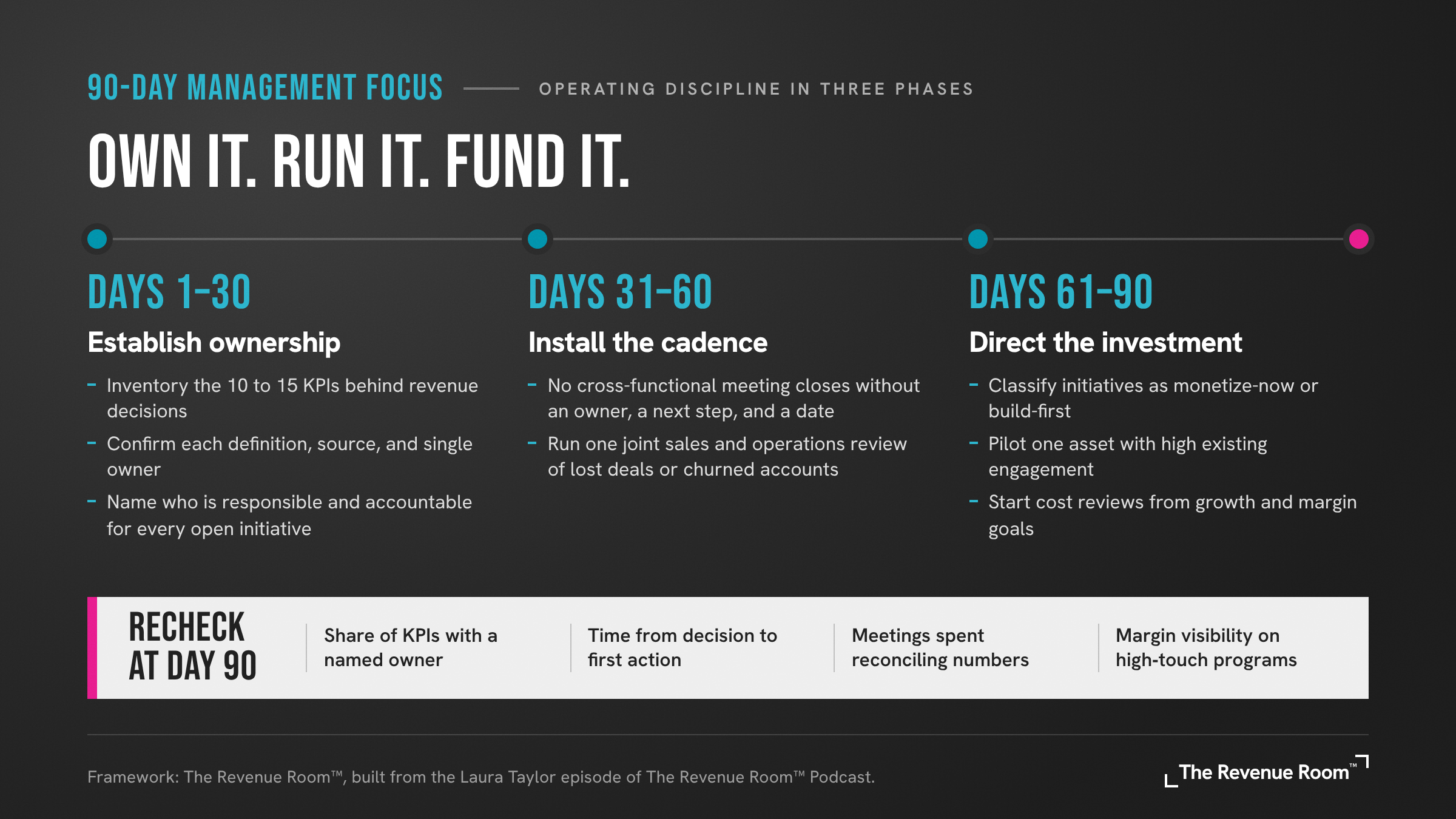
Days 1 to 30: Establish ownership. Inventory the ten to fifteen KPIs leadership uses to make revenue decisions. For each, confirm the definition, the source, and a single named owner. List every open cross-functional initiative and name who is responsible and who is accountable.
Days 31 to 60: Install the cadence. Adopt a standing rule that no cross-functional meeting closes without an owner, a next step, and a date. Run one joint sales and operations review of recent lost deals or churned accounts to separate execution issues from process, product, and reporting issues.
Days 61 to 90: Direct the investment. Classify current revenue initiatives as monetize-now or build-first. Launch one low-lift pilot on an asset with existing high engagement. Run a cost review that starts from growth and margin goals and maps the human effort behind client delivery before anything is cut.
Progress indicators to recheck at 90 days: share of KPIs with a named owner, time from decision to first action, number of meetings spent reconciling numbers rather than acting on them, and margin visibility on custom or high-touch programs.
Questions for the leadership team
- Which of our KPIs do functional leaders still debate rather than act on, and who owns each one?
- How many initiatives from last quarter's strategy discussions have no single accountable owner today?
- When we lose a deal or a renewal, who examines whether the cause sits outside the sales function?
- Which revenue streams are we monetizing before the engagement exists, and which high-engagement assets are we not monetizing at all?
- If we had to reduce costs by 15%, would our current process protect the client experience that drives retention?
Continue the conversation
Listen to the full episode with Laura Taylor on The Revenue Room™ Podcast for her complete perspective on non-dues revenue, operating ownership, and AI capacity.
For leadership teams that want to test whether their own operating model is ready to support their growth agenda, the Revenue Room™ Growth Readiness Diagnostic pairs a CEO Value Creation Baseline with the Revenue Intelligence, Revenue Leakage, and AI Value Creation Scorecards to produce a connected Growth Readiness Profile. And inside Revenue Room™ CXO , an invite-only executive peer network and year-round decision system for profitable growth, operators like Laura work through these decisions with peers who are building at the same altitude.
Where to Take This Next
Revenue Room™ CXO is where this exact question, who owns the decision once AI sits inside the workflow, is being worked through in real time by CEOs, CROs, and RevOps leaders building the next revenue operating model together. The Revenue Room™ Growth Readiness Diagnostic's AI Value Creation Scorecard is a practical starting point for mapping where decision rights are currently missing inside your own commercial workflows.
About The Revenue Room™
Revenue Room™ CXO is an invite-only executive peer network and year-round decision system for profitable growth, serving CEOs, Presidents, and C-suite operating leaders across media, events, data, information services, marketplaces, subscriptions, and professional communities. Explore Revenue Room™ CXO membership or start with the Growth Readiness Diagnostic.
Sign in or Join the community
The Nexus for Data-Driven Growth Leaders

Create an account
The Nexus for Data-Driven Growth Leaders
Like
Comments (0)
Popular

Dive in
Related
Blog
Growth Theater: Why Most “Strategic Initiatives” Are Just Expensive Distractions
By Coleen Thomson • Aug 1st, 2025 • Views 52
Blog
The Strategic Shift Behind EndeavorB2B's Growth and Why It Matters for the Entire Industry
By Heather Holst-Knudse... • Dec 8th, 2025 • Views 42
Blog
From Audience to Ecosystem: Why Community is the New Growth Engine
By Heather Holst-Knudse... • Aug 29th, 2025 • Views 70
52:15
Video
The Strategic Shift Behind EndeavorB2B's Growth and Why It Matters for the Entire Industry
By Heather Holst-Knudse... • Dec 9th, 2025 • Views 45
Blog
Growth Theater: Why Most “Strategic Initiatives” Are Just Expensive Distractions
By Coleen Thomson • Aug 1st, 2025 • Views 52
Blog
From Audience to Ecosystem: Why Community is the New Growth Engine
By Heather Holst-Knudse... • Aug 29th, 2025 • Views 70
52:15
Video
The Strategic Shift Behind EndeavorB2B's Growth and Why It Matters for the Entire Industry
By Heather Holst-Knudse... • Dec 9th, 2025 • Views 45
Blog
The Strategic Shift Behind EndeavorB2B's Growth and Why It Matters for the Entire Industry
By Heather Holst-Knudse... • Dec 8th, 2025 • Views 42