Artificial Intelligence
October 21, 2026
Your 2027 Operating Plan Is Where AI ROI Gets Decided

# AI ROI
# 2027 AI budget
# AI value creation
# AI spending CFO
# SaaS cost reduction
Most leadership teams will budget for AI tools next year. The ones that show a return will budget for the work, the cost, and the outcome those tools are meant to change.

Heather Holst-Knudsen
Your 2027 Operating Plan Is Where AI ROI Gets Decided
The budget line that decides the return
Planning season is when most AI value is won or lost, and very few leadership teams treat it that way. The 2027 plan will almost certainly include an AI line. In most companies that line will describe licenses, seats, and a pilot or two. It will rarely describe which workflow changes, which cost goes away, which revenue motion improves, and who is accountable for the result
That omission is where AI ROI disappears. AI ROI is decided in the operating plan, before any tool ships: when the budget names the outcome, the cost being replaced, and an accountable owner, value can be measured; when it names only the tool, the return is left to chance. The rest of this piece is about how to write the first kind of plan.
Business consequence: AI spend without an economic hypothesis compounds cost, not value
The finance function already sees the problem. Open Future Forum's October 2026 CFO AI Leverage Report, drawing on 389 finance responses, found that 54 percent name proving ROI as the main blocker to AI spending, and 31 percent report no clear AI budget at all. Only 20 percent fund AI by reallocating existing software spend, and 19 percent by redirecting money that would otherwise have gone to headcount. In other words, most AI money is being added on top of the cost base it was supposed to change.
The vendor side adds a second pressure. Tropic's analysis of AI-driven software renewals across its customer base found initial AI pricing uplifts of 20 to 37 percent, against the 3 to 9 percent uplift typical of a standard renewal. Negotiation brought the average final uplift down to about 12 percent, still well above the pre-AI baseline. At the same time, Zylo's 2026 SaaS Management Index puts average annual waste on unused SaaS licenses at $19.8 million, with organizations using only 54 percent of the licenses they pay for.
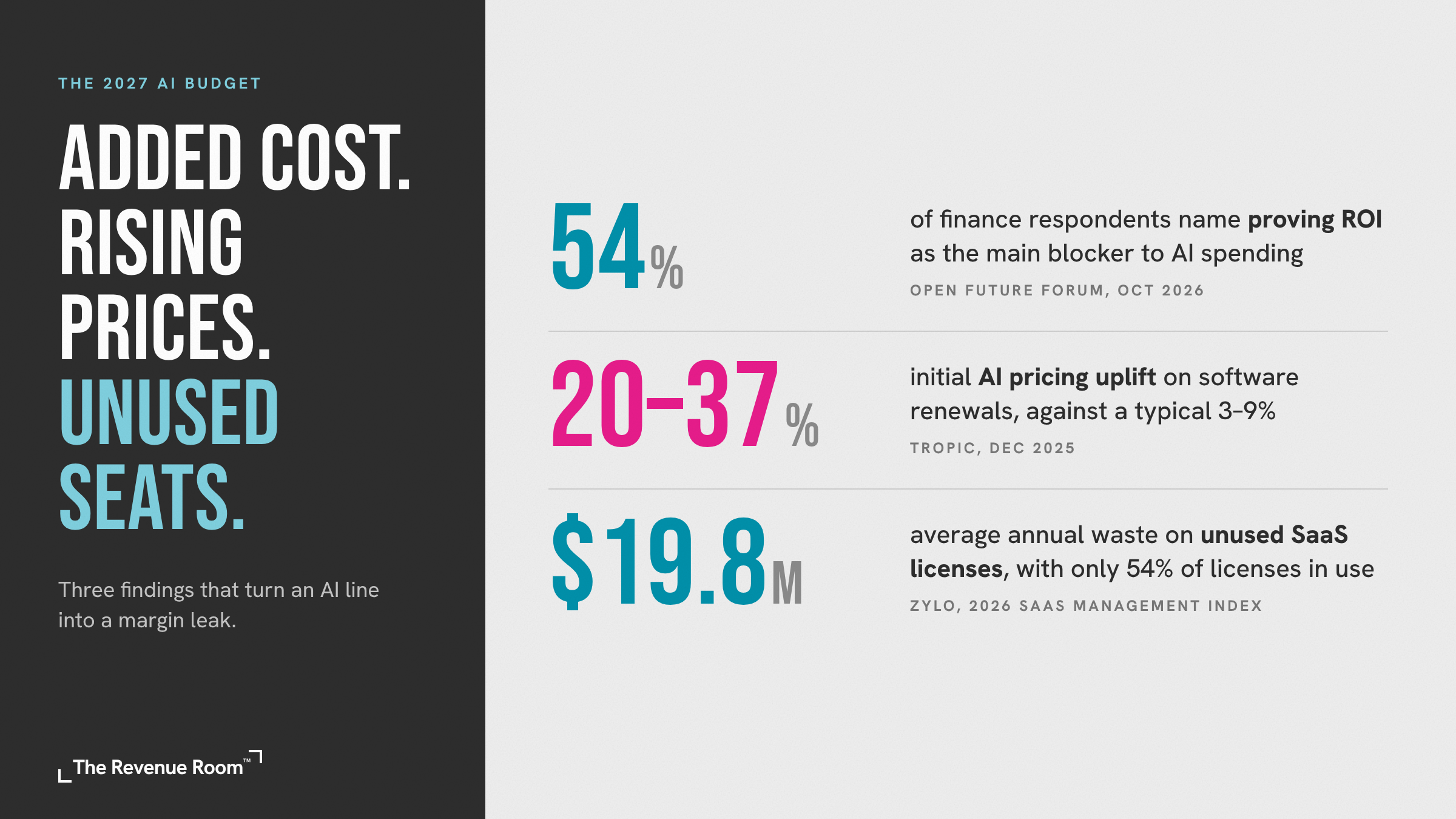
Put those three findings together and the 2027 risk is clear. A company can add AI spend, absorb AI price increases on its existing stack, and keep paying for the tools AI was meant to replace, all in the same fiscal year. That is not an AI strategy. It is a margin leak with a technology label.
The measurement standard is also moving. Futurum Group's 1H 2026 survey of 830 IT decision-makers found direct financial impact, meaning revenue growth and profitability, nearly doubled as the primary measure of AI ROI, while productivity fell from 23.8 to 18.0 percent as the leading metric. Boards and lenders are beginning to ask the same question: not how many hours AI saved, but where those hours showed up in revenue, margin, or cost.
Operating diagnosis: why AI budgets describe tools instead of outcomes
This is not a finance problem or a technology problem. It is a planning-design problem that runs across the leadership team.
The budget is built by function, and the value crosses functions. Marketing budgets its AI tools, sales budgets its call-intelligence platform, finance budgets its forecasting add-on. The workflow that actually produces revenue, from first signal to renewal, runs across all of them. No single budget owner is accountable for whether the end-to-end workflow got cheaper, faster, or more accurate.
Ownership of AI value is unassigned. Open Future Forum found that 49 percent of respondents name the CEO as the AI sign-off owner and 31 percent name finance, with 13 percent reporting no single owner. Sign-off is not the same as value realization. Someone approves the spend. Often no one is named to prove it worked.
The context work is not funded. Sharon Roessen , Chief Operating Officer at Terrapinn, described on The Revenue Room™ Podcast how her team cut £470,000 of SaaS renewal in a quarter using Claude. The savings followed months of loading company, functional, and event-level context before any skill was built. Plans that fund the license and not that groundwork tend to produce demonstrations rather than savings.
Pilots have no stop rule. Gartner predicted in June 2025 that more than 40 percent of agentic AI projects will be canceled by the end of 2027, citing escalating costs, unclear business value, and inadequate risk controls. A pilot with no stated economic hypothesis has no basis for either scaling or stopping, so it lingers and consumes management attention.
Five moves for an AI budget that can prove a return
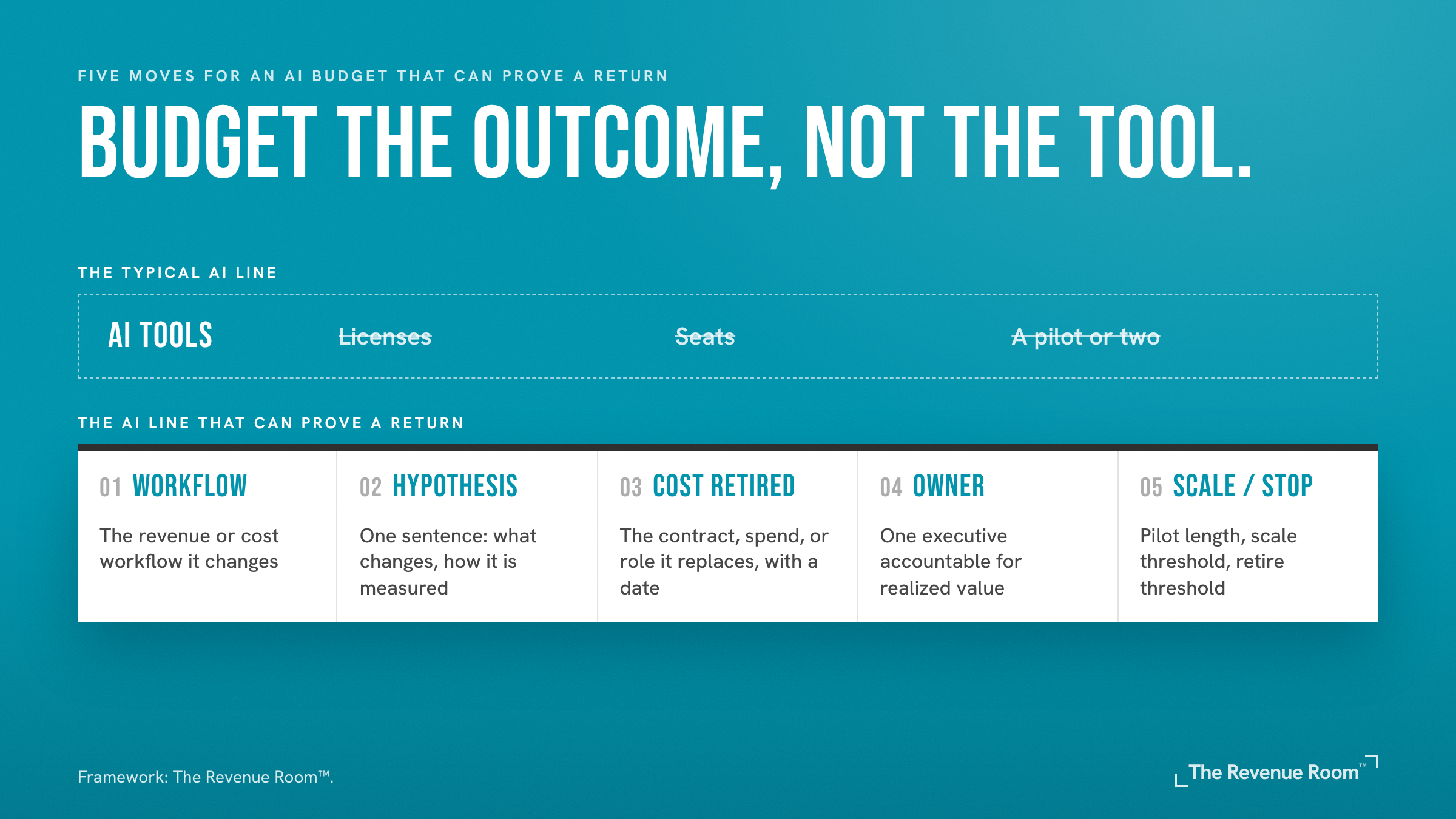
1. Budget the workflow, not the tool
Every AI line in the 2027 plan should name a revenue or cost workflow: renewal-risk identification, sponsorship proposal building, event business planning, deal review, lead routing. The tool is an input to the workflow. The Human-AI Revenue Operating System playbook developed with the Revenue Room™ CXO Growth Room frames this as a requirement that every workflow carry an owner, approved data, human-review rules, quality standards, adoption measures, and an explicit economic hypothesis.
2. Write the economic hypothesis before approving spend
For each workflow, state in one sentence what changes and how it will be measured: revenue protected, cycle time reduced, cost avoided, or capacity redeployed. If the team cannot write that sentence, the spend is not ready for the plan. This is also the cleanest defense against vendor price uplifts, because it gives procurement a value baseline to negotiate against.
3. Pair every AI line with the cost it should retire
Before approving net-new AI money, require each sponsor to name the SaaS contract, freelance spend, manual process, or open role the workflow is expected to replace or defer, with a target date. Roessen's team started from the renewal list itself, flagging tools whose core function AI could perform directly once the context was in place. That sequence converts AI from an added cost into a reallocation.
4. Name one executive accountable for commercial AI value
Sign-off authority and value accountability should not be the same line on an org chart by default. Name the executive who owns realized value across the commercial workflows, separate from the leader who approves enterprise architecture and controls. Reporting on adoption without reporting on value is how a company ends up with high usage and flat margin.
5. Set scale and stop criteria in the plan
Each workflow should enter the year with a pilot duration, a threshold for scaling, and a threshold for retirement. Measure outcomes, not logins. A quarterly review that can say "stop" is as valuable as one that can say "scale," because it returns capital and management capacity to the workflows that are working.
90-Day Management Focus
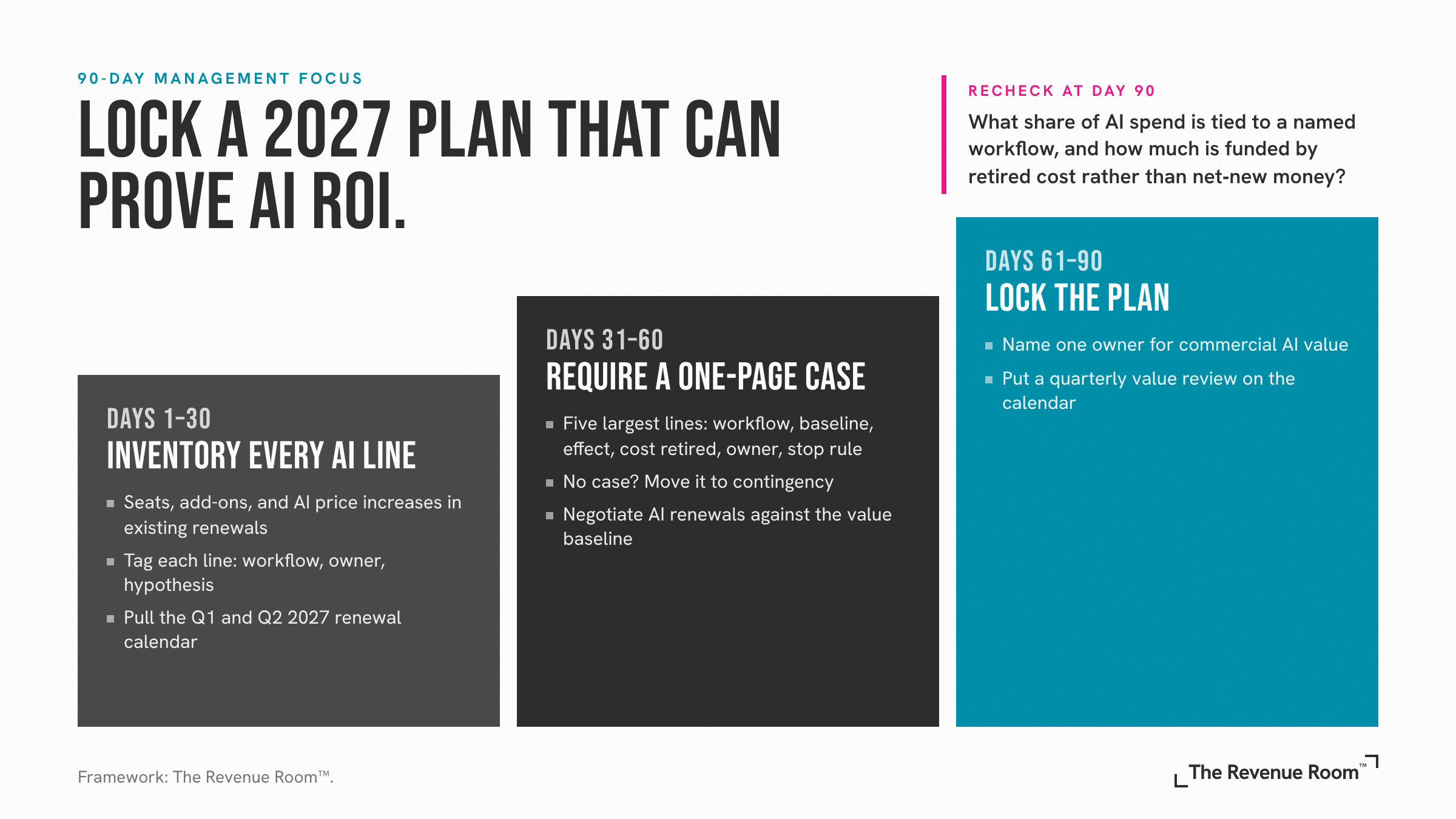
Days 1 to 30. Inventory every AI-related line in the draft 2027 plan, including seats, add-ons, and AI price increases embedded in existing renewals. Tag each line with the workflow it serves and whether an owner and economic hypothesis exist. Pull the SaaS renewal calendar for the first two quarters of 2027.
Days 31 to 60. For the five largest lines, require a one-page case: workflow, baseline, expected effect, cost to be retired, owner, and stop rule. Move any line without a case into a contingency pool rather than the committed plan. Negotiate upcoming AI-driven renewals against the stated value baseline.
Days 61 to 90. Lock the plan with a named owner for commercial AI value and a quarterly value review on the calendar. Recheck at day 90: what share of AI spend is tied to a named workflow, and how much of it is funded by retired cost rather than net-new money?
Questions for the leadership team
- Which AI lines in our 2027 plan describe a tool rather than a workflow and an outcome?
- For each major AI investment, what cost, contract, or process are we committing to retire, and by when?
- Who is accountable for proving AI value across our revenue workflows, not just approving AI spend?
- How much of our planned 2027 software increase is AI pricing uplift on tools we already own?
- Which current pilots would we stop today if we applied the scale and stop criteria we are about to require?
Continue the conversation
The AI Value Creation Scorecard within the Revenue Room™ Growth Readiness Profile is designed to show where an organization's AI activity is, and is not, connected to measurable business value, read against the priorities set in the CEO Value Creation Baseline. Revenue Room™ CXO is an invite-only executive peer network and year-round decision system for profitable growth, and 2027 AI allocation is one of the decisions CEOs and their revenue-critical teams are pressure-testing with peers right now. The same question will be on the agenda at RevvedUP 2027 .
Sign in or Join the community
The Nexus for Data-Driven Growth Leaders

Create an account
The Nexus for Data-Driven Growth Leaders
Like
Comments (0)
Popular

Dive in
Related
Blog
AI Is Not the Strategy. Your Revenue Strategy Is.
By Heather Holst-Knudse... • May 12th, 2026 • Views 52
Blog
The Revenue Room™ - Building Your Revenue Operating Plan
By Heather Holst-Knudse... • Dec 7th, 2023 • Views 46
Blog
The Revenue Room™ - Building Your Revenue Operating Plan
By Heather Holst-Knudse... • Dec 7th, 2023 • Views 46
Blog
AI Is Not the Strategy. Your Revenue Strategy Is.
By Heather Holst-Knudse... • May 12th, 2026 • Views 52