RevvedUP CEO Roundtable: The CEO Playbook for Leading When the Rules Keep Changing
At RevvedUP 2026, the CEO Roundtable did not drift into vague AI optimism. It went straight to the operating question every media and event CEO is now facing:
How do you lead when volatility is permanent, AI is moving faster than your org chart, and customers are demanding measurable value?
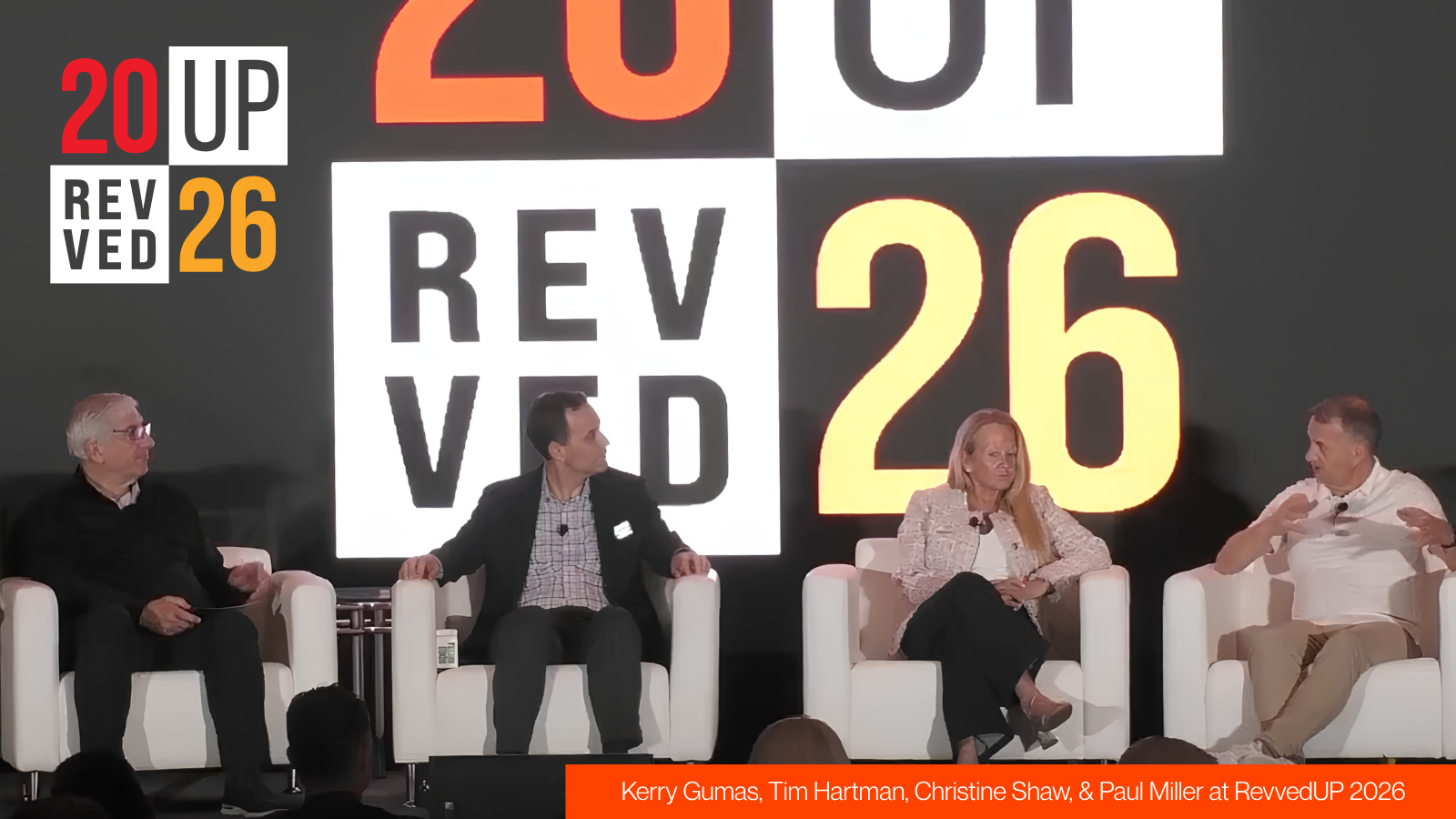
Moderated by Kerry Gumas, CEO of Metacomet, the panel featured Paul Miller, CEO of Questex; Christine Shaw, CEO of Naylor; and Tim Hartman, CEO of GovExec. All four are members of Revenue Room™ CXO, the fast-growing professional network and executive decision cadence for CEOs and revenue-critical CXOs leading media and event organizations. The discussion felt less like a conference panel and more like an executive operating session. The message was sharp: CEOs cannot delegate AI, culture, pricing discipline, or customer proximity. These are now core value creation responsibilities.
The CEO Reality: Turbulence Is No Longer an Exception
Paul Miller opened with a useful metaphor from a former EasyJet pilot: “Turbulence is where pilots learn.”
For CEOs, that line lands because turbulence is now the base case. Media and event organizations are managing ownership changes, AI disruption, customer budget scrutiny, federal market volatility, staffing pressure, and margin expectations all at once.
Paul’s takeaway was not to wait for calmer conditions. It was to use uncertainty as a learning environment.
He framed the moment alongside prior industry shocks: print-to-digital, the global financial crisis, COVID, and now AI. But this one, he said, is different: “It’s faster and it’s bigger.”
That is the CEO challenge. The speed of change has outrun traditional planning cycles.
AI Adoption Is a Culture Problem Before It Is a Technology Problem
Christine Shaw gave one of the clearest accounts of why AI adoption stalls.
At Naylor, she said early attempts to drive adoption were not working. The issue was not simply tool access. It was fear, training, and trust.
Employees were asking:
- Will my skills become irrelevant?
- Do I know how to use this well enough?
- Will the data reflect the quality of our work?
Christine rejected the old “digitize or die” posture. Instead, Naylor made AI employee-led, supported by policies, tools, training, and permission to experiment.
Her defining line: “This is now part of our DNA.”
That cultural reset mattered. Christine reported that 73% of Naylor employees are now actively using AI, with many using it weekly or daily.
For CEOs, the lesson is practical: adoption does not happen because the CEO buys licenses. It happens when the company makes AI safe, useful, measurable, and tied to real work.
The Next Org Chart Includes AI Agents
Tim Hartman pushed the discussion from adoption to management design.
GovExec had the opportunity to learn from Google Public Sector, one of its strategic partners. Tim described a future where individual contributors are not only doing work themselves but managing teams of AI agents.
His most provocative point: employees may eventually be assessed not just by their personal output, but by “the impact that their agents have made for the company as well.”
That should get every CEO’s attention.
If AI agents become part of the operating model, then management itself changes. Productivity expands. Decision cycles compress. Weak processes get exposed. Strong managers get more leverage. Poor managers run out of hiding places faster.
Tim used a baseball metaphor: if a player suddenly gets 20 at-bats instead of four or five, the high performers separate quickly from the low performers.
His warning was clear: “This is moving much faster than any of us anticipate.”
Efficiency Is Not Enough. CEOs Need Revenue Proof.
Paul Miller made a point every private equity sponsor, CFO, and board member will recognize: “time saved” is not a complete business case.
He said the obvious follow-up is: “What are you doing with the extra time?”
That question cuts through most AI theater. If a seller saves hours but pipeline does not improve, if marketing moves faster but conversion does not rise, or if content production scales but customer value does not increase, the gain is cosmetic.
At Questex, Paul said AI is being measured through hard commercial metrics:
- What revenue is being generated?
- What leads are being converted?
- Are inbound leads being qualified faster?
- Are sellers making more outbound calls?
- Can AI agents help create more revenue-producing activity?
When asked how much revenue Questex was generating from AI, Paul answered: “Hundreds of thousands of dollars.”
That is the standard. Not AI usage. AI yield.
Profitability Comes From Hard Choices, Not Just New Tools
Christine Shaw connected AI directly to profitability acceleration.
Naylor had a business unit tied to job boards, a category facing obvious market pressure. Revenue had been declining roughly 15% year over year. The company reduced sales headcount, removing roughly $600,000 in cost when salary, commission, and benefits were included.
But the move was not just cost-cutting. Christine described how Naylor used Clay AI stitched together with Mailchimp to scale marketing work, qualify leads, and put better opportunities into the hands of fewer sellers.
The outcome: the business reached its first flat year-over-year month after a period of decline.
Christine’s framing was candid: "We ripped the Band-Aid off."
That is the real CEO work. Not choosing growth or margin. Redesigning the operating model so the company can pursue both.
Data Products Are Becoming the Next Growth Layer
Tim Hartman explained how GovExec is monetizing proprietary data through AI-enabled products.
GovExec has built intelligence capabilities around government contracting and trained models on unique data. Customers can ask questions and receive high-value insight through SaaS-style interfaces. Tim also described emerging usage-based models through MCP technologies, where users can access GovExec’s engine and be charged based on usage.
This is a major signal for media and event CEOs.
The next wave of growth may not come from selling more impressions, booths, or badges. It may come from turning proprietary audience, event, content, community, and market data into intelligence products customers will pay to use repeatedly.
The Closing Mandate: Stay Close to the Customer
Paul Miller’s final advice was simple and difficult: "Spend time with your customers."
Christine echoed the point, saying CEOs need to listen to the right ICP and walk away from what no longer serves the company.
That may be the most important takeaway from the panel. AI does not replace customer proximity. It raises the premium on it.
The CEOs who win will not be the ones with the most experiments. They will be the ones with the clearest decision cadence: customer signal, data discipline, operating action, financial measurement.
That is the Revenue Room™ CEO mindset.
For CEOs leading media and event companies, the question is no longer whether AI matters. The question is whether your company can convert it into revenue growth, profitability acceleration, and enterprise value before your competitors do.
To go deeper, watch the full RevvedUP session video here. To join the next conversation, request an invitation to RevvedUP 2027, March 14–16 at The Vinoy in St. Petersburg. Or better yet, join the conversation with Kerry Gumas, Paull Miller, Tim Hartman and Christine Shaw all year long and become a Revenue Room™ CXO member, the fastest growing professional network for CEOs and their revenue-critical C-Suite teams in media, events, and data/information sectors.