Finance
January 15, 2026
From Cost Center to Growth Engine: Measuring AI's Impact on Enterprise Valuation
# Artificial Intelligence
# Finance
# Digital Strategy
# DATA
# Business growth
Why CEOs must move beyond traditional ROI to measure how AI architecture creates lasting enterprise value and competitive advantage.

Heather Holst-Knudsen
Why Traditional ROI Metrics Miss AI's True Value
Your CFO walks into the board meeting with the quarterly AI report: "We've automated 15% of our customer service tickets and reduced processing time by 3 minutes per call." The board nods politely, approves continued funding, and moves to the next agenda item. What they don't realize is that they just missed the most important conversation of the quarter.
The uncomfortable truth is that traditional ROI metrics were designed for industrial automation, not intelligent transformation. When executives measure AI impact through cost savings alone, they fundamentally misunderstand what they're building. According to BCG and MIT research , organizations using AI-powered KPIs are five times more likely to effectively align incentive structures with objectives compared to those relying on legacy metrics.
The companies that will dominate the next decade aren't those squeezing pennies from AI, they're the ones unlocking exponential value creation that traditional finance frameworks can't even measure.
What Enterprise Valuation Means in the AI Era
Enterprise valuation in 2025 isn't about assets - it's about intelligence architecture. The market increasingly values companies based on their ability to generate, process, and monetize data-driven insights at scale. Yet most boards still evaluate AI investments using the same frameworks they'd apply to new manufacturing equipment.
Research from Andreessen Horowitz reveals that 100 enterprise CIOs across 15 industries are fundamentally restructuring how they budget for AI, shifting from project-based ROI to architectural value creation. The difference? Cost-center thinking treats AI as expense optimization. Growth-engine thinking treats AI as competitive moat expansion.
When Salesforce reports that AI-driven CRM analytics result in 20% increases in sales forecasting accuracy, they're not celebrating operational efficiency. They're demonstrating predictive intelligence capabilities that compound competitive advantage over time.
The Enterprise Value Framework: Beyond Traditional Metrics
Successful CEOs measure AI impact through three interconnected value drivers that directly correlate with enterprise valuation multiples:
Offensive Value: Revenue and Margin Enhancement
Revenue Attribution Through AI Capabilities
- Customer lifetime value optimization driven by predictive personalization
- Market expansion enabled by AI-powered product development
- Pricing optimization through real-time competitive and demand intelligence
Measurable Impact Indicators:
- Percentage of revenue influenced by AI-driven initiatives
- Customer acquisition cost improvements from predictive lead scoring
- Average order value increases from AI-powered recommendations
Companies using AI for revenue analytics report an average revenue increase of 10-15% , with 83% of AI-enabled sales teams experiencing revenue growth compared to 66% without AI capabilities.
Defensive Value: Risk Mitigation and Operational Intelligence
Enterprise Risk Reduction Through Predictive Capabilities
- Supply chain disruption prediction and response automation
- Customer churn prevention through behavioral pattern recognition
- Regulatory compliance monitoring and predictive remediation
Strategic Protection Indicators:
- Reduction in operational surprise incidents
- Improvement in forecast accuracy for board-level planning
- Decrease in compliance-related risks and associated costs
Research shows companies integrating AI into forecasting see 40% improvements in forecast accuracy, enabling better strategic decisions and reducing enterprise risk exposure.
Strategic Value: Market Position and Competitive Differentiation
Competitive Moat Creation Through AI Architecture
- Proprietary data advantage that strengthens over time
- AI-enabled customer experience differentiation
- Market intelligence capabilities that inform strategic positioning
Long-term Value Creation Measures:
- Speed of new product/service introduction enabled by AI insights
- Customer retention improvements from AI-powered personalization
- Market share protection through AI-driven competitive intelligence
The Board-Level AI Valuation Dashboard
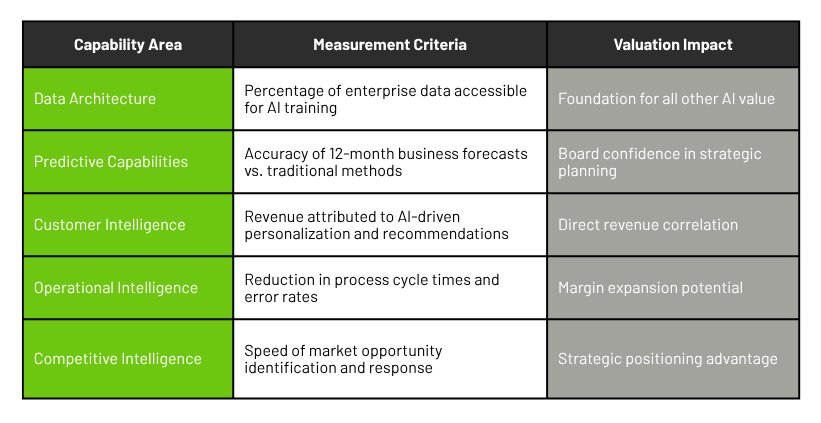
Traditional boards track lagging indicators. AI-mature boards track leading indicators of enterprise value creation. Here's the executive dashboard framework that correlates AI investments with valuation multiples:
Intelligence Maturity Index
Value Creation Attribution Model
Hard Value Metrics (Immediate P&L Impact):
- Revenue growth attributable to AI-enabled capabilities
- Cost reduction through intelligent process automation
- Margin expansion from AI-optimized pricing and resource allocation
Strategic Value Metrics (Long-term Competitive Position):
- Customer lifetime value improvements from AI-powered experiences
- Time-to-market acceleration for new products/services
- Market share protection through AI-enabled differentiation
Enterprise Risk Mitigation Metrics:
- Reduction in operational disruptions through predictive intelligence
- Improvement in regulatory compliance through automated monitoring
- Enhancement in strategic decision quality through data-driven insights
How Leading CEOs Communicate AI Value to Boards
The most effective AI presentations to boards don't start with technology—they start with enterprise value creation. Here's the framework that works:
The Three-Horizon AI Value Story
Horizon 1 (0-12 months): Operational Excellence
Present measurable improvements in current business operations with specific ROI calculations and competitive benchmarking.
Horizon 2 (1-3 years): Competitive Advantage
Demonstrate how AI capabilities create sustainable differentiation and market position strengthening.
Horizon 3 (3+ years): Market Leadership
Show how AI architecture enables business model innovation and market expansion opportunities.
Board Communication Best Practices
Lead with Enterprise Impact, Not Technical Capability
Instead of "Our AI model achieves 94% accuracy," say "Our predictive intelligence reduces customer churn by 15%, contributing $2.3M annually to enterprise value."
Connect AI Metrics to Board-Tracked KPIs
Link AI performance directly to existing board metrics: revenue growth, margin expansion, market share, customer satisfaction, and operational efficiency.
Show Competitive Positioning Context
Benchmark AI capabilities against industry leaders, not just direct competitors, to demonstrate strategic positioning.
Frequently Asked Questions: AI Valuation Measurement
Q: How do we separate AI impact from other business improvements?
A: Use control groups and baseline measurements to isolate AI contributions. Track performance before/after AI implementation while controlling for other variables.
Q: What if our AI benefits are mostly "soft savings" rather than hard ROI?
A: Quantify soft savings through productivity measurements and opportunity cost analysis. Time saved can be converted to strategic capacity for growth initiatives.
Q: How often should we report AI value creation to the board?
A: Quarterly strategic reviews with detailed annual assessments. AI transformation moves too quickly for annual-only evaluation.
Q: Should we include AI investment costs in enterprise valuation discussions?
A: Yes, but frame total cost of ownership against long-term competitive advantage creation, not just immediate ROI payback periods.
Q: How do we benchmark our AI value creation against competitors?
A: Focus on industry-standard metrics like customer acquisition cost, lifetime value, forecast accuracy, and operational efficiency improvements that can be compared across companies.
The Valuation Multiple Effect

Companies demonstrating measurable AI-driven value creation command higher valuation multiples. Research from Fortune reveals that firms using "smart KPIs" powered by AI are three times more likely to see greater financial benefit than those relying on traditional metrics.
This isn't theoretical. Private equity firms increasingly evaluate AI integration depth during due diligence processes, recognizing that AI architecture capabilities directly correlate with sustainable competitive advantage and long-term value creation potential.
The market rewards companies that can demonstrate:
- Predictable revenue growth through AI-enabled customer intelligence
- Margin expansion through intelligent operational optimization
- Risk mitigation through predictive enterprise management
- Competitive differentiation through proprietary AI capabilities
Why This Measurement Framework Matters for RevvedUP 2026
The CEOs and CFOs joining RevvedUP 2026 (March 23-24, The Vinoy Resort, St. Petersburg, FL) understand that AI valuation isn't an accounting exercise - it's a strategic imperative. In markets where B2B and B2C models are converging, the companies that can demonstrate measurable AI-driven value creation will attract capital, talent, and customers.
RevvedUP 2026 brings together leaders who've moved beyond pilot programs to architectural transformation sharing specific methodologies for measuring and communicating AI's impact on enterprise valuation. Because leaders that understand AI value creation will govern the companies that redefine their industries.
👉 Join RevvedUP 2026
For many of those leaders, the work continues well beyond the event itself. Revenue Room™ CXO serves as the ongoing peer environment where these valuation frameworks are tested against real operating decisions, board expectations, and market pressure. It is where CEOs and senior executives refine how AI strategy shows up in governance, capital conversations, and enterprise value creation over time.
Sign in or Join the community
The Nexus for Data-Driven Growth Leaders

Create an account
The Nexus for Data-Driven Growth Leaders
Like
Comments (0)
Popular

Dive in
Related
47:33
Video
From Fragmented Events to Category Powerhouses: Inside Hyve’s Growth Engine
By Heather Holst-Knudse... • Feb 5th, 2026 • Views 70
Blog
Revenue Room™ CXO Names Finalists and Honorable Mentions for the 2026 Revenue Room™ Vanguard Awards
By Heather Holst-Knudse... • Sep 16th, 2026 • Views 53
Blog
From Fragmented Events to Category Powerhouses: Inside Hyve’s Growth Engine
By Heather Holst-Knudse... • Feb 10th, 2026 • Views 45
Blog
From Audience to Ecosystem: Why Community is the New Growth Engine
By Heather Holst-Knudse... • Aug 29th, 2025 • Views 66
47:33
Video
From Fragmented Events to Category Powerhouses: Inside Hyve’s Growth Engine
By Heather Holst-Knudse... • Feb 5th, 2026 • Views 70
Blog
From Fragmented Events to Category Powerhouses: Inside Hyve’s Growth Engine
By Heather Holst-Knudse... • Feb 10th, 2026 • Views 45
Blog
From Audience to Ecosystem: Why Community is the New Growth Engine
By Heather Holst-Knudse... • Aug 29th, 2025 • Views 66
Blog
Revenue Room™ CXO Names Finalists and Honorable Mentions for the 2026 Revenue Room™ Vanguard Awards
By Heather Holst-Knudse... • Sep 16th, 2026 • Views 53