Artificial Intelligence
November 3, 2026
AI Pays Back Only When the Operating Model Changes With It
# AI operating model
# Productized insights
# Value-based pricing for data businesses
# AI transformation ROI
MarketCast's Aditi Sinha on turning data, engineering, and AI into productized client value, pricing power, and margin.

Heather Holst-Knudsen
AI Pays Back Only When the Operating Model Changes With It
Most executive teams still treat AI as a product decision: which model, which vendor, which feature to ship. The companies getting paid for it treat AI as an operating model decision. A faster insight is worth very little if the workflow, the data, and the people behind it still run at the speed of a custom project.
That was the core of my recent conversation on The Revenue Room™ Podcast with Aditi Sinha , Executive Vice President and Global Head of Technology & Operations at MarketCast . Aditi has led operations and transformation at NielsenIQ, Nielsen, Kantar, and DHL Express, and is a co-inventor on a U.S. patent for using AI to decode purchase receipt images. Her position is clear: an AI operating model creates economic value only when leadership starts with the client problem, rebuilds data, workflow, and roles around it, and measures the result in revenue, cost, and speed.
Business Consequence: Transformation Belongs on the Revenue Side of the Ledger
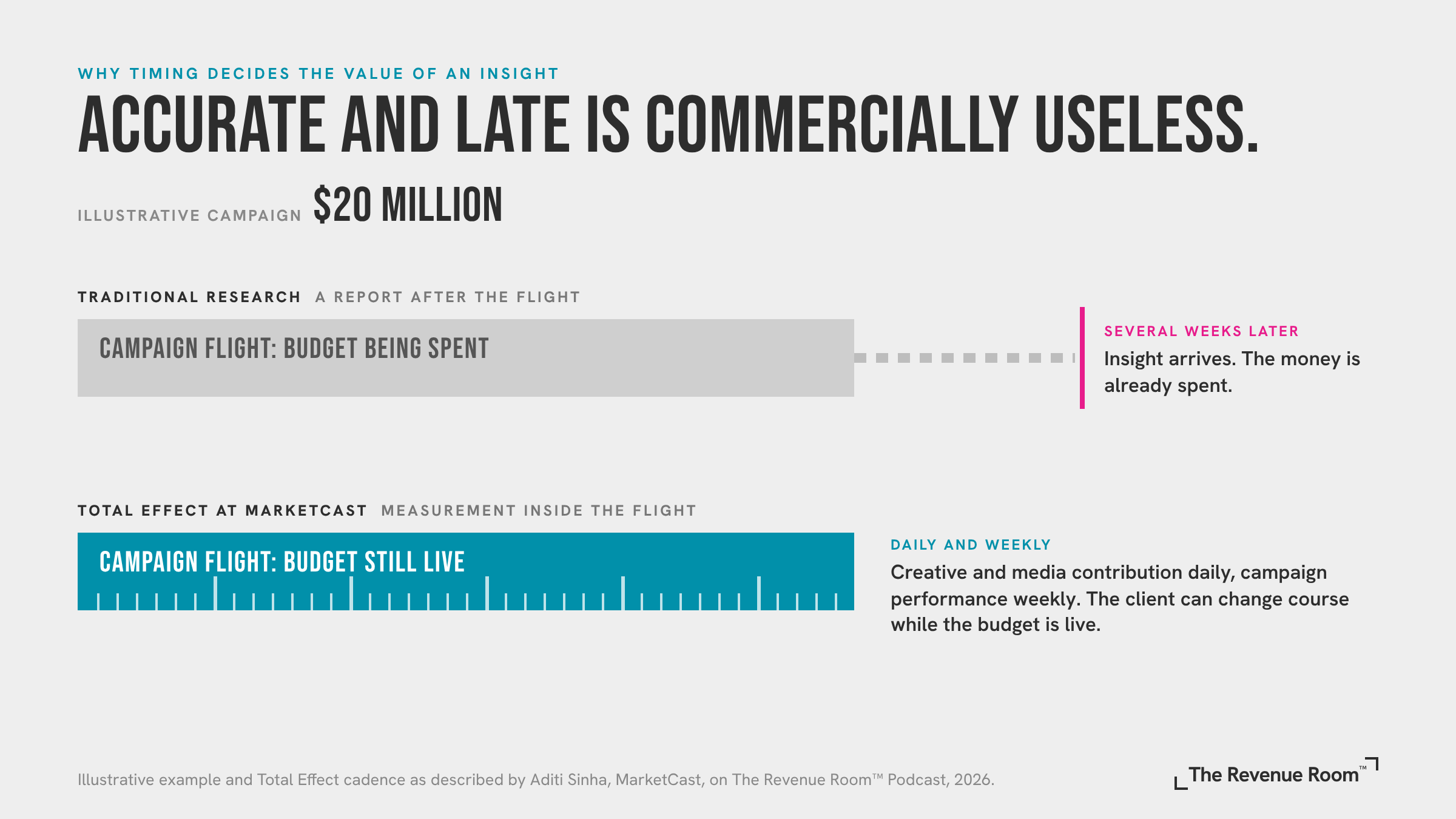
Consider a brand spending $20 million on a campaign. In the traditional research model, it might learn several weeks after the flight ends that the campaign underperformed. The insight is accurate and commercially useless, because the money is already spent.
MarketCast built Total Effect to close that gap. As discussed in the episode, it tracks creative and media contribution daily and campaign performance weekly, connecting creative, media, and business outcomes in one measurement system. The client is no longer buying a report. It is buying the ability to change course while the budget is still live.
That shift changes the economics. Aditi described MarketCast's pricing as anchored in "what business problem we are helping the client to solve and what is it worth to them." Cost to serve sets the floor, complexity is layered on top, and the value of the decision protected sets the price. Asked whether the productized model has become a differentiator affecting sales and retention, she answered without hesitation: "Totally, absolutely."
The parallel for The Revenue Room™ audience is direct. An events business selling square footage, a media company selling impressions, and a data business selling reports are all pricing the deliverable rather than the decision. Each sits on data that could support a higher-value, decision-grade product, and most of it sits in disconnected platforms carrying years of technical debt.
Operating Diagnosis: Where the AI Operating Model Breaks Down
The breakdown is rarely the model. It is the system around it. Four patterns came through in the conversation.
Capability and delivery report to different leaders. MarketCast placed engineering and operations under one executive. Aditi's rationale: "technology creates the capability and the capacity, and operations then make sure it delivers the value." The client does not experience your org chart. It experiences speed, quality, and how easily it can reach its own data. When the team that builds and the team that delivers answer to different goals, the client feels the seam.
Data is fragmented across products and funnel stages. Total Effect required what Aditi called "heavy lifting in the back end": connecting datasets across funnel stages, combining legacy and new products into a common data architecture, cleaning the data, layering in norms from data science and product, and building a client interface to deliver it. She described it as "a massive end-to-end transformation." No AI feature substitutes for that work.
The commercial model lags the product. Productized delivery forced changes in sales training, a reorientation toward customer success, and a deliberate search for friction points in every client interaction. As I noted in the episode, static deliverables also hide the signals that matter: whether the client is engaging, applying the insight, or coming back. A platform makes adoption visible, and adoption is a leading indicator of renewal.
Customization is treated as a client right rather than an operating choice. Aditi's logistics background makes the contrast sharp. A DHL customer wants a shipment delivered on time and intact. An insights client wants more insight, which is intangible and, in her words, "it's the IP. You can't really automate that IP." Many B2B media and data businesses respond by customizing everything, which erodes margin without anyone deciding it should.
Management Framework: Five Operating Moves
1. Start with the problem, not the technology
Aditi's patent work at NielsenIQ is the clearest illustration. Consumer panelists were spending close to 20 minutes per shopping trip scanning every item with a barcode scanner, and panel coverage was declining. The fix was to ask panelists for a photo of the receipt, cutting the task to under three minutes. The hard part moved to the back end: using deep learning, NLP, and machine learning to resolve a vague receipt line into an exact product, in near real time. By her account, the model removed the need to place scanners in homes, accelerated market expansion, and contributed to revenue growing roughly threefold. Her lesson: "AI can create economic value if you first understand what problem you're trying to solve. If you're force-fitting AI into your processes, it may not give you the kind of value you really want it to give."
2. Put capability and delivery under one outcome
Convergence is not a reorganization for its own sake. It is a way to make one leader accountable for the client outcome. Aditi's DHL lesson applies here: technology has to be embedded in the process. If it sits outside the workflow as "another thing that you need to deal with, it just gets in your way."
3. Productize the repeatable work and protect the expert layer
Standardize and automate the mundane, repeatable tasks: process steps, quality control, and pattern detection a human would miss. Protect the contextual judgment that produces the insight. "The actual secret sauce is the human added value," Aditi said. MarketCast also draws hard governance lines. It does not use AI to generate client data, it treats AI-extrapolated samples and digital twins as still too early for insight generation, and the AI assistant inside its client platform is ring-fenced to read only that client's data, with no open-ended LLM queries.
4. Price the decision, not the deliverable
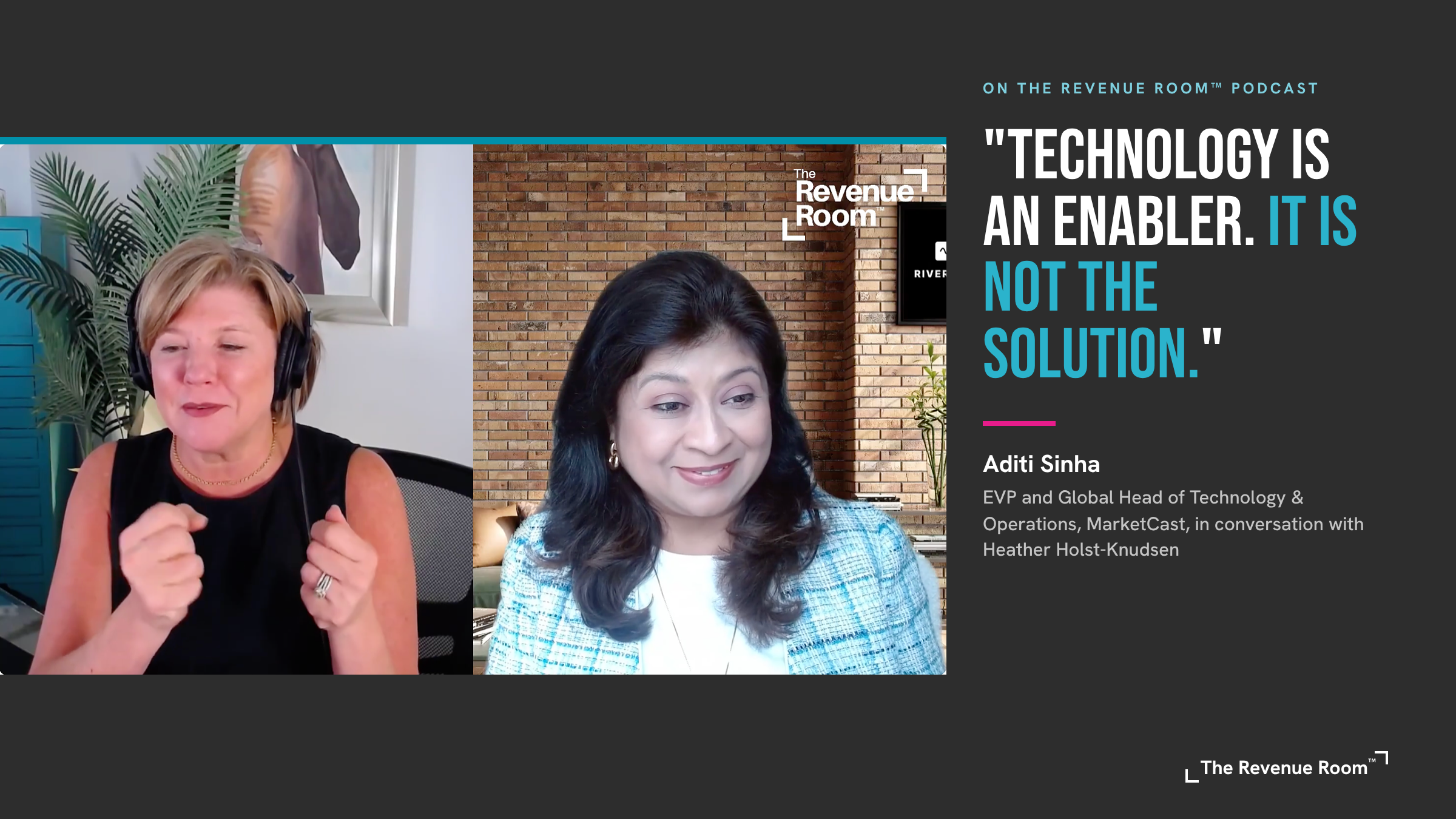
Value-based pricing is not subjective pricing. It requires a clear understanding of cost to serve, a clear view of delivery complexity, and a credible statement of the client value protected or created. As Aditi put it: "Technology is an enabler. It is not the solution."
5. Measure transformation in numbers the CFO already tracks
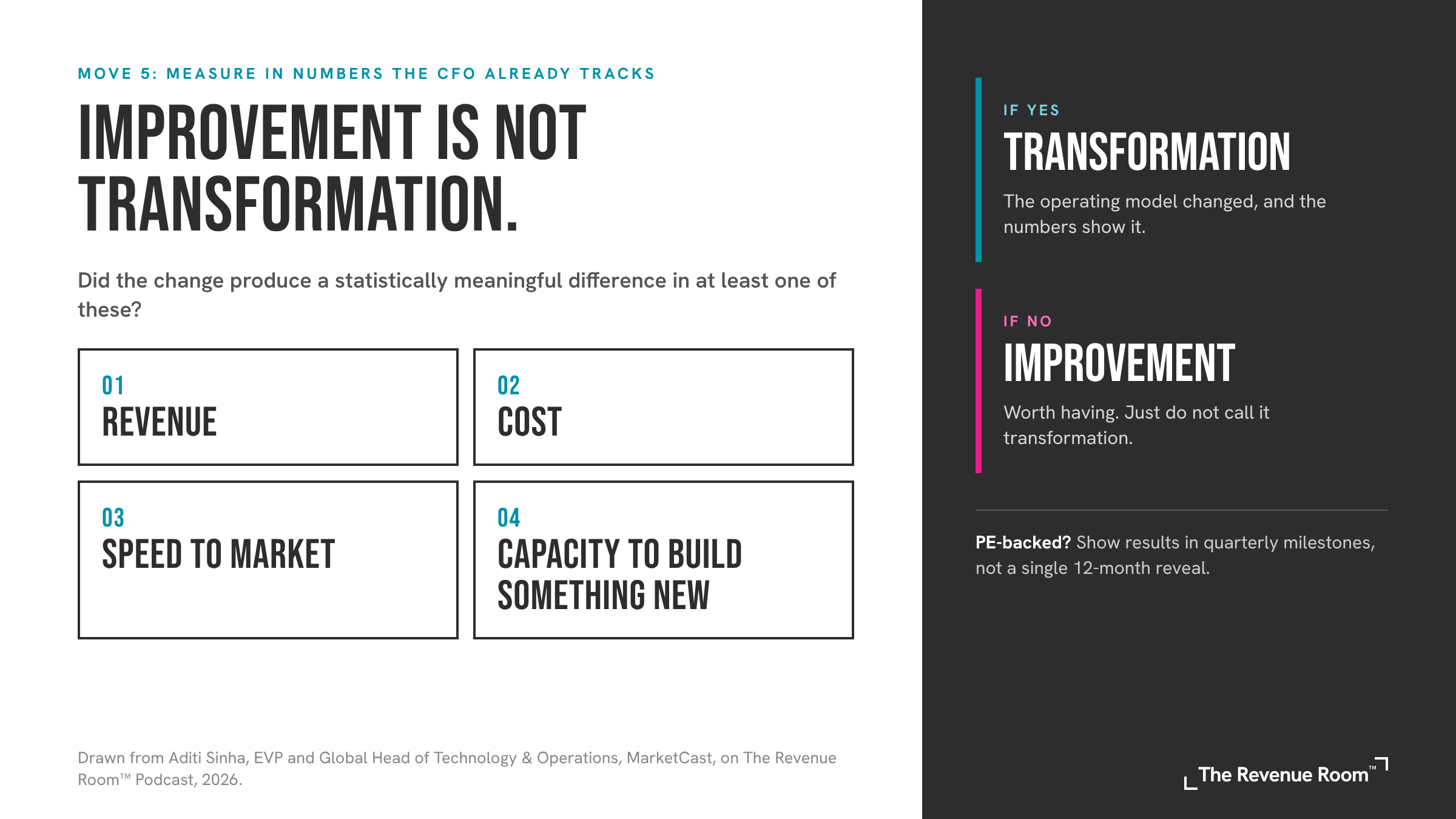
Aditi quoted a statistics professor: "In God we trust, and everyone else bring data." Her test is whether the change produced a statistically meaningful difference in revenue, cost, speed to market, or capacity to build something new. If not, it is improvement, which is worth having, but it is not transformation. At NielsenIQ, the transformation she led was credited with a 35% year-on-year gain in operational efficiency and a 15% year-on-year improvement in quality. For private equity-backed companies in particular, those results need to arrive in quarterly milestones, not a single 12-month reveal.
90-Day Application
Days 1 to 30: Anchor on one client decision. Pick a single consequential decision your data supports, such as an advertiser's mid-campaign reallocation, a sponsor's renewal, or a subscriber's purchase decision. Map every dataset, team, and handoff that feeds it. Name one executive accountable for the outcome across engineering, operations, and commercial.
Days 31 to 60: Separate the repeatable from the IP. Inventory the tasks in that workflow that are repeatable enough to standardize or automate, and the steps where expert judgment creates the value. Write explicit AI governance rules for the client-facing chain. Set a baseline for two or three hard metrics: time to insight, cost to serve, and renewal rate or revenue per client.
Days 61 to 90: Pilot, instrument, and price. Run a productized version with a small set of clients, track how they use it, and train sales and customer success on the problem being solved rather than the features being shipped. Test a value-based price against your cost-to-serve floor. Keep the executive sponsor close. Aditi was direct on this point: transformations stall when the sponsor is detached, and the leader's job is to remove barriers so the experts can do everything else.
Expect resistance from your experts, and address it on their terms. Aditi's approach is to show teams how technology removes repetitive administrative work and gives them back the thinking space to practice their craft at a higher level.
Executive Questions
- Which client decision does our data improve, and does the insight arrive before or after that decision is made?
- When engineering builds a capability and operations delivers it, does one leader own the client outcome, or does a handoff own it?
- Which parts of our delivery are repeatable enough to standardize, and which are the IP we must protect?
- Are we pricing reports, square footage, or seats, or the risk we reduce and the value we protect for the client?
- Which three numbers will tell our CFO within two quarters whether this transformation is working?
Continue the Conversation
Listen to the full episode with Aditi Sinha on The Revenue Room™ Podcast. If your leadership team is working through how to turn data and AI investments into pricing power and margin, that is the kind of consequential decision Revenue Room™ CXO members work through with peers year-round.
RevvedUP 2027
This conversation continues on stage at RevvedUP 2027 , The Revenue Room™’s flagship annual conference, March 14–16, 2027, at The Vinoy in St. Petersburg, Florida. Now in its third year, RevvedUP brings together a curated group of CEOs and C-suite revenue leaders around this year’s theme, “Compounding Advantage: AI, Data, and the New Race for Enterprise Value.” The questions raised in this post are the ones operators will pressure-test with peers in the room. Register now for RevvedUP 2027
Sign in or Join the community
The Nexus for Data-Driven Growth Leaders

Create an account
The Nexus for Data-Driven Growth Leaders
Like
Comments (0)
Popular

Dive in
Related
Blog
When AI Agents Become an Audience, the Media Business Model Changes
By Heather Holst-Knudse... • Oct 12th, 2026 • Views 45
47:36
Video
Owning the Room: Samantha Skey on AI, Imposter Syndrome, and Leading with Intention
By Samantha Skey • Jul 18th, 2025 • Views 52
Blog
How the Channel Company is Transforming B2B Media with Data and AI
By Heather Holst-Knudse... • Feb 12th, 2025 • Views 53
Blog
Owning the Room: Samantha Skey on AI, Imposter Syndrome, and Leading with Intention
By Heather Holst-Knudse... • Jul 17th, 2025 • Views 77
Blog
When AI Agents Become an Audience, the Media Business Model Changes
By Heather Holst-Knudse... • Oct 12th, 2026 • Views 45
Blog
How the Channel Company is Transforming B2B Media with Data and AI
By Heather Holst-Knudse... • Feb 12th, 2025 • Views 53
Blog
Owning the Room: Samantha Skey on AI, Imposter Syndrome, and Leading with Intention
By Heather Holst-Knudse... • Jul 17th, 2025 • Views 77
47:36
Video
Owning the Room: Samantha Skey on AI, Imposter Syndrome, and Leading with Intention
By Samantha Skey • Jul 18th, 2025 • Views 52