Why AI Investment Stalls on Data Debt, and What Leadership Has to Decide First
Most media, events and information companies now have an AI program. Far fewer can name the revenue it has produced. The gap is rarely the model. It is the data underneath it, and how leadership has assigned responsibility for that data.
Justin Evans , founder and CEO of The DataStory Group and author of The Little Book of Data , saw the pattern at a major travel company spending tens of millions of dollars a quarter on digital advertising. When he asked how it was putting its customer data to work, the executive's answer was: "I think the data is down the hall with the loyalty group." That is data debt. AI investment stalls when it is layered on data debt: the gap between what a company's data could do and where that data actually sits today, spread across siloed systems, short on the right skills, and missing a clear business question. Closing that gap is a leadership decision before it is a technical one.
The business consequence: AI spend without P&L impact
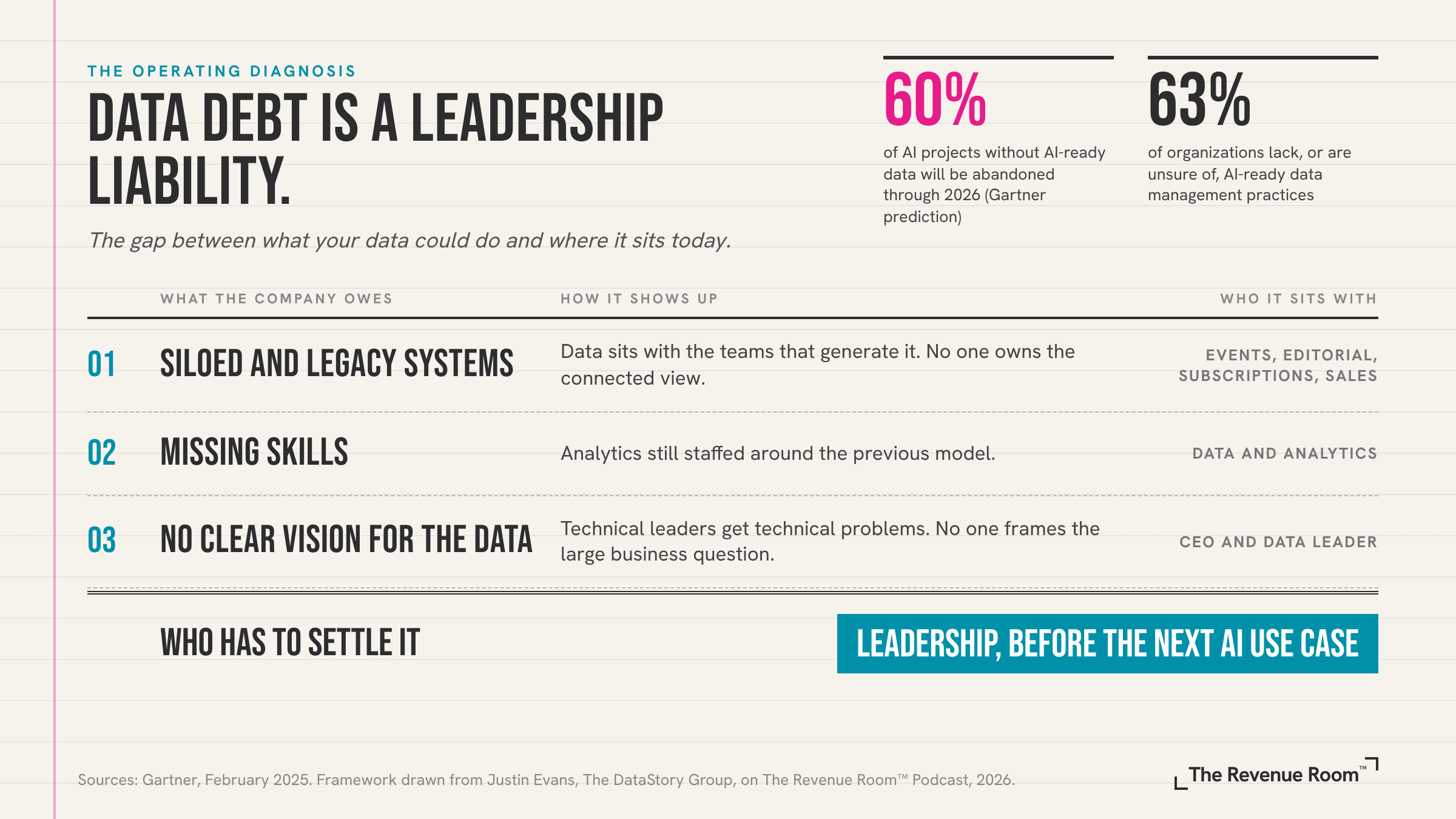
Gartner predicted in February 2025 that through 2026, organizations will abandon 60% of AI projects that are not supported by AI-ready data. In the same research, 63% of organizations said they either did not have, or were unsure whether they had, the right data management practices for AI. Evans frames the cost in terms of timing. Companies were already carrying years of legacy systems and fragmented ownership when AI arrived, and now "they're two courses behind in the class." Every AI initiative launched on top of that debt either inherits the fragmentation or spends its budget working around it.
For Revenue Room™ business models, the exposure is specific. A single customer relationship may span an event sponsorship, a digital program, a research subscription and a membership, each recorded in a different system with a different owner. Acquisitive companies compound the problem: every deal adds another registration platform, CRM instance and audience database that has not been integrated.
The economic effects follow:
- Capital without return. AI budgets fund pilots that cannot reach production because the inputs are incomplete or inconsistent.
- Marginal ambition. Evans observes that leaders who are not confident with data hand their data teams narrow technical assignments: "Fix my pricing. Make my margin another 0.75 points higher." In his words, "those are not really big business problems, those are marginal business problems."
The operating diagnosis: why data debt persists
Evans breaks data debt into three components, and none of them belongs to a single function.
Siloed and legacy systems. Customer, audience and transaction data sits with the teams that generate it: events, editorial, subscriptions, sales. No one owns the connected view.
Missing skills. Some organizations still staff analytics around the previous model. In television, Evans describes a generation of research specialists who knew legacy panel measurement deeply but had to be complemented by big data and predictive analytics talent when the industry changed how it measured audiences.
No clear vision for the data. This is the hardest of the three, and it sits at the boundary between business and data leadership. Evans describes a loop that reinforces itself. A CEO who came up through sales or finance expects data conversations to be complex and full of jargon, so they hire a highly technical data leader and give that leader only technical problems. The data team, left alone, tends to overcomplicate the work. Neither side frames the large business question.
The same pattern is now showing up with AI. Unchecked experimentation produces duplicate agents, tools used twice and abandoned, and automations no one owns. Data debt becomes AI debt.
This is not only a data team issue. The outcome depends on the CEO, the data and analytics leader, product and content owners, sales, RevOps, AI Ops and finance agreeing on which questions matter and who owns the answer.
A management framework for retiring data debt
1. Price the debt before funding the next AI use case. Map where customer and audience data sits for each revenue line (events, sponsorship, advertising, subscriptions, membership, research), who owns it, and whether it connects to the others. Evans defines data debt as the distance between where the company is today and what its data could do. Make that distance explicit before approving new AI spend that depends on it.
2. Write every data and AI initiative as a business question. Evans is direct on this point: "Has to be a business question with a business outcome that we can articulate in business terms, in English effectively. Not in data, but in business." At Nielsen, he recalls, his boss at Claritas, Matt O'Grady, summed up the discipline: "simple is so hard." An initiative that cannot be stated in one plain sentence tied to revenue, retention or margin is not ready for funding.
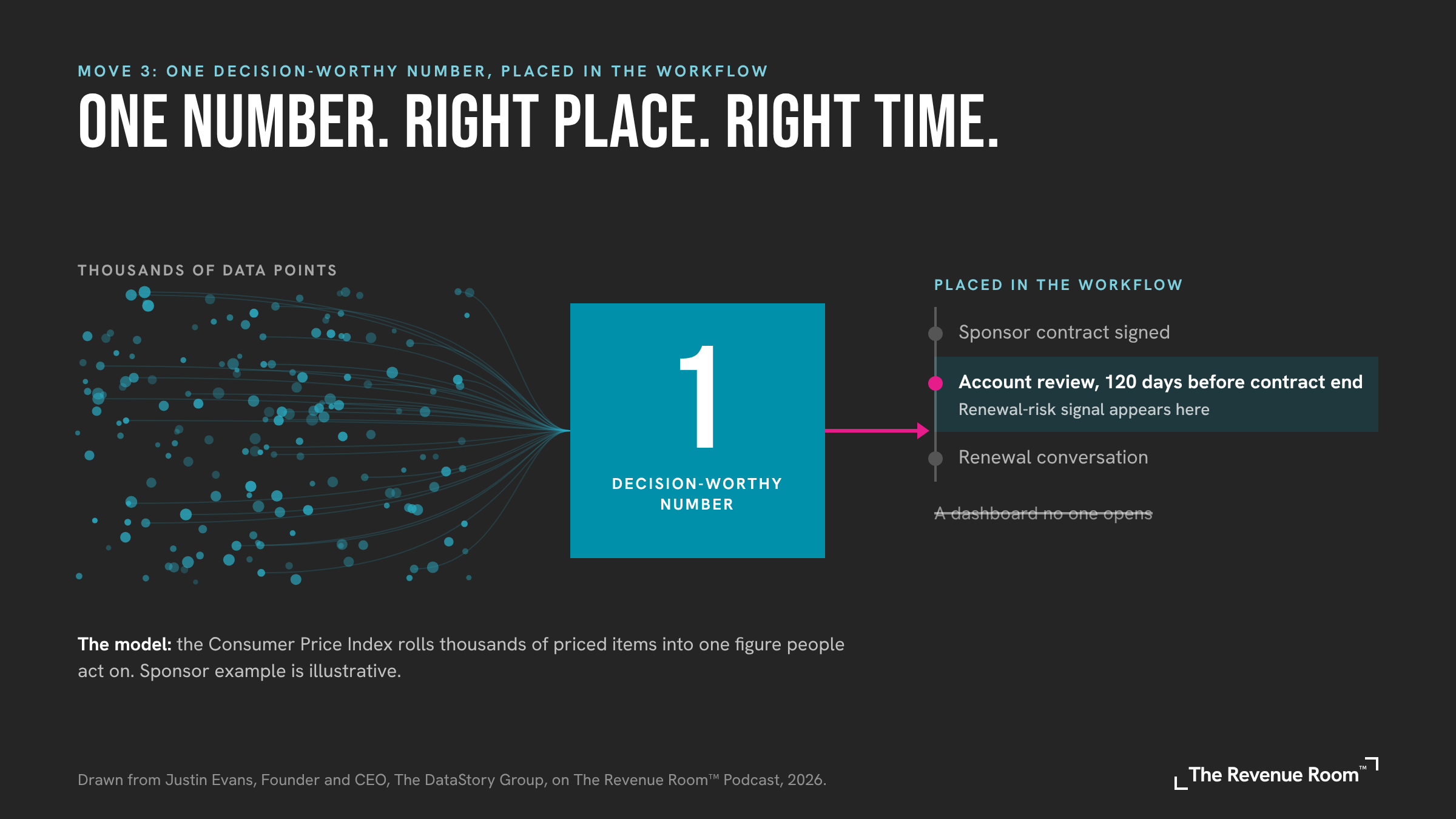
3. Reduce the output to one decision-worthy number, placed in the workflow. In The Little Book of Data, Evans uses the Consumer Price Index as the model: thousands of priced items rolled up into a single inflation figure that people can act on. The same standard applies to AI. "It needs to land as a simple decision-worthy number that you can plant in the workflow in exactly the right spot at the right time." For a media or events company, that might be a sponsor renewal-risk signal that appears in the account review 120 days before the contract ends, not in a dashboard no one opens.
4. Make the CEO and data leader joint owners of the agenda. Evans argues that change happens only when two things are true. The CEO treats data as a tool they own and are confident directing. The data leader accepts that statistical or AI work has no value unless it moves a large business problem. That partnership, not a reporting line, is the operating requirement.
5. Mine first-party data for new revenue, not only efficiency. For publishers and event organizers facing lower referral traffic, Evans points to the data already generated by the audience relationship : when people show up, how often, for how long and for what. "Your data is reflecting the essence of your brand," he says. Mining that data for new revenue , he adds, means "you're not betraying the essence of your brand, you're finding digital expression of it." That expression can be a tool, a transaction or an education product built on the company's proven value proposition. 90-Day Management Focus
Days 1 to 30: Make the debt visible. Inventory customer and audience data by revenue line. Name an accountable business owner and data owner for each. List every active AI initiative and confirm whether it has a named business outcome and owner.
Days 31 to 60: Narrow the agenda. Select two business questions with a clear revenue or retention outcome, for example which sponsors are at renewal risk, or which event attendees are most likely to convert to subscribers or members. Pause AI pilots that lack a named outcome and owner.
Days 61 to 90: Deliver one number into one workflow. Ship a single decision-worthy metric for each question into the workflow where the decision is made. Track whether it is used.
Progress indicators to recheck at 90 days:
- Share of AI initiatives with a plain-English business question and an accountable owner
- Time from business question to a usable number in the workflow
- Adoption of that number by the teams making the decision
- The specific data gaps that slowed delivery, which become the next funding priorities
Questions for the leadership team
- For each revenue line, where does our customer and audience data sit, and who owns the connected view?
- Which of our current AI initiatives can be stated as one business question with a measurable revenue, retention or margin outcome?
- Are we giving our data and AI leaders large business problems, or only marginal technical ones?
- What is the one number our account teams need before a renewal conversation, and where in their workflow would they see it?
- What could our audience data tell us about new products, tools or transactions that we are not using today?
Continue the conversation
Evans names the myth he most wants leaders to drop: that data is "specialized and complicated and not for them." Inside Revenue Room™ CXO , an invite-only executive peer network and year-round decision system for profitable growth, CEOs and their revenue-critical leaders work through these decisions with peers who run comparable businesses. The AI Value Creation Scorecard within the Revenue Room™ Growth Readiness Diagnostic offers a structured way to test whether AI activity is translating into measurable business value. Listen to the full conversation with Justin Evans on The Revenue Room™ Podcast, and learn more about Revenue Room™ CXO membership.