Events
May 28, 2026
Jonathan Weiner’s Provocation for Media and Events CEOs: AI Is Not a Feature. It Is a Margin Reset
# RevvedUP 2026
# AI in events
# Media revenue strategy
# event technology
# CXO strategy
# sponsor monetization
# B2B event strategy
# B2B events and media
# Enterprise Value
jonathan-weiner-ai-margin-reset-events

Heather Holst-Knudsen
Jonathan Weiner's Provocation for Media and Events CEOs: AI Is Not a Feature. It Is a Margin Reset
The uncomfortable part: AI is different this time
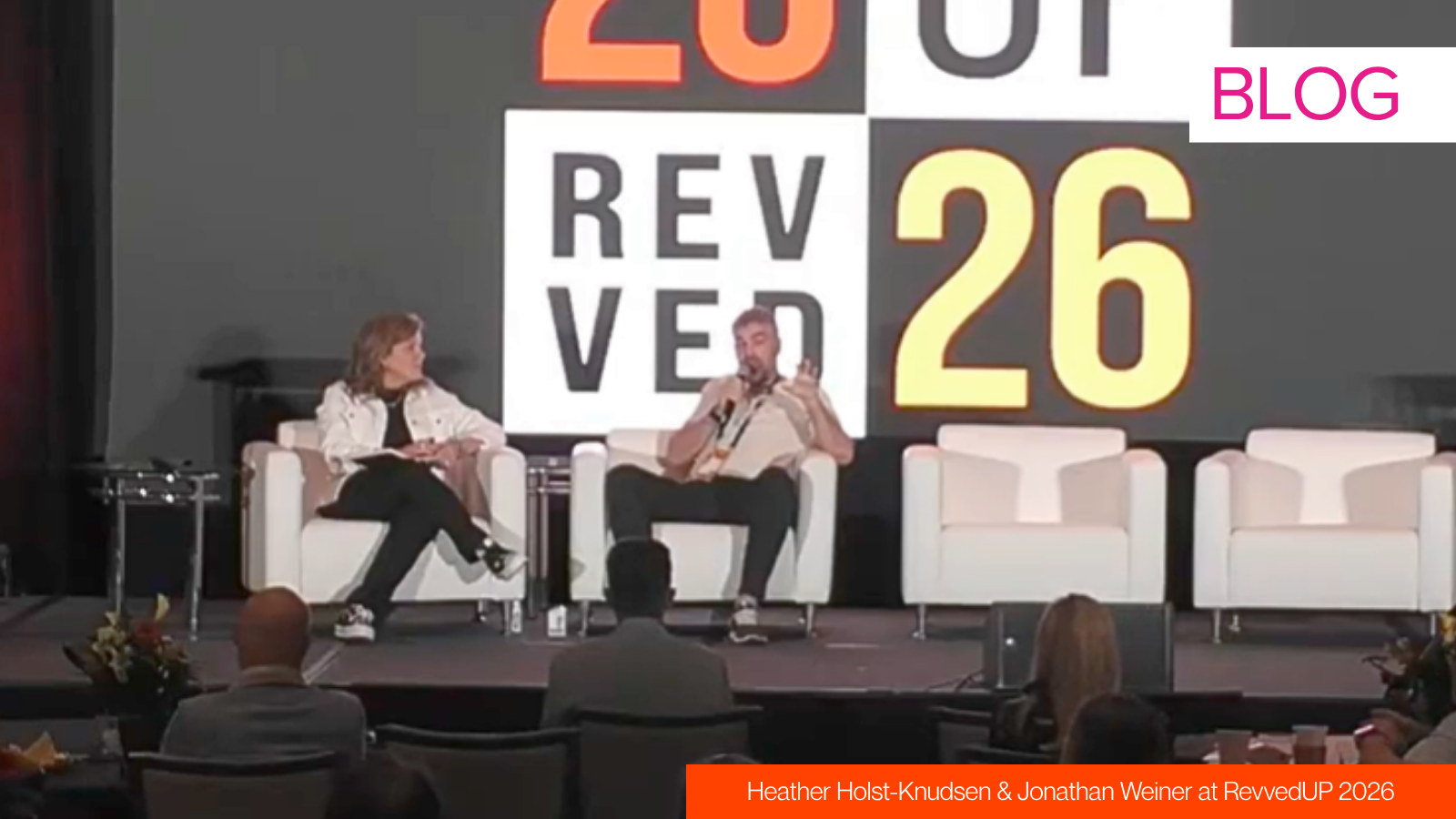
Jonathan Weiner did not come to RevvedUP 2026 to deliver a tidy innovation keynote. He brought the investor's blunt instrument: pattern recognition.
"We've all lived through essentially what I'll call three really large technology platform shifts," Weiner said, naming the internet, mobile, and cloud. "The big difference here is this is going to displace a lot of jobs."
That line landed because it cut against the usual conference optimism. Media and event executives are fluent in platform shifts. They have survived search, social, programmatic, virtual events, hybrid events, subscription fatigue, cookie deprecation, and the long hangover of pandemic era digital pivots.
But Weiner's argument was sharper: this is not just another channel migration. It is a labor model reset.
For media and events CEOs, the practical test is simple: revenue per employee, revenue per seller, sponsor renewal rate, profile completeness, time to proposal, and gross margin by event or product line. If AI does not move those numbers, it is empty spectacle.
The question is not, "Which AI tools should we buy?"
It is: What parts of our operating model only exist because the old cost structure made them necessary?
Revenue per employee is the new peer pressure
The most important number in the next era of media and events may not be attendance, booth count, or even sponsorship revenue.
It may be revenue per employee.
Weiner put the benchmark in blunt terms. A decade ago, he said, a company producing $1 million in revenue per employee looked almost absurdly efficient. Today, that number may become the floor, not the ceiling.
The public benchmarks make the pressure easier to see. Adobe sits closer to $500,000 in revenue per employee. Alphabet/Google is commonly estimated in the $1.5 million to $2 million range. Nvidia, using 2024 SEC filed revenue and headcount data, has been calculated at about $3.6 million per employee. Midjourney, depending on the headcount and revenue assumptions used, is often cited in the multi million dollar revenue per employee range, with some analyses placing it around $3 million to $4.6 million.
That is the part media and event CEOs should not soften.
For a $50 million events business, the boardroom question becomes brutally practical. Are you producing $300,000 per employee? $500,000? $750,000? More important: which functions are increasing that number, and which are quietly protecting manual work?
For years, complexity has been the industry's alibi. Large event businesses require speaker teams, sponsor success, audience marketing, registration support, operations, programming, content, sales, analytics, and finance. That is true.
But AI is about to separate necessary complexity from inherited labor.
If an AI agent can qualify sponsor interest, produce a tailored deck, answer attendee questions, recommend sessions, clean registration data, and surface sales intelligence, then the old headcount model starts to look less like service quality and more like technical debt with salaries attached.
This is not a call for indiscriminate cuts. That is spreadsheet showmanship.
The smarter move is to redesign the operating model around higher value humans: senior sellers, better producers, sharper analysts, stronger product leaders, and operators who can turn first party data into pricing power.
The boardroom question changes from:
"How many people do we need to run the event?"
to:
"How much revenue, margin, and enterprise value can each role create now that AI handles the repetitive work?"
The AI growth curve is shortening the distance between product market fit and valuation
Weiner's investor lens made the conversation more combustible. He compared earlier platform shifts with the current AI wave, then pointed to the speed of company formation and revenue growth.
Amazon and Google, he said, reached $1 billion in revenue in roughly five years, once a staggering pace. Public historical references broadly support the "on the order of five years" framing, though the exact comparison is best treated as a directional benchmark rather than a single clean data point.
Now the curve is collapsing.
OpenAI has been reported as approaching or crossing a $20 billion annualized revenue run rate in 2025, roughly three years after ChatGPT's commercial breakout.
Cursor makes the reset even harder to dismiss. Sacra's February 2025 research described Cursor as the fastest growing SaaS company of all time, estimating that it went from $1 million ARR to $100 million ARR in roughly 12 months. SaaStr later tracked the next leg of the curve: $100 million ARR in January 2025, $500 million by June 2025, and $1 billion plus by November 2025. In other words, Cursor moved from $100 million to roughly $1 billion ARR in about 10 to 11 months.
The point is not that every media company should pretend to be OpenAI or Cursor. The point is sharper: AI is shortening the distance between product market fit and valuation.
That matters because media and events companies have historically tolerated slow systems, manual handoffs, dirty data, and relationship driven sales cycles as the cost of doing business. AI will make those excuses harder to defend.
If your team needs three systems, four meetings, and two analysts to answer a sponsor's basic question, "Who will I meet, what will I get, and what outcomes can you prove?", the problem is not AI readiness.
It is commercial latency.
The SaaS apocalypse comes for bloated workflows
Weiner described AI as "the true gold rush" for venture investors, while warning that much of the last decade's SaaS stack is suddenly vulnerable.
"The SaaS apocalypse is real," he said.
For media and events companies, this should sting. Many operators have spent years stitching together registration platforms, CRMs, audience databases, email tools, BI dashboards, sponsor portals, lead retrieval systems, matchmaking platforms, and analytics vendors. The stack got larger. The data did not always get cleaner. The customer experience often stayed fragmented.
Weiner gave a simple example from HLTH: a marketing leader used Claude Code to build an internal application that crunched audience and analytics data for the sales team "in an hour."
The implication is not that every vendor disappears. It is that every workflow now has to earn its margin.
If a non technical operator can prototype an analytics tool, a registration workflow, a sponsor assistant, or a personalized agenda engine in an afternoon, then "we need another platform" becomes a weaker answer.
The better executive question is: Where is our proprietary data advantage, and how quickly can we turn it into revenue?
That question sits at the center of the businesses Weiner has built and shaped. HLTH, HumanX, Shoptalk, and Groceryshop are not just event brands. At their best, they are market infrastructure: concentrated communities, data signals, buyer intent, and commercial trust.
AI simply makes the infrastructure more measurable.
Personalization is no longer a premium experience. It is table stakes.
One of the most concrete moments in the discussion came when Weiner described building an "agentic registration system." The system could identify a registrant, pre fill categories, infer interests, and reduce the junk data that pollutes so many event databases.
For event companies, this is not a UX detail. It is a monetization issue.
Bad registration data creates bad segmentation. Bad segmentation weakens sponsor targeting. Weak targeting reduces renewal power. The result is margin leakage disguised as operational friction.
Weiner also described the "holy grail" of using known attendee data, webinars watched, articles read, profile attributes, and behavioral signals, to serve a personalized agenda.
For CEOs, the mandate is clear: your agenda is no longer just content programming. It is a recommendation surface. Your registration form is no longer just intake. It is a data product. Your event app is no longer just navigation. It is a conversion engine.
That changes the economics of audience engagement.
A personalized agenda can increase session attendance. Better session attendance can improve sponsor satisfaction. Better sponsor satisfaction can support renewal, expansion, and pricing power. The data trail matters as much as the moment in the room.
This is where many event companies are still underplaying the opportunity. They are using AI to write session blurbs when the bigger prize is to redesign the attendee experience around intent.
Sales teams are next, but not in the lazy way people say
The most provocative commercial thread was Weiner's discussion of AI powered sponsor and attendee conversations. He described a system that could answer sponsorship questions, surface testimonials, pull up relevant decks, and continue the conversation in real time.
"A human just can't do that," he said.
That does not mean strategic account executives vanish. Weiner was careful to distinguish between transactional sales motions and key accounts. The more likely near term split: AI absorbs low intent education, repetitive discovery, collateral retrieval, and basic qualification, while humans focus on enterprise negotiation, relationship risk, multi year packaging, and expansion.
This matters for profitability acceleration.
If AI can qualify more sponsor interest, improve response speed, and capture better discovery data before a human enters the loop, the sales team should become smaller, more senior, and more productive.
The board level metric is not "AI adoption." It is revenue per seller, pipeline created per seller, conversion rate by source, and gross margin by sponsorship package.
Weiner also pointed to a new class of agentic workflows: agents that can monitor funding announcements, identify target accounts, gather contact details, research company pain points, and create custom presentations.
That is not a marginal productivity gain. That is a rebuild of the sales development function.
The uncomfortable question: how many people on your revenue team are creating differentiated commercial value, and how many are moving information between tabs?
The new event operating model
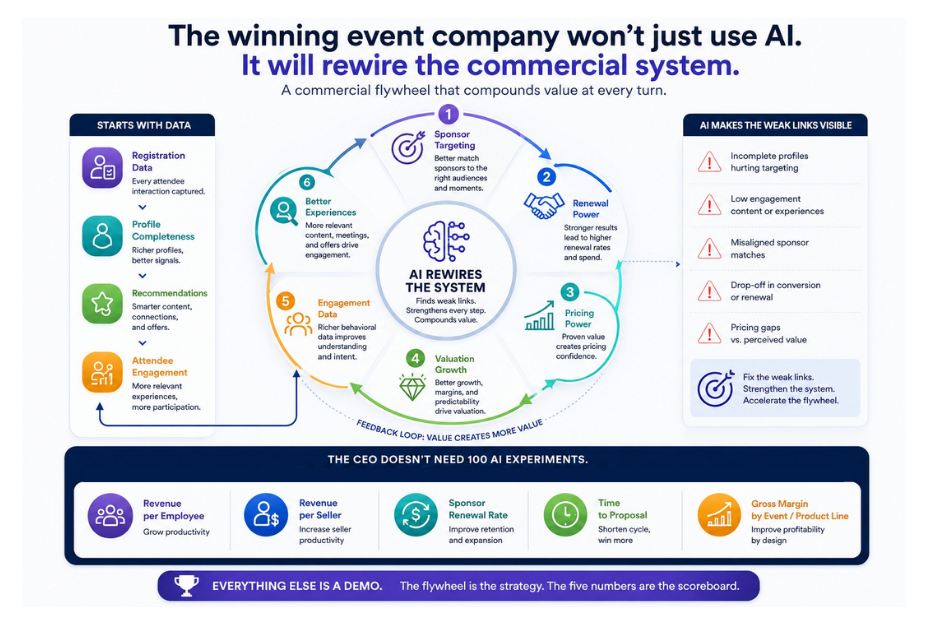
The winning event company will not simply "use AI." It will rewire the commercial system around it.
That means registration data flows into profile completeness. Profile completeness improves recommendations. Recommendations improve attendee engagement. Engagement data improves sponsor targeting. Sponsor targeting improves renewal power. Renewal power improves pricing. Pricing improves valuation.
This is the flywheel media and events companies have talked about for years. AI makes the weak links visible.
A CEO does not need a hundred AI experiments. A CEO needs five numbers moving in the right direction: revenue per employee, revenue per seller, sponsor renewal rate, time to proposal, and gross margin by event or product line.
Everything else is a demo.
The takeaway for CEOs
Weiner's RevvedUP message was provocative because it refused the comfort of gradualism.
AI will not politely sit beside the current media and events business model. It will interrogate every workflow, every vendor, every junior role, every handoff, and every weak data layer.
The upside is equally direct. Better personalization creates better attendee value. Better data creates better sponsor outcomes. Better automation creates better margins. Better margins create better valuation stories.
Or, to put it less politely: the companies that treat AI as a content theme will sell booths about the future.
The companies that treat AI as an operating model will own more of it.
Ready to Step Into the Revenue Room™?
The ideas in this article are just the starting point. Revenue Room™ brings together CEOs and revenue-critical leadership teams across media, events, data, and information services to align around one growth plan, one scorecard, and one execution cadence—turning data, AI, and operator insight into measurable revenue, margin, and enterprise value outcomes.
Continue the conversation and take the next step:
Check out our event lineup including upcoming Exchange Roundtables, Revenue Room™ Salon: Women Who Accelerate & Lead, and RevvedUP 2027
Apply to Join Revenue Room™ CXO
Become part of the invite-only executive network for CEOs and revenue-critical C-suite leaders building the next era of profitable growth.
Learn More About Upcoming Revenue Room™ Bootcamps
Equip your teams with practical, instructor-led programs designed to move from learning to execution.
Download Revenue Room™ Playbooks
Access frameworks, templates, and operating tools to help your team assess gaps, prioritize growth moves, and execute with greater speed and clarity.
Latest playbooks
Step into the room where modern growth leaders align, accelerate, compound, and connect.
Sign in or Join the community
The Nexus for Data-Driven Growth Leaders

Create an account
The Nexus for Data-Driven Growth Leaders
Like
Comments (0)
Popular

Popular
Blog
AI Is Eating Your Traffic – How Media Companies Can Reclaim Audience and Revenue
By Heather Holst-Knudsen
47:08
Video
Zero-Click Futures and AI Truths: How Tag Digital is Redefining Event Marketing
By Laura Davidson
52:15
Video
The Strategic Shift Behind EndeavorB2B's Growth and Why It Matters for the Entire Industry
By Heather Holst-Knudsen
Dive in
Related
55:08
Video
Why Traffic-Reliant Media is "Done For" (And Why Media + Events + Data Wins)
By Heather Holst-Knudse... • Feb 27th, 2026 • Views 6
Blog
How the Channel Company is Transforming B2B Media with Data and AI
By Heather Holst-Knudse... • Feb 12th, 2025 • Views 32
Blog
Why Traffic-Reliant Media is "Done For" (And Why Media + Events + Data Wins)
By Heather Holst-Knudse... • Mar 5th, 2026 • Views 26
Blog
Predictive Signals for Media and Events Revenue Leaders
By Heather Holst-Knudse... • May 14th, 2026 • Views 9
55:08
Video
Why Traffic-Reliant Media is "Done For" (And Why Media + Events + Data Wins)
By Heather Holst-Knudse... • Feb 27th, 2026 • Views 6
Blog
Why Traffic-Reliant Media is "Done For" (And Why Media + Events + Data Wins)
By Heather Holst-Knudse... • Mar 5th, 2026 • Views 26
Blog
Predictive Signals for Media and Events Revenue Leaders
By Heather Holst-Knudse... • May 14th, 2026 • Views 9
Blog
How the Channel Company is Transforming B2B Media with Data and AI
By Heather Holst-Knudse... • Feb 12th, 2025 • Views 32