Revenue
June 5, 2026
Zero Trust for AI Agents: Six Guardrails Before MCP Scales

# Artificial Intelligence
# Ai agents
# Enterprise ai
# Revops
# B2b media
# AI operating model
# Sponsor data
# first-party data strategy
# Thought leadership
# AI revenue workflow
Here is the minimum guardrail stack every enterprise needs before production agents connect to CRM, customer data, finance, event systems, or collaboration tools.

Heather Holst-Knudsen
Before Agents Touch Enterprise Data, Build the Guardrails

Most companies do not need fewer agents.
They need better boundaries.
The business case is real. Agents can help revenue teams move faster: account prep, sponsor reporting, campaign briefs, lead routing, renewal risk, customer summaries, sales follow-up, and CRM cleanup.
The control problem is just as real. Once agents can act through MCP-connected tools, they are no longer simple chat interfaces. They are closer to privileged operators.
That changes zero-trust.
For a person, zero-trust asks: who are you, what can you access, and is your behavior normal?
For an agent, zero-trust asks: who owns this workflow, which tools can it call, which data can it touch, which actions can it take, what gets logged, and how fast can we stop it?
MCP adoption is moving quickly because it solves a practical integration problem. Axios described MCP as a technical standard gaining traction with developers because it gives AI systems a simpler way to connect to software applications and data sources, while also raising concerns about authentication, security, and privacy. ( Axios )
That is the tension: speed and exposure arrive together.
The CEO Skim Box
Before any production agent gets access to enterprise systems, it needs five things:
- A named owner
- Scoped access
- Approved tools
- Runtime logs
- A shutdown path
Everything else is maturity. These are table stakes.
Guardrail 1: Give Every Agent an Identity
Every production agent needs its own identity.
Shared service accounts blur accountability. Generic automation tokens make incidents harder to trace. Broad access granted during a pilot has a habit of becoming permanent.
A governed agent identity should answer:
❓Who owns it?
❓What is its business purpose?
❓Who can use it?
❓Which systems can it access?
❓What actions can it take?
❓When does access expire or get reviewed?
For media and events companies, this matters because the most useful agents often touch high-value commercial data: pipeline, discounting, attendee behavior, sponsor engagement, registration, session attendance, renewal history, and margin.
A renewal agent does not need admin access because it summarizes account notes.
The rule: one agent, one purpose, one permission set.
Guardrail 2: Use a Private MCP Registry
MCP makes it easy to connect agents to tools. That means companies need a controlled list of approved servers.
A private MCP registry should show which MCP servers are allowed in production, who owns them, what functions they expose, what data they touch, where they can send data, and when they were last reviewed.
This is the line between testing and production.
The risk is not hypothetical. Recent reporting on security research around MCP described critical vulnerabilities affecting SDK implementations and large numbers of server instances, with concerns tied to remote code execution, prompt injection, UI injection, and supply-chain poisoning. ( Tom's Hardware )
The executive takeaway is simple: MCP servers are part of the control surface. Treat them like production infrastructure.
Guardrail 3: Put Boundaries Around Data
Agents do not just retrieve data. They combine it.
That is useful when a CRO asks for renewal risk across top accounts. It is risky when the agent blends CRM notes, legal context, finance margin, support tickets, event behavior, and private messages into one output.
The control has to consider source, sensitivity, requester, destination, and action.
A governed agent should know which data it can retrieve, which fields must be masked, which sources are excluded, which destinations are allowed, and which outputs need review.
This is where the growth story and risk story meet.
Registration data, badge scans, session attendance, sponsor engagement, content behavior, and CRM history can improve segmentation, sponsor ROI, renewals, and pricing. Those same data flows can create privacy, contractual, and trust problems if agents surface them in the wrong place.
Good boundaries make the data more usable, not less.
Guardrail 4: Monitor the Chain, Not Just the Event
Traditional logging asks what happened.
Agent monitoring asks what happened, in what order, because of which request, using which tools, and with what result.
The chain matters:
User request → agent plan → tool call → data retrieval → output → action → destination
Monitoring should flag unusual tool combinations, export spikes, sensitive data access outside the use case, new external destinations, after-hours activity, repeated failed permissions, and high-risk actions without approval.
For revenue leaders, this is not only a security feed. It is proof of value.
The same telemetry that catches risk can show where agents are saving time, reducing service cost, improving renewal prep, accelerating campaign production, and protecting margin.
Guardrail 5: Put Human Review Where the Risk Is
Human review fails when every action needs approval.
It also fails when high-risk actions move without review.
The practical answer is approval by risk level.
Low-risk work can run automatically: summarizing public materials, drafting internal notes, creating task suggestions, or tagging low-sensitivity content.
Medium-risk work may need review: updating CRM fields, drafting customer-facing messages, enriching account records, or recommending discount changes.
High-risk work should require explicit approval: exporting customer data, changing permissions, deleting records, publishing content, sending external communications, issuing refunds, modifying contracts, or moving money.
The more irreversible, external, sensitive, or financially material the action, the stronger the approval gate.
This is how control supports speed. Teams do not wait on low-risk work, and leaders do not wake up to a preventable incident.
Guardrail 6: Build the Shutdown Path First
Every production agent should have a shutdown path.
That path should not depend on a meeting, a ticket queue, or finding the only engineer who knows where the controls live. The accountable owner needs authority to suspend the agent, revoke credentials, disable an MCP server, block tool calls, freeze external outputs, and notify incident response.
Agent incidents will not look exactly like traditional security incidents.
❓What happens if an agent leaks sponsor terms?
❓What happens if it sends the wrong renewal guidance to a customer?
❓What happens if it updates CRM records incorrectly?
❓What happens if a compromised MCP server calls an outside webhook?
Those questions should be answered before the agent goes into production.
A Practical Maturity Ladder
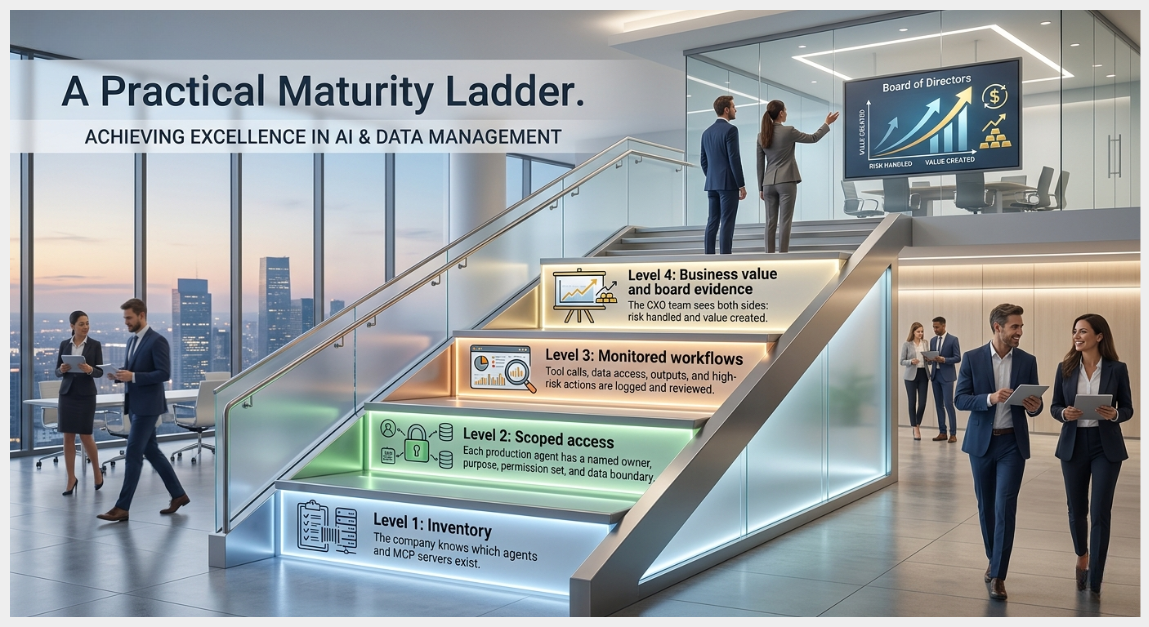
This ladder matters because most organizations do not need a perfect program on day one. They need to stop pretending unmanaged production agents are still experiments.
Metrics + Instrumentation
Track these monthly:
✅ Agent inventory coverage: production agents with owner, purpose, access, and review date.
✅ Approved MCP coverage: production servers reviewed and registered.
✅ Permission drift: agents with access beyond their approved use case.
✅ High-risk actions: exports, permission changes, outside sends, deletions, financial actions, and customer-impacting updates.
✅ Human approval rate: high-risk actions approved, rejected, or escalated.
✅ Containment time: alert to suspension, credential revocation, or server disablement.
✅ Business impact: cycle time saved, cost avoided, pipeline influenced, renewal prep reduced, sponsor reporting accelerated, or margin leakage reduced.
RevOps should own the value instrumentation. Security should own the risk telemetry. Finance should validate savings and margin impact. Business leaders should decide whether the workflow deserves to scale.
Ready to Step Into the Revenue Room™?
The ideas in this article are just the starting point. Revenue Room™ brings together CEOs and revenue-critical leadership teams across media, events, data, and information services to align around one growth plan, one scorecard, and one execution cadence—turning data, AI, and operator insight into measurable revenue, margin, and enterprise value outcomes.
Continue the conversation and take the next step:
Check out our event lineup including upcoming Exchange Roundtables, Revenue Room™ Salon: Women Who Accelerate & Lead, and RevvedUP 2027
Apply to Join Revenue Room™ CXO
Become part of the invite-only executive network for CEOs and revenue-critical C-suite leaders building the next era of profitable growth.
Learn More About Upcoming Revenue Room™ Bootcamps
Equip your teams with practical, instructor-led programs designed to move from learning to execution.
Download Revenue Room™ Playbooks
Access frameworks, templates, and operating tools to help your team assess gaps, prioritize growth moves, and execute with greater speed and clarity.
Latest playbooks
Step into the room where modern growth leaders align, accelerate, compound, and connect.
Sign in or Join the community
The Nexus for Data-Driven Growth Leaders

Create an account
The Nexus for Data-Driven Growth Leaders
Like
Comments (0)
Popular

Dive in
Related
Blog
The New AI Attack Surface: Agents, MCP, and the Toolbelt Problem
By Heather Holst-Knudse... • Jun 5th, 2026 • Views 52
47:08
Video
Zero-Click Futures and AI Truths: How Tag Digital is Redefining Event Marketing
By Laura Davidson • Jun 30th, 2025 • Views 61
34:35
Video
MCP, Agentic AI Risk, and the Governance Decisions Leaders Must Make Now Webinar
By Sean Goodwin • Jul 9th, 2026 • Views 81
Blog
The New AI Attack Surface: Agents, MCP, and the Toolbelt Problem
By Heather Holst-Knudse... • Jun 5th, 2026 • Views 52
47:08
Video
Zero-Click Futures and AI Truths: How Tag Digital is Redefining Event Marketing
By Laura Davidson • Jun 30th, 2025 • Views 61
34:35
Video
MCP, Agentic AI Risk, and the Governance Decisions Leaders Must Make Now Webinar
By Sean Goodwin • Jul 9th, 2026 • Views 81