Most executives approach an AI rollout backward. They expect the tool to arrive already knowing the business, and they measure success by how fast a chatbot goes live.
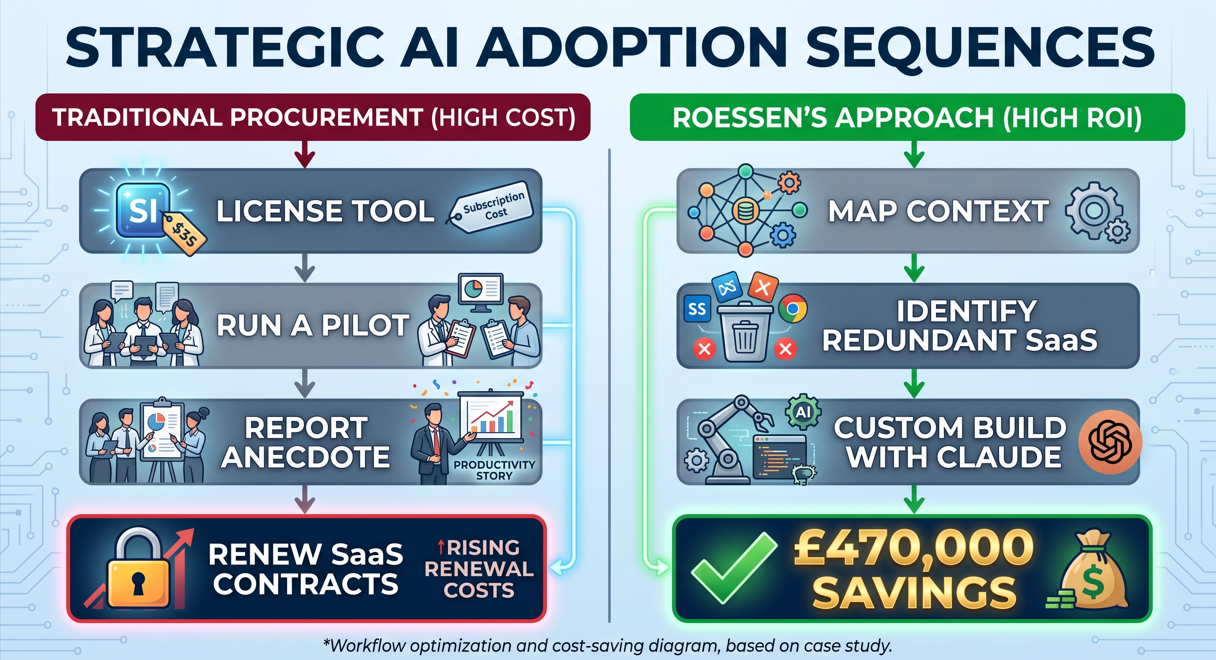
Sharon Roessen , Chief Operating Officer at Terrapinn , did the opposite. Before Claude touched a single workflow at the B2B events company, she spent months loading in the context a new employee would need on day one. Who her team is. Past event agendas. Venue contracts. Marketing plans. Live connectors so Claude could see current data instead of a snapshot. WATCH FULL EPISODE HERE That groundwork produced results she was willing to publish herself: £470,000 of SaaS renewal cut in a single quarter, with more to come, and thirteen working Claude skills shipped in five weeks. The number that should get an executive team's attention is not the savings. It is the time she spent before any of it showed up on a P&L. AI value creation does not start with the tool. It starts with the unglamorous work of building the operating foundation the tool needs before it can do anything useful.
Business Consequence
The instinct in most organizations is to treat AI adoption as a procurement decision: license the tool, run a pilot, report a productivity anecdote at the next leadership meeting. That sequence produces demos, not savings. Roessen's £470,000 came from a different sequence. She identified which SaaS tools existed only because no one had built anything better yet, then had Claude do that work directly once the underlying context was in place. The SaaS renewal was never the target. It was the byproduct of building something that made the renewal unnecessary.
This matters for capital allocation as much as for cost. A leadership team that funds AI pilots without funding the context-building work behind them is paying twice: once for the tool, and again for the SaaS contracts the tool was supposed to replace. The organizations that will show real margin improvement from AI are not the ones with the most licenses. They are the ones willing to spend the unglamorous months building the foundation first.
Operating Diagnosis
This is not only a technology decision. It depends on operations, marketing, sales, and finance agreeing to work from the same current information, and on someone senior enough to insist the foundation gets built before the skills do.
Roessen describes what she built as a three-layered structure: a company layer, a functional layer covering marketing, sales, and the rest of the business, and a brand layer for each individual event. Each layer had to be loaded with real material, not generic prompts, before Claude could produce anything a leadership team would trust. Without that structure, an AI rollout tends to stall in one of two places. Either it stays confined to a single department because no one connected the layers, or it produces output that looks plausible but does not hold up once it hits a real leadership meeting.
The accountability shift is the clearest signal the foundation is working. Roessen has said that once last week's actions get checked automatically against the CRM, whether the target sponsor actually closed becomes visible without anyone asking. That kind of visibility is not a feature of the AI tool. It is a consequence of finance, sales, and operations agreeing in advance what "current" and "correct" mean across their systems.
Management Framework
Build the foundation before the skill. Loading in team structure, historical agendas, contracts, and live connectors is not a prerequisite task to get through quickly. It is the actual work. Skills built on top of a shallow foundation produce shallow output, however good the prompt is.
Pick one recurring document and turn it into a living system. Every event at Terrapinn generates a business plan. It used to be a static document, drafted once and stale within weeks. Roessen rebuilt it as a skill that keeps the plan current inside Claude as the event moves, rather than a deck that needs to be manually refreshed. The lesson generalizes past events: any recurring plan, report, or briefing a team currently treats as a point-in-time document is a candidate for the same redesign.
Expect the first skill to take longer than the demo suggested. Roessen has said the business plan skill took roughly four weeks of going back over the output before it was something she would put in front of her own CEO. That is not a sign the project was behind schedule. It is the actual cost of a skill that will run correctly every time instead of one that looked good once.
Ship at good enough, then keep iterating. Roessen's standard was that eighty percent quality was good enough to ship a first version, with the expectation that the skill would keep improving as more people used it and pushed back on the output. Waiting for a finished skill before anyone uses it is how AI initiatives stay permanently in pilot.
Make AI fluency a hiring requirement, not a training afterthought. Terrapinn is recruiting graduates this year with AI literacy treated as non-negotiable, after watching an entry-level placement student outproduce more senior staff simply because he was not afraid of the tools. Waiting to train AI skills into an existing team is a slower path than hiring for the aptitude directly.
90-Day Application
Audit the SaaS renewal list for the next two quarters and flag any tool whose core function is something Claude could already do directly once it has the right context. That list becomes the priority order for foundation-building, not a separate cost-cutting exercise.
Choose one recurring document, plan, or report that every function in the business currently treats as static, and assign one owner to rebuild it as a living skill. Set the expectation up front that the first version will take weeks, not an afternoon, and that success means it holds up in front of leadership, not that it was fast to build.
Add one AI-fluency question to every interview for the next hiring cycle, and treat the answer as seriously as any other core competency.
Executive Questions
- Which of our recurring documents are still static when they should be living systems that update themselves?
- How much of our current SaaS renewal spend is paying for work our own AI tools could already do directly, once someone builds the context behind it?
- Who on our team has actually shipped a skill that holds up under real accountability, rather than experimented with a chat window?
- What does good enough to ship look like for our first AI-built deliverable, and are we willing to accept that standard?
- Is AI fluency a requirement in our hiring bar today, or still an optional nice-to-have?
Sharon Roessen shared the full story, including what she says still cannot be automated in her industry, the face-to-face relationship building that closes B2B events business, on the latest episode of The Revenue Room™ Podcast. If your leadership team is weighing the same tradeoff between AI licenses and AI value, that conversation is a good place to start. Sharon will also join us on the RevvedUP 2027 stage to go deeper on what she has learned since. Revenue Room™ CXO members can bring this exact question, how much of our AI spend is producing real value versus renewing the same tools by another name, into their next peer room conversation. About Revenue Room™ CXO
Revenue Room™ CXO is an executive community and platform for CEOs and revenue-critical C-suite leaders across media, events, data and information services, and professional communities. Through executive Salons, peer networks, research, content and strategic programs, Revenue Room™ CXO helps leaders navigate the changing operating models, technologies and growth strategies shaping the modern revenue organization. Revenue Room™ CXO is operated by H2K Labs.