Events
October 28, 2026
From Badge Scans to Buyer Signals: What Clarion Events Shows About Turning an Events Portfolio Into a Data Business
# event lead intelligence
# First-party data monetization for events
# AI partnerships under private equity
# Event organizer subscription model
Clarion's Chief Digital Officer, Narisa Wild, built a lead intelligence platform in about 12 months under private equity ownership, with no build budget. Two weeks after our conversation, Informa agreed to acquire Clarion. The lessons are less about AI than about who owns the signal, and what it is worth when ownership changes.

Heather Holst-Knudsen
Most event organizers do not have a lead problem. They have a signal ownership problem. Every sponsor, exhibitor, and attendee generates intent data across the event cycle: registrations, session attendance, booth conversations, webinar sign-ups, newsletter engagement. For decades, the organizer kept very little of it. What it did capture often sat with third-party lead retrieval vendors or disappeared into an exhibitor's spreadsheet the day the show closed.
Event lead intelligence is the practice of connecting those signals to individual buyers and returning them to sellers as prioritized, actionable insight before, during, and after the event. On a recent episode of The Revenue Room™ Podcast, Narisa Wild , Chief Digital Officer at Clarion Events North America , explained how Clarion built that capability through its Converge+ platform in roughly 12 months.
The useful lesson for operators is not the feature list. It is how a private equity owned organizer made the shift with no build budget and no meaningful increase in headcount.
The timing adds a second lesson. Two weeks after the recording, Informa announced it had agreed to acquire Clarion from Blackstone, which turns a question about building data capability under PE ownership into a question about what that capability is worth when ownership changes.
The Business Consequence: Why Event Lead Intelligence Outgrows the Badge Scan
For most organizers, lead retrieval has been a pass-through line. According to a case study published by Omeda , Clarion's marketing automation partner, lead retrieval revenue at Clarion had been flowing to third-party vendors who owned the scanning infrastructure and the data that came with it. Bringing that capability in-house turned a pass-through expense into a subscription-style revenue stream with data ownership attached.
That is the smaller prize. The larger one is the ROI conversation. An organizer has historically lost sight of the lead the moment the exhibitor leaves the floor. Without evidence of what happened next, renewal turns into a negotiation over square footage and price. As Wild put it, the moment exhibitors leave the show floor, "it's hard for us to know what happened next." Every follow-up email, scheduled meeting, and recorded note captured inside the platform gives the organizer more signals deeper into the exhibitor's pipeline, and a stronger position in the renewal discussion.
The third prize is revenue mix. Asked what success would look like in two years, Wild did not point to a product launch. She pointed to the distribution of revenue and contribution shifting from dependence on events toward what she called data solutions. For a PE-backed business, that shift matters to enterprise value as much as to the P&L, because recurring data revenue and event revenue tend to be valued differently.
The Operating Diagnosis: The Constraint Is Behavior, Not Technology
Wild was candid that the technology is not the hardest part. Customer behavior and internal stakeholder behavior are. That diagnosis holds across every function involved.
Exhibitors split into two camps. Long-tenured exhibitors still want scan volume and rely on large sales teams to work leads manually after the show. A newer generation treats the event as a place to reconnect with existing customers, spend focused time with the people they already know, and find the next set of accounts. A platform built for the second group has to win over the first.
Sales teams faced their own shift. Sellers who had spent careers selling booths and sponsorships were now asked to sell data as a solution, bundled with media, across multiple events. Wild described them as initially lacking the confidence and expertise to do it.
Operations had to create a "golden thread" that, in her words, does not exist, so the experience feels seamless to customers and as easy as possible for sales.
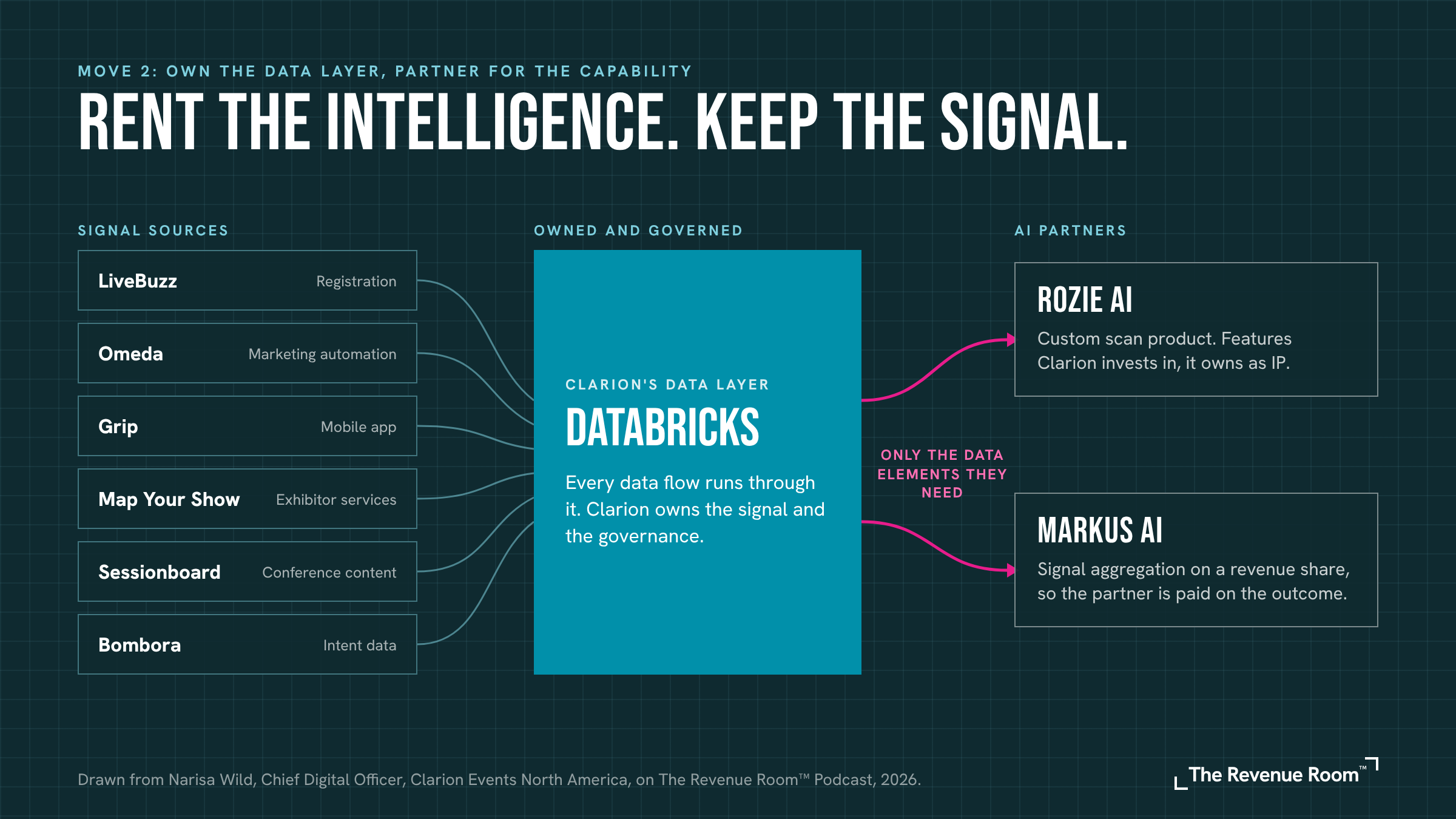
Data and technology faced a fragmentation problem. The signals Clarion needed came from at least five systems: registration (LiveBuzz), marketing automation (Omeda), the mobile app (Grip), exhibitor services (Map Your Show), and conference content (Sessionboard). The CDO owns the customer value case. The CIO and CTO role owns the architecture and governance. Neither can produce the outcome alone.
Notably, Clarion's Databricks data architecture did not originate on an IT roadmap. It was initiated by a customer need for Converge+ that required access to multiple data sources, which gave the data team the mandate to build what it had wanted to build for some time. Product demand pulled governance forward rather than governance blocking product.
The Management Framework: Five Moves
1. Measure depth of engagement, not volume of scans
Clarion does not stop at how many scans an exhibitor received. It tracks what exhibitors do with them: conversations recorded, notes added, follow-up emails sent, meetings scheduled. The platform lets an exhibitor send a calendar link from inside the scan, which closes the gap between a booth conversation and a next step.
Speed matters. The often-cited 2011 Harvard Business Review study of online sales leads found that firms contacting a prospect within an hour were nearly seven times as likely to qualify the lead as those that waited even an hour longer. That research covered web inquiries, not show floors, but the decay principle carries over. Exhibitors can also define up to 10 ideal customer profiles before the show, and each new scan is automatically matched against them. Tightening the filters might take a list from 200 leads to 10, but those 10 are the ones the exhibitor defined in advance.
2. Own the data layer and partner for the capability
Clarion ran a build, buy, or partner analysis roughly 15 months before the recording. Building was ruled out by capital constraints. Buying technology is rarely how an event organizer invests for growth. That left partnership, and the design of each partnership is where the discipline shows.
Clarion's scan product was custom built with Rozie AI, with Clarion investing in features it owns as IP, such as issuing continuing education completion certificates at the scan for FDIC's hands-on training classes. Signal aggregation runs through Markus AI on a revenue share, so the partner's economics depend on the outcome. Bombora intent data enriches the profiles. Every data flow runs through Clarion's Databricks layer, and partners receive only the specific data elements they need rather than direct API access to everything. The principle is to rent the intelligence and keep the signal.
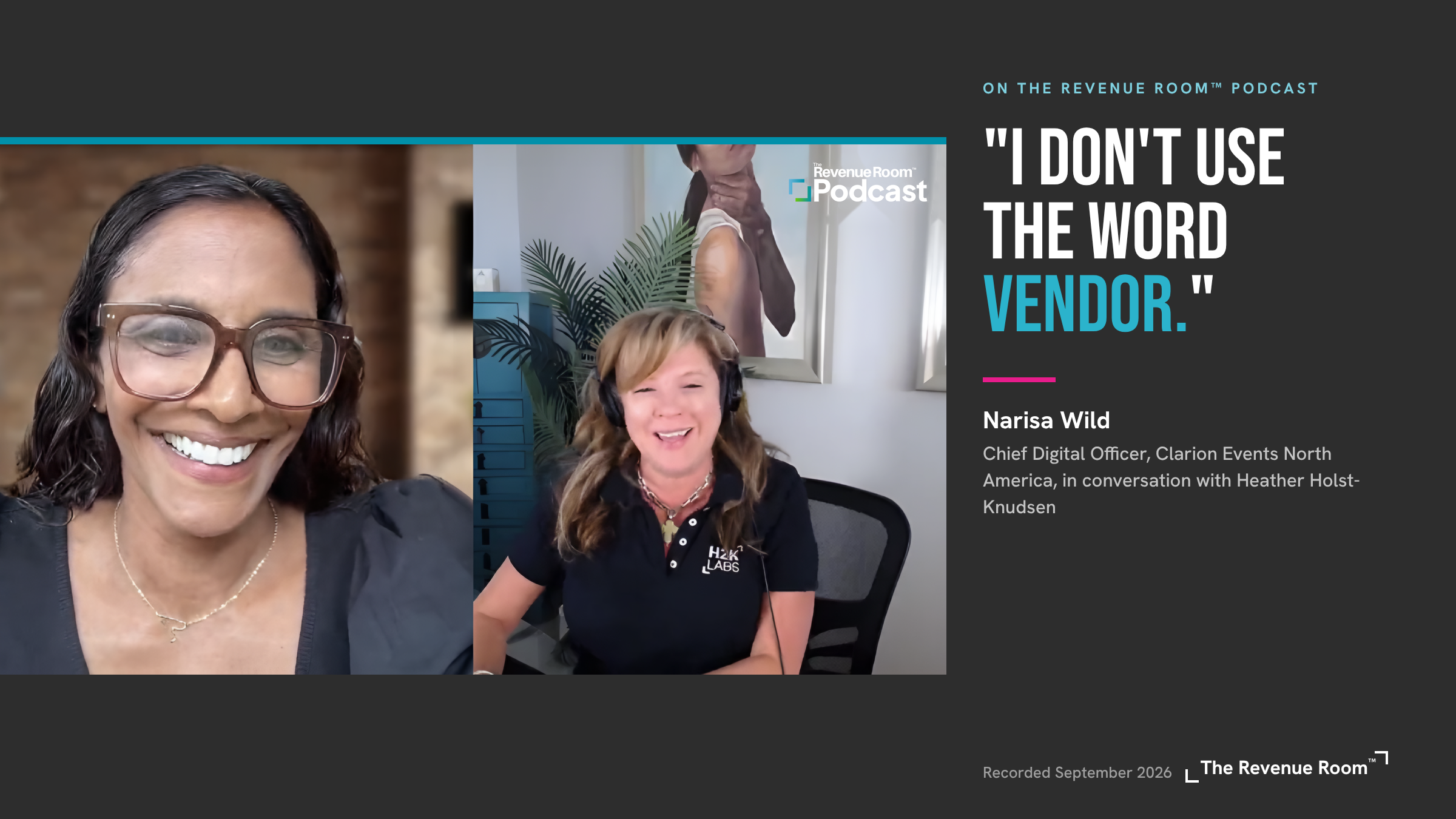
Wild extends this to culture. "I don't use the word vendor," she said. Partners sit in Clarion's Teams channels and Monday boards, because they play a role in whether the product succeeds.
3. Use the event brand as the trust layer
Converge Activate gives a limited number of sponsors access to the registered attendee database with sensitive data masked. Sponsors can segment by job title, function, and motivation for attending, use AI to build segments and write content, and send co-branded invitations to dinners, demos, or side meetings. Attendees consent to data sharing at registration and can opt out through Clarion's privacy policy.
The co-branding is the point. An invitation carrying the event's name tells the attendee the outreach is legitimate and relevant, which Wild reports converts far better than one-to-one requests through an event app. Scarcity protects both the attendee experience and the price of access. Trust and governance are not overhead on this model. They are part of what makes the signal valuable.
4. Package one capability many ways, and arm the sellers
Wild calls Converge+ a "product chameleon." At flagship trade shows, it is positioned as lead capture and conversation intelligence. At retail specialty shows, where buyers are budget-constrained, booths may be staffed by one person, and transactions happen on the floor, it is positioned as a personal digital assistant that logs every sale, note, and invoice number so no follow-up is missed.
Sellers now bundle Converge+ with the booth sale and extend it through media products before and after the event. The enablement investment behind that is substantial: packaging, assets, objection handling, and cheat sheets. Confidence, Wild noted, comes as much from sellers trusting the product as from knowing how to describe it.
5. Fund the platform from contribution, not capital
The year-one mandate was to be profitable, add to the contribution line, and cover its own costs, without materially growing the team. Clarion ran pilots, brought the results to group leadership, Liz Irving, and the executive team, and built the monetization model from there. Under PE ownership, a self-funding mandate is the burden of proof, and it forces decisions about scope that an open-ended investment never would.
What the Informa Deal Changes
On October 6, 2026, Informa announced an agreement to acquire Clarion Events from Blackstone for £2.24 billion, roughly $3 billion, at about 11.1 times Clarion's expected 2027 EBITDA. The deal is expected to close in the fourth quarter of 2026, and Informa has said Clarion will continue operating under its existing leadership while the two companies determine how to combine their brands and businesses. Informa is pairing the acquisition with a planned separation of Taylor & Francis, narrowing the group toward B2B live events.
Nothing in the podcast addressed the transaction, and nothing here should be read as a view on how Converge+ will be treated after close. But the deal sharpens three points for any operator building data capability inside an events portfolio.
First, ownership changes test architecture. A data layer the organizer controls, with partners receiving only the data they need, is likely easier to evaluate, migrate, or extend during integration than capability locked inside a third-party vendor's stack. Clarion's design choice was made for governance reasons. It may also turn out to matter for portability.
Second, a self-funding product is easier to defend. In any integration, overlapping capabilities get compared. A platform that covers its own costs and contributes margin enters that conversation with evidence rather than a roadmap.
Third, scale changes the economics of the signal. Informa expects its combined B2B live events business to span roughly 1,000 specialist brands. The compounding mechanism described below depends on participation, and a larger portfolio is, in principle, more participation. Whether that potential is realized depends on integration decisions about data standards, identity, and which platforms survive, which are exactly the decision-rights questions this post raises.
Where the Compounding Starts, and Where It Does Not Yet
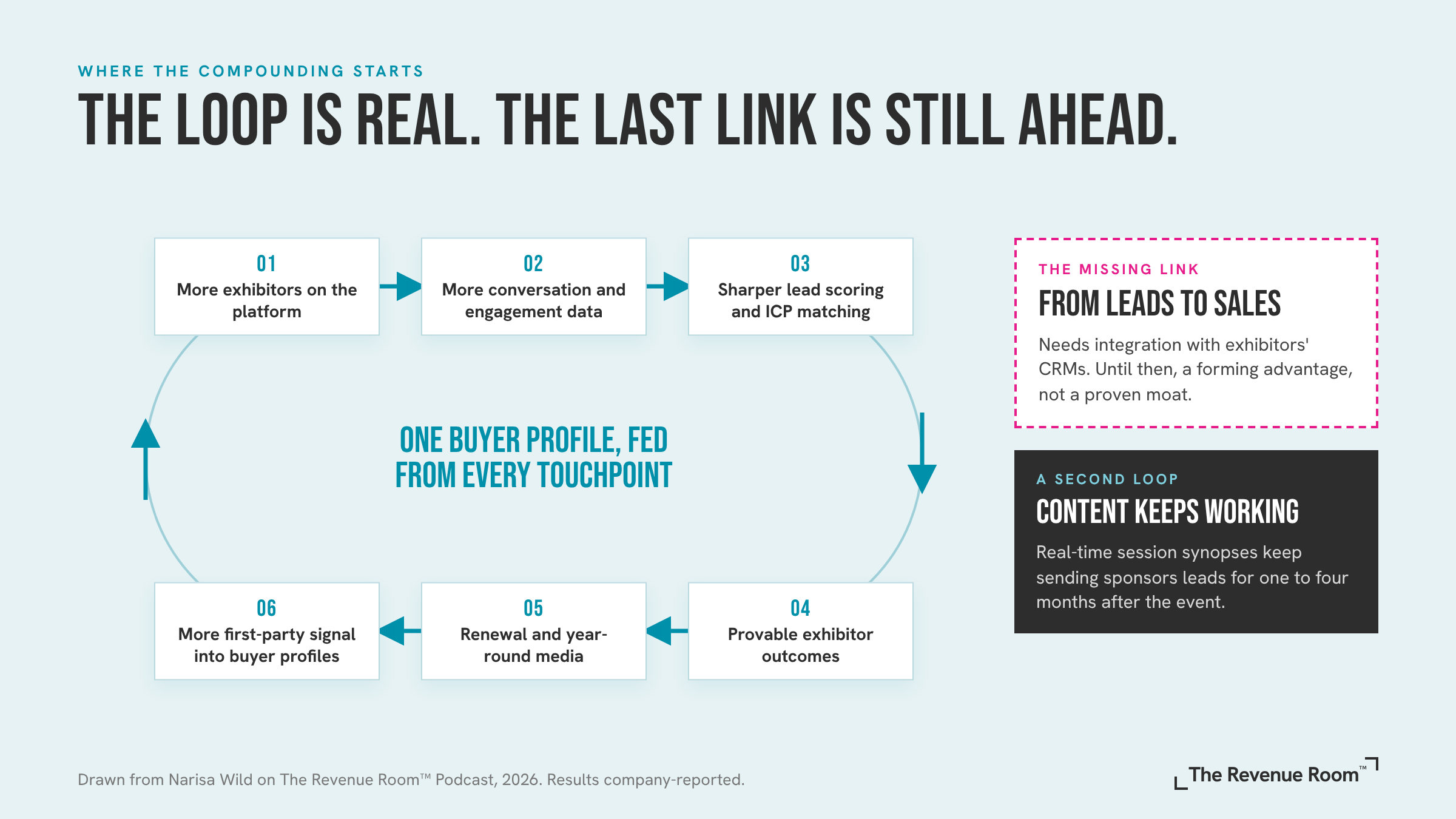
The mechanism Clarion is building looks like this. More exhibitors using the platform produce more conversation and engagement data per buyer. That data improves lead scoring and ICP matching. Better matching produces stronger, provable exhibitor outcomes. Provable outcomes support renewal and expansion into year-round media programs. Those programs, in portfolios such as fire and energy, generate more first-party signal from webinars, podcasts, newsletters, and display campaigns, which flows back into the same buyer profiles.
Content is becoming a second loop. Through Rozie AI, session synopses are generated in real time, and Clarion reports that sponsors continue to receive leads from synopsis access for one to four months after the event. An AI librarian lets attendees query everything said at the event. Internally, the same corpus feeds social content, daily digests, and co-branded sponsor programs that can be upsold after the show.
One link is still missing. Wild described the holy grail as being able to say, "of the 200 leads, here are 10 sales." That requires integration into exhibitors' CRMs and pipeline workflows. Until that closed loop exists, this is best described as a strong and forming strategic advantage rather than a proven moat. The loop is real. The final proof point is still ahead.
90-Day Application
Days 1 to 30: Map the signal. Inventory every system that captures buyer intent across one flagship event and its adjacent media. For each, document who owns the data, who has direct access, and who captures the economics.
Days 31 to 60: Redesign one partnership. Run a build, buy, or partner decision for one capability. Where a partner is paid on a fee-for-service basis, test whether IP ownership or a revenue share would align incentives better. Stand up a governed data layer for that single use case rather than a full enterprise program.
Days 61 to 90: Pilot and prove. Launch with a defined exhibitor segment. Track depth-of-engagement measures such as follow-up actions and meetings scheduled, not scan counts. Report the result to ownership in contribution terms.
Executive Questions
- Which of our buyer signals currently sit with partners who capture both the economics and the data?
- Do we report scans delivered, or the actions exhibitors take on them within the first days after the show?
- When a product need conflicts with architecture standards, who holds the decision right, and how fast can it be resolved?
- What would we need from exhibitors' CRMs to report sales rather than leads, and what would they need from us to share it?
- If our ownership changed next quarter, which of our data capabilities would an acquirer see as owned, portable assets, and which would it see as vendor contracts?
Continue the Conversation
Listen to the full episode of The Revenue Room™ Podcast with Narisa Wild for the complete discussion. Questions like these are the work of Revenue Room™ CXO , an invite-only executive peer network and year-round decision system where CEOs and revenue-critical leaders in media, events, and data businesses pressure-test decisions on data monetization, AI value creation, and profitable growth. If your team is weighing whether its AI activity is producing measurable value, the AI Value Creation Scorecard within the Growth Readiness Diagnostic is a practical place to start.
Sign in or Join the community
The Nexus for Data-Driven Growth Leaders

Create an account
The Nexus for Data-Driven Growth Leaders
Like
Dive in
Related
57:50
Video
Turning Your Passive Data Lake into an Active Revenue Stream
By Heather Holst-Knudse... • Mar 4th, 2026 • Views 52
Blog
Why B2B Event Strategy Fails When the Audience Comes Last
By Heather Holst-Knudse... • Oct 26th, 2026 • Views 9
49:23
Video
From Beanie Babies to Big Data: Why Your Company’s "Dormant" Assets Are Worth More Than Your Core Business
By Heather Holst-Knudse... • Jan 14th, 2026 • Views 24
Blog
Before You Hire Another Seller, Fix the System They Sell Into
By Heather Holst-Knudse... • Oct 28th, 2026 • Views 0
57:50
Video
Turning Your Passive Data Lake into an Active Revenue Stream
By Heather Holst-Knudse... • Mar 4th, 2026 • Views 52
49:23
Video
From Beanie Babies to Big Data: Why Your Company’s "Dormant" Assets Are Worth More Than Your Core Business
By Heather Holst-Knudse... • Jan 14th, 2026 • Views 24
Blog
Before You Hire Another Seller, Fix the System They Sell Into
By Heather Holst-Knudse... • Oct 28th, 2026 • Views 0
Blog
Why B2B Event Strategy Fails When the Audience Comes Last
By Heather Holst-Knudse... • Oct 26th, 2026 • Views 9