Events
October 26, 2026
Why B2B Event Strategy Fails When the Audience Comes Last
# B2B event strategy
# Event audience strategy
# Event sponsorship renewal
# Media and events business model
Patrick Garrigan, the operator behind Vogue World and the Qatar Economic Forum, on why durable event businesses are built on audience, narrative, and judgment rather than speaker slates.

Heather Holst-Knudsen
A Strong Speaker Slate Is Not an Event Strategy
Most B2B event teams can show you an impressive speaker slate. Far fewer can tell you what the audience should believe, decide, or do differently by the time they leave the room. That gap is where event revenue quietly stalls.
A durable B2B event strategy starts with a defined audience and a desired outcome, builds a narrative around both, and treats speakers as the cast rather than the product. Sponsorship value, return attendance, and pricing power follow from that order of operations, not the other way around.
Patrick Garrigan has tested that order at unusual scale. Before co-founding the advisory and events firm Tenning with Kris Coratti Kelly , he launched the Qatar Economic Forum as global head of Bloomberg Live and Vogue World as SVP of global events and business services at Condé Nast. He started his career in musical theater. When he sat down with Heather Holst-Knudsen on The Revenue Room™ Podcast, nearly every answer led back to the same place: "It all goes back to the audience."
Business Consequence: Programming Volume Is Not Product Value
Garrigan describes an attendee's time as the most generous gift they can give. That framing is commercially precise. An executive who spends two days at your event has made a capital allocation decision with their calendar. If the experience was available anywhere else, the organizer has spent heavily on something the market will not pay for twice.
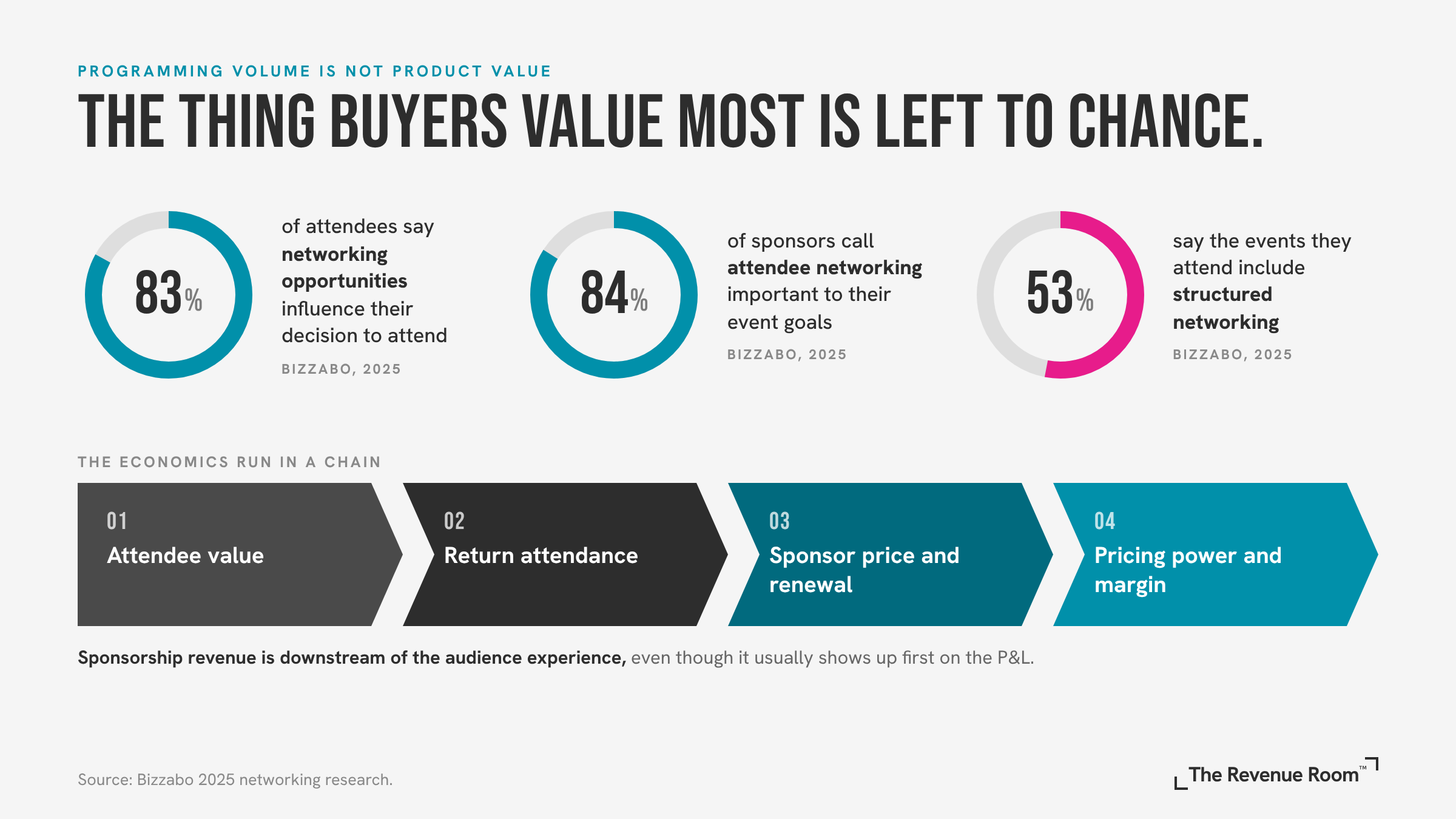
The economics run in a chain. Attendee value drives return attendance. Return attendance and audience quality determine what sponsors will pay and whether they renew. Sponsor renewal and attendee loyalty together determine pricing power and margin. Sponsorship revenue is downstream of the audience experience, even though it usually shows up first on the P&L.
Many organizers appear to underinvest in exactly the part of the experience that drives both sides of that chain. In Bizzabo's 2025 networking research , 83% of attendees said networking opportunities influence their decision to attend and 84% of sponsors called attendee networking important to their event goals, yet only 53% said the events they attend include structured networking. eMarketer's 2026 B2B event marketing research found the same 83% of US B2B attendees would add more networking to their ideal event. The thing buyers and sponsors value most is the thing most agendas leave to chance between sessions.
There is a second consequence: measurement. Garrigan's least favorite metric in any strategy framework is brand lift, because it means whatever the person in the room wants it to mean. When success conditions are vague, leadership cannot make sound decisions about pricing, capital, or whether an event deserves a second year.
Operating Diagnosis: Why the Audience Becomes an Afterthought
This is not only a programming issue. In most media and event organizations, the outcome depends on several functions that each optimize for their own measure.
- Programming and editorial are rewarded for the names on the agenda.
- Sponsorship sales sells the agenda, because a speaker slate is easy to put in a deck.
- Audience marketing is often brought in after the agenda is locked, with a registration target rather than an audience definition.
- Finance sees the result after the event, when the decisions that shaped it can no longer be changed.
No one owns the audience outcome end to end, so the default becomes booking speakers instead of reporting. The result, in Garrigan's words, is "a series of meandering one-act plays." Media organizations are especially prone to this. As he put it, there is a reflex that if every minute is not programmed with content, the event has underdelivered. Holst-Knudsen admitted to the same pull while planning RevvedUP 2027: the instinct is to keep adding speakers.
A second pattern is the belief that B2B or regulated audiences require a formal, joyless format. Garrigan rejects it, arguing that constraints create freedom. Holst-Knudsen offered a case from her background in manufacturing media: an executive summit for an industry used to forgettable conferences, moved to The Breakers and paired with an awards program. CEOs started attending themselves instead of sending their VPs. The audience felt proud of their industry, and the event became something people wanted to be part of.
The same diagnosis explains an asymmetry Garrigan has watched for years. Media companies tend to launch events well because they already build a year-round world for an audience; an event is one more touchpoint. Event organizers who see their audience a few days a year often struggle to launch media, because they are trying to manufacture a continuous relationship they never had. His first question to them: is anybody asking for this?
Management Framework: Five Moves for an Audience-Led B2B Event Strategy
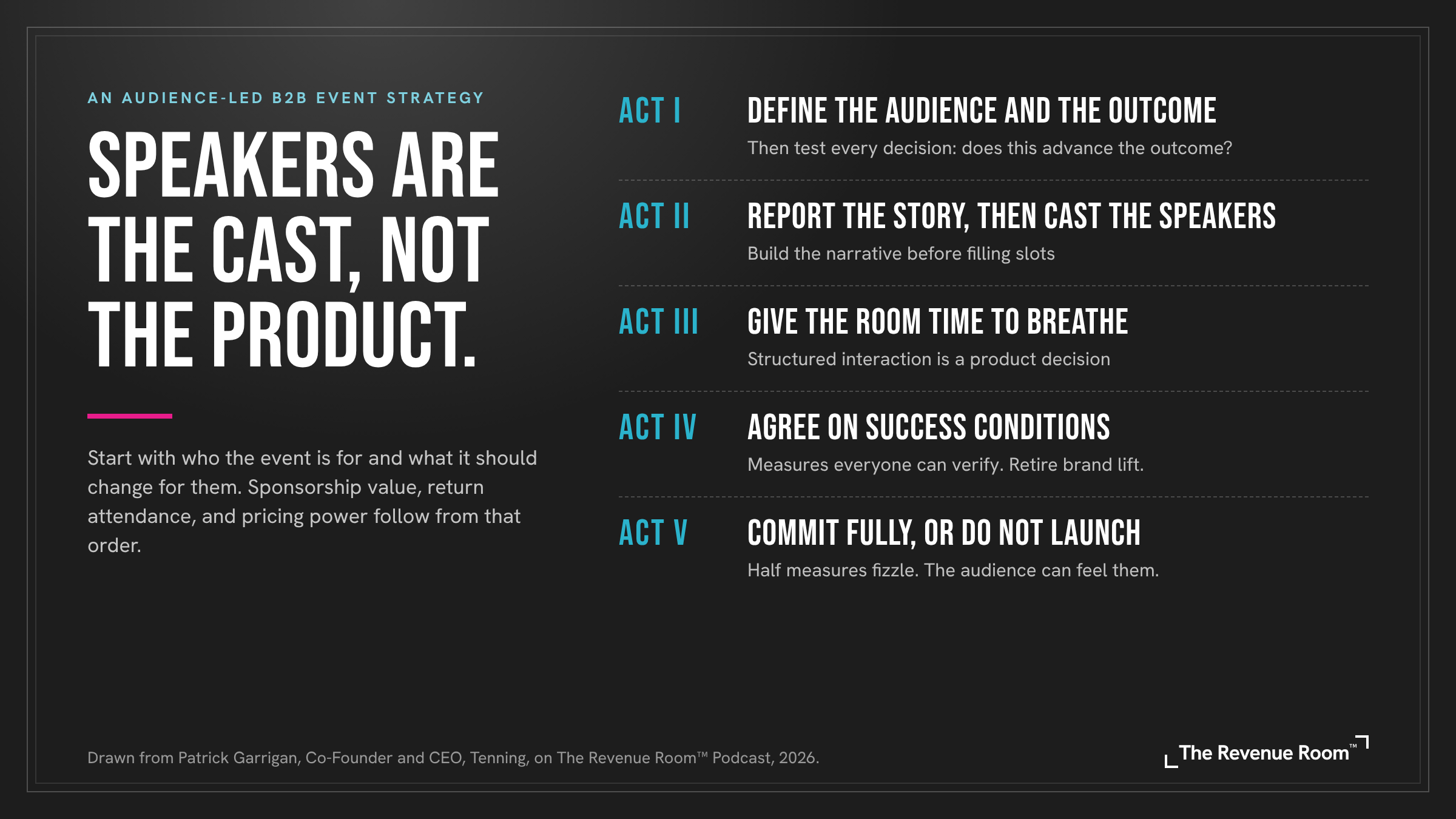
1. Define the audience and the desired outcome before anything else
Garrigan's theater training started with Aristotle's Poetics: know your audience, take them on a journey, and have them leave feeling differently than when they arrived. Once leadership knows who the event is for and what it should produce, most decisions reduce to one test: does this advance the outcome? Tenning made the point structurally. Its first hire led event marketing and audience strategy, so audience work starts every engagement.
2. Report the story, then cast the speakers
Do the research, build the narrative, and decide how each session stacks on the last before filling slots. Then prepare moderators and speakers to perform it. Garrigan tells the story of a Broadway choreographer who watched an assistant's number and asked one question: "Does it have to stink?" Most executive programs never ask it. At Condé Nast, the WIRED Big Interview was built around a small number of interviews that mattered rather than what Garrigan calls "speakerpalooza."
3. Give the room time to breathe
Fewer sessions can produce a more valuable event. For a recent tech client, Tenning deliberately built long networking blocks because attendees had traveled across the country to connect and digest. The programming felt more fulfilling as a result, all entrées and no filler. Holst-Knudsen has tested a version of this at RevvedUP , where attendees were matched into tables using AI and handed a sealed envelope with a real business problem to solve together. Structured interaction is a product decision, not a break in the schedule.
4. Agree on success conditions everyone can measure
Before launch, get every stakeholder to agree on what success means and remove anything as subjective as brand lift. Garrigan finds that once the guardrails are set, teams are more creative, not less, because they know where the boundaries are. Reasonable candidates include return attendance, sponsor renewal, qualified meetings, and conversion of attendees into year-round subscribers or members. The specific measures matter less than agreeing on them before the first contract is signed.
5. Commit fully, or do not launch
Garrigan's consistent thread from Bloomberg to Condé Nast is thinking audaciously. The Qatar Economic Forum launched as one of the first hybrid events out of the pandemic, with roughly a dozen heads of state and hundreds of virtual roundtables, and by his account is now in its sixth edition. Half measures tend to fizzle because the audience can feel them. The same discipline applies to extensions: before turning a flagship event into a media business, confirm someone is asking for it, that it is distinctive, that editorial and commercial talent is funded, and that it will get enough runway to experiment and fail.
Why these moves compound: where a platform advantage could come from
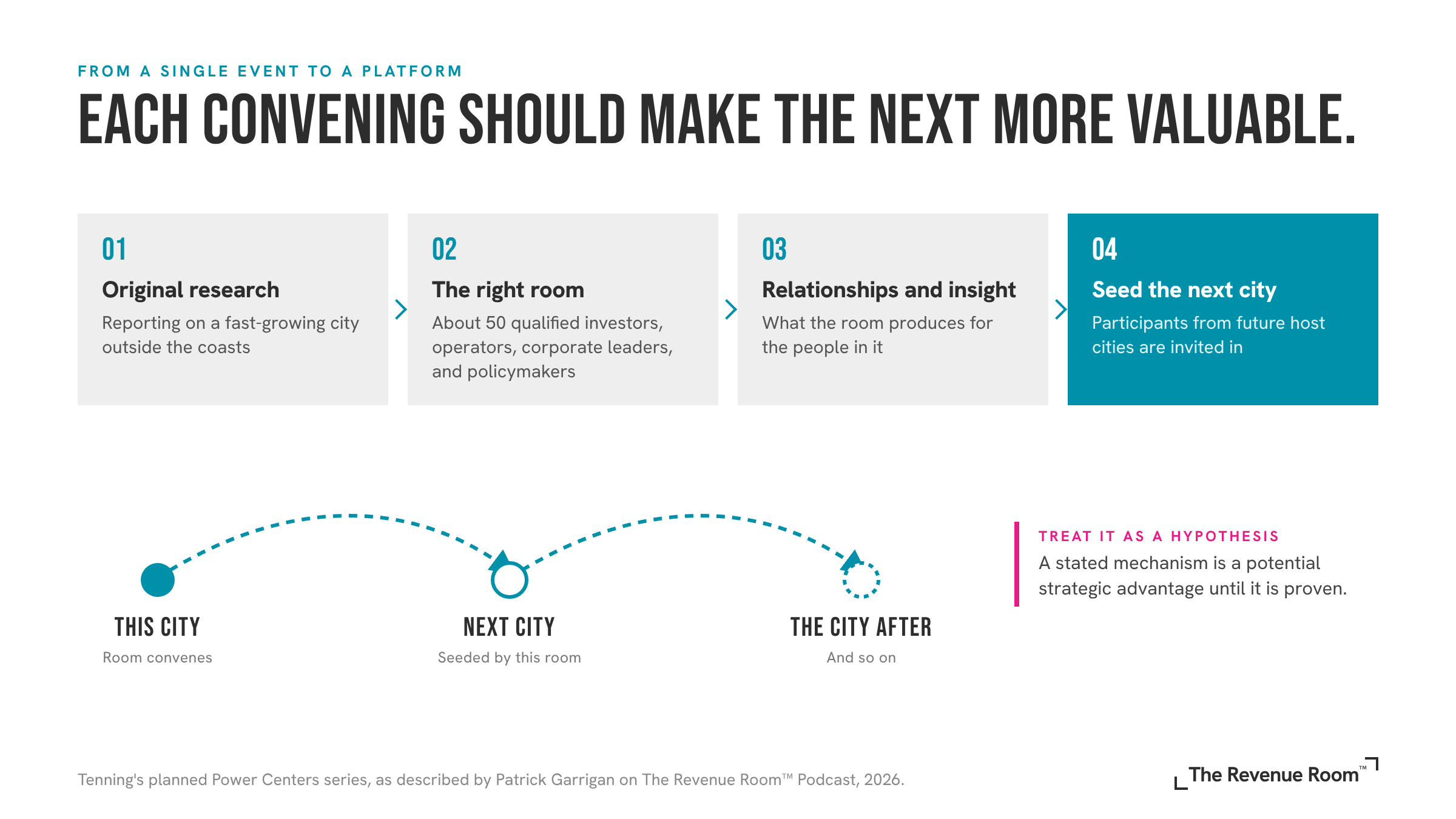
A single strong event is a product. An event business becomes a platform when each gathering makes the next one more valuable. Tenning's planned Power Centers series illustrates the design: each convening is anchored in original reporting on a fast-growing city outside the coasts, brings together about 50 qualified investors, operators, corporate leaders, and policymakers, and invites participants from future host cities. The intended loop is explicit. Research attracts the right room, the room produces relationships and insight, and those participants seed the next city. Until proven, that is a potential strategic advantage, but it is a stated mechanism, which is more than most event portfolios have.
Tenning's founding principle, be useful, reinforces the same logic. It means scoping only to what the client needs and treating a client who brings the work in house as a success; Garrigan argues that integrity makes the work evolve rather than end. For event and media companies, the parallel is the sponsor pitch. Too many still leave the buyer thinking, as Garrigan put it, "I get why this is good for you, but I have no idea what this does for me." Sponsors renew when the audience in the room serves their goals, and that conversation, he insists, happens across a table, not only over Zoom.
90-Day Application
Days 1 to 30: Audit the last event against its audience. Define who the flagship event is for and what it should change for them. Map every session against that outcome. Pull return attendance and sponsor renewal for the last two editions, and name one executive who owns the audience outcome end to end.
Days 31 to 60: Build the narrative before the agenda. Draft a narrative brief for the next event before booking remaining speakers. Agree on three to five success measures with programming, sales, marketing, and finance, and retire any metric no one can verify. Allocate structured networking time on the agenda as deliberately as keynote time.
Days 61 to 90: Test one format change and rebuild the sponsor conversation. Pilot one structured interaction format, such as matched tables or a shared problem-solving session. Brief moderators as performers with a role in the story. Meet top sponsors in person to learn what they need the audience to do. At day 90, recheck: did the narrative brief change the agenda, and did sponsor conversations shift from inventory to outcomes?
Executive Questions
- Who owns the audience outcome for our flagship event end to end, and do they have authority over programming, marketing timing, and format?
- If we removed a third of the sessions, what would attendees lose, and what would they gain?
- Which of our event success measures would survive scrutiny from finance, and which are closer to brand lift?
- Are sponsors renewing because of the audience in the room or because of the names on the agenda?
- Before we launch the next extension of a successful event, who is asking for it, and are we funding the talent and runway it needs?
Continue the Conversation
Listen to the full episode of The Revenue Room™ Podcast with Patrick Garrigan. The questions above are the kind Revenue Room™ CXO members work through together inside an invite-only executive peer network and year-round decision system for profitable growth. If you are rethinking how your event portfolio creates value, learn more about membership , and join us at RevvedUP 2027 , where registration is now open.
Sign in or Join the community
The Nexus for Data-Driven Growth Leaders

Create an account
The Nexus for Data-Driven Growth Leaders
Like
Dive in
Related
32:12
Video
Why the Durable B2B Media Moat Starts With Following the Reader
By Jon Howland • Oct 15th, 2026 • Views 4
Blog
Don't License the Archive. Own the Interface or Meter the Access.
By Heather Holst-Knudse... • Oct 22nd, 2026 • Views 1
Blog
When AI Agents Become an Audience, the Media Business Model Changes
By Heather Holst-Knudse... • Oct 12th, 2026 • Views 42
Blog
From Audience to Ecosystem: Why Community is the New Growth Engine
By Heather Holst-Knudse... • Aug 29th, 2025 • Views 70
32:12
Video
Why the Durable B2B Media Moat Starts With Following the Reader
By Jon Howland • Oct 15th, 2026 • Views 4
Blog
When AI Agents Become an Audience, the Media Business Model Changes
By Heather Holst-Knudse... • Oct 12th, 2026 • Views 42
Blog
From Audience to Ecosystem: Why Community is the New Growth Engine
By Heather Holst-Knudse... • Aug 29th, 2025 • Views 70
Blog
Don't License the Archive. Own the Interface or Meter the Access.
By Heather Holst-Knudse... • Oct 22nd, 2026 • Views 1