The job posting is not the intervention
When growth falls short, the explanation most leadership teams reach for is sales execution. The remedy follows quickly: a new CRO, a new sales leader, more hunters, a reorganized team. Sometimes that is right. Often it is not.
Early results from the Revenue Room™ CEO Value Creation Baseline point to why. When sales execution is named as the constraint, leadership should first test whether the role is the problem or the system the role operates inside . A strong seller placed into unreliable customer data, a blended go-to-market motion, and unclear handoffs will underperform, and the company will have spent a year and a salary learning what a diagnostic could have shown in a month. Business consequence: expensive hires into unclear systems
The cost of getting this wrong is larger than one salary. One Revenue Room™ CEO Boardroom member with long experience building sales teams estimated that a new seller takes roughly nine months to ramp, and that teams should hire six to nine months ahead to cover expected turnover. A hire made into a broken system can consume most of a fiscal year before the problem becomes undeniable, and then the cycle restarts. There is also a capital allocation trap. New logo acquisition is expensive and its return is slow, often 18 months or longer in member experience. Expansion returns faster. The result, as one CEO in the CEO Boardroom Exchange described it, is that expansion quietly cannibalizes the new business effort, even when new business is the stated priority. Leadership announces a hunting strategy and funds a farming one.
The number that governs this tension is net revenue retention. If the same sellers are asked to chase new logos while protecting the base, retention is usually what slips. SaaS Capital's 2026 survey of more than 1,000 private SaaS companies put median NRR at 103 percent for companies between $3 million and $20 million in ARR. Media, events, and data businesses do not have a comparable public benchmark, but the management standard members discussed is clear: if new business is the priority, the design has to hold NRR at 100 or above while pursuing it. Ninety is a bad number, and it is easy to reach while celebrating new logos. Operating diagnosis: what the baseline shows
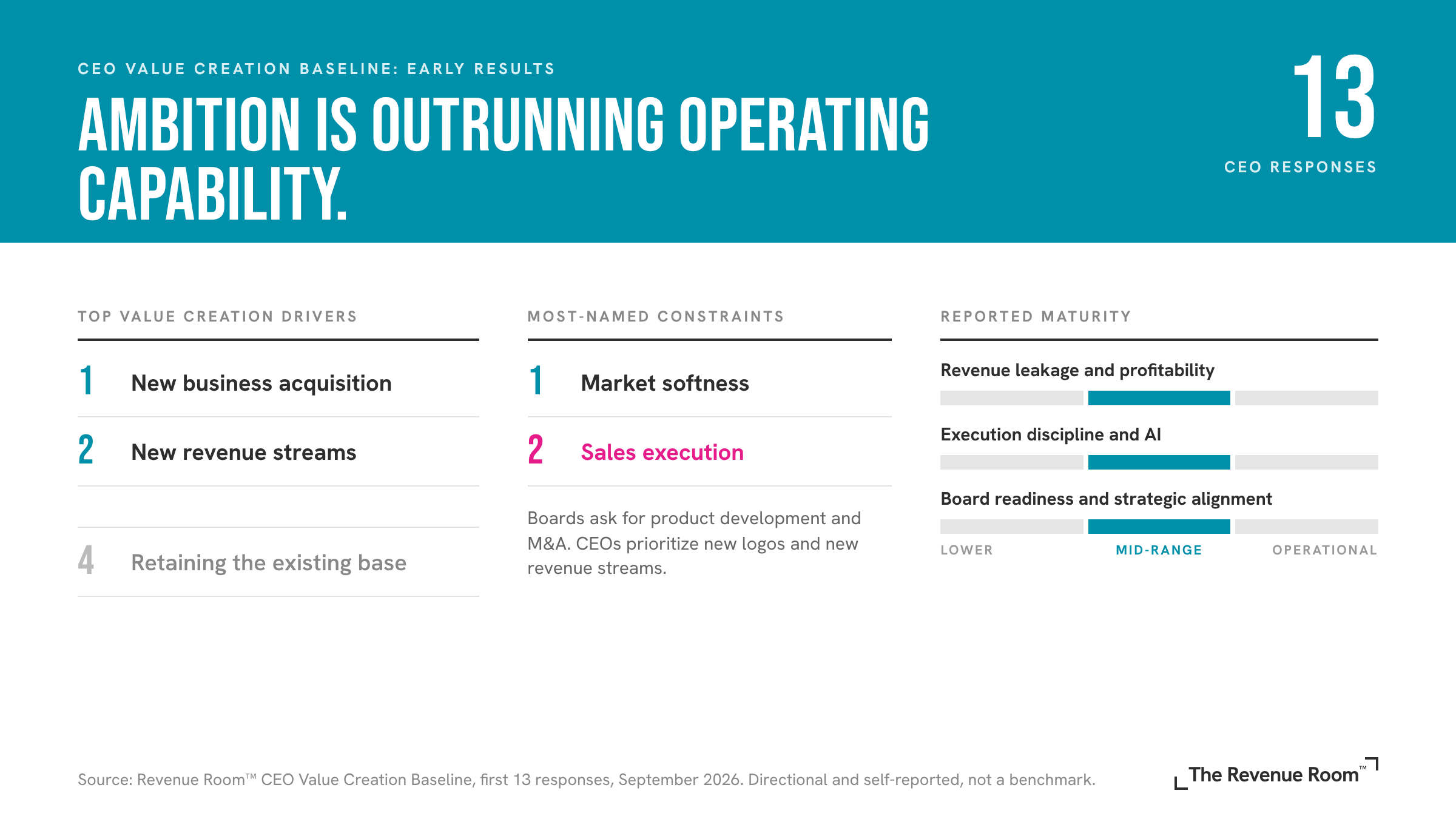
The first 13 responses to the CEO Value Creation Baseline span media and marketing services, private equity backed and privately held companies, from under $1 million to $100 million in revenue. The sample is small and the findings are directional, but the shape is consistent with what CEOs describe in the room.
- New business acquisition is the top value creation driver CEOs name, followed by new revenue streams. Retaining the existing base ranks fourth.
- Market softness and sales execution are the two constraints named most often for missing target.
- Reported maturity sits in the middle across all three capability areas the baseline examines: revenue leakage and profitability, execution discipline and AI, and board readiness and strategic alignment. Respondents place themselves mid-range rather than at an operational level, and they do so evenly across all three.
- Board and CEO priorities diverge. Respondents report boards asking for product development and M&A while CEOs prioritize new logos and new revenue streams.
The pattern suggests ambition is outrunning operational capability. Wanting new logos is not the same as having a motion designed for acquisition, sellers suited to hunting rather than farming, or a marketing function carrying a pipeline KPI.
The diagnosis is also where perspectives diverge. In an earlier readiness study, three executives from the same company answered the same questions. The CEO reported the business was in good shape. The chief commercial officer reported it was mostly fine, with customer success not using data well. The division head reported gaps across the board. None of them was necessarily wrong. The difference itself was the signal, and it is why a single executive's view is a weak basis for a hiring decision.
Five tests before the next sales hire
1. Test the root cause before naming the role
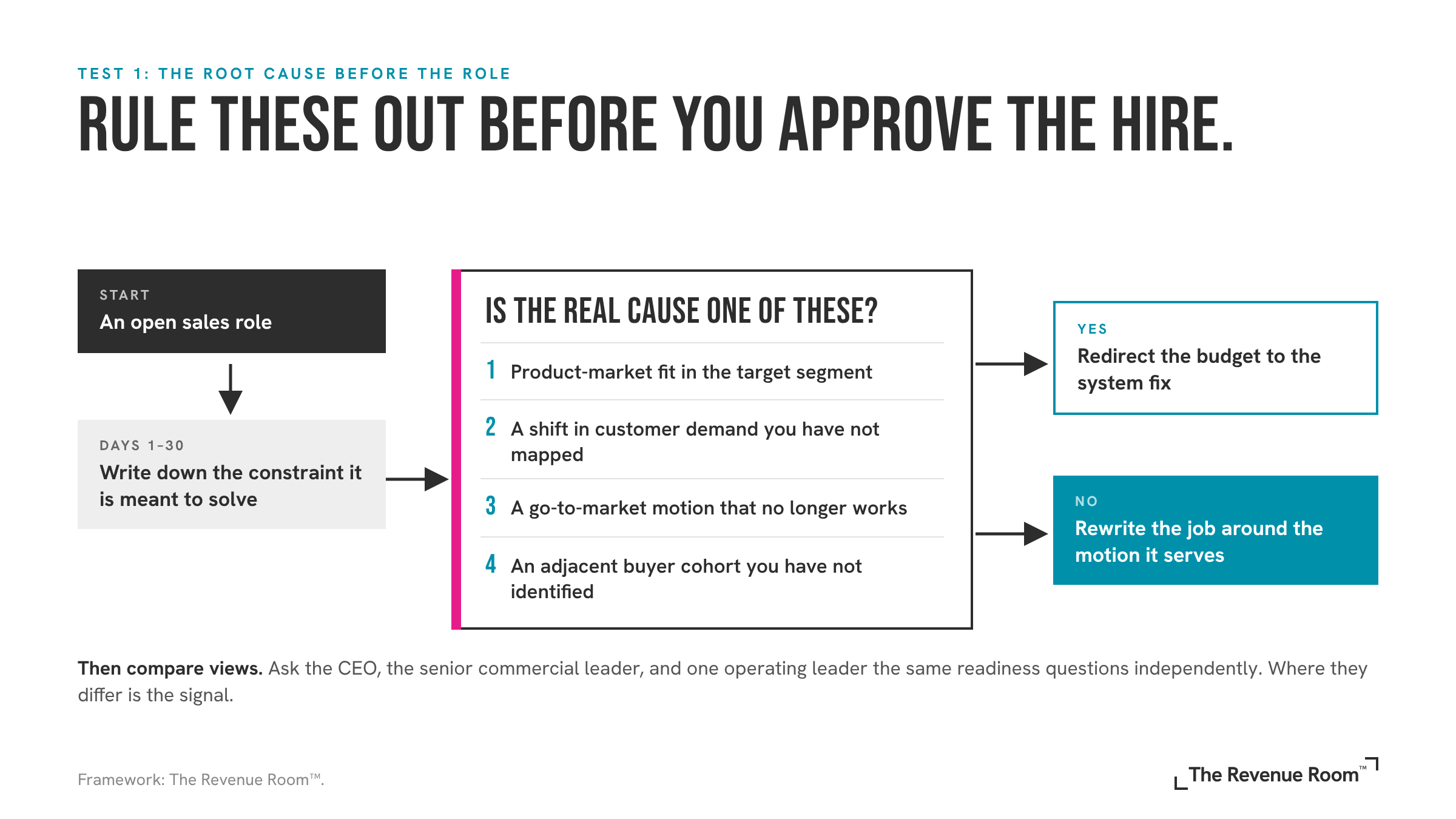
If sales execution is the stated constraint, check four alternatives first: product-market fit in the segment you are targeting, a shift in customer demand you have not mapped, a go-to-market motion that no longer works, or an adjacent buyer cohort you have not identified. If any of these is the real cause, the hire will not fix it.
2. Separate the motions
Acquisition, retention, and expansion require different talent, evidence, incentives, and cadences. The Human-AI Revenue Operating System Playbook developed with the Revenue Room™ CXO Growth Room recommends organizing around these motions while preserving one account strategy. Where customers would be frustrated by three people calling on them, a viable middle path is one sales owner for the account, partnered with a customer success function chartered to find additional wallets and hand qualified expansion back. 3. Fix the right side of the bow tie
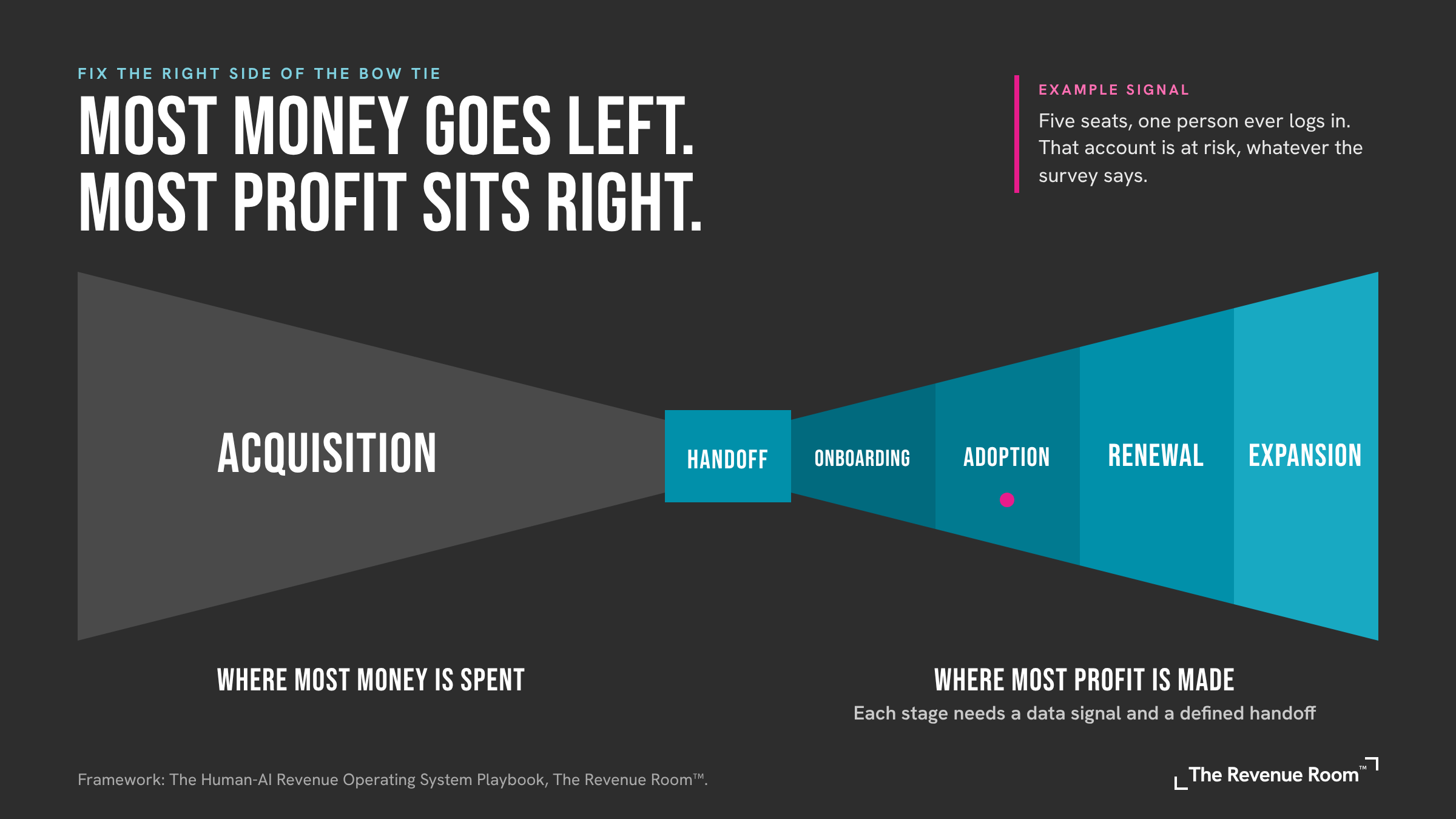
The playbook replaces the funnel with a bow tie. Acquisition sits on the left and is where most money is spent. Onboarding, adoption, renewal, and expansion sit on the right and are where most profit is made. Each stage needs a data signal and a defined handoff. A simple example from member discussion: if a member company has five seats and only one person ever logs in, that account is at risk, whatever the satisfaction survey says.
4. Make lead follow-up a measured accountability
A common frustration among members is not lead volume but lead action. Marketing generates qualified demand, and sellers return to existing accounts. If leads are a cost, response time, touch cadence, and conversion within 30 and 60 days should be KPIs for both the seller and the sales leader, visible on the same dashboard as quota. Members also report that live experiences, such as roundtables and small events with the right buyers in the room, often convert better than nurture campaigns, which argues for measuring an event's pipeline value rather than treating it as a marketing expense. 5. Design the role for the people you can hire
One member, a former digital media operator, described a model that stopped chasing exceptional sellers. The company hired capable reps, made success easier through tooling, pricing support, and clear account targets, and moved its strongest sellers into specialist roles that parachute onto strategic accounts. The approach accepts a planned turnover rate, but it scales without depending on rare talent. Whether it fits depends on how transactional the business really is, a question several members noted they tend to answer less honestly than they should.
90-Day Management Focus
Days 1 to 30. Before approving any open sales role, write down the constraint it is meant to solve and test it against the four alternative causes. Ask the CEO, the senior commercial leader, and one operating leader to answer the same readiness questions independently, and compare the results.
Days 31 to 60. Map acquisition, retention, and expansion ownership on one page, including handoff points. Establish lead-action KPIs and put them on the sales leadership dashboard. Calculate NRR at the account level for the top 50 accounts. Days 61 to 90. Decide whether the open role is still the right intervention. If it is, rewrite the job around the motion it serves. If it is not, redirect the budget to the system fix identified. Recheck at day 90 whether NRR held while new business activity increased.
Questions for the leadership team
- When we say sales execution is the constraint, what evidence rules out product fit, demand shift, or a broken motion?
- Would a strong new seller inherit customer data and a CRM they could trust?
- Is new business our priority in the budget, or only in the strategy deck?
- What NRR are we committing to hold while we pursue new logos, and who owns it?
- Where do our CEO, commercial leaders, and operating leaders see the business differently, and have we asked?
Continue the conversation
The Revenue Room™ Growth Readiness Profile pairs the CEO Value Creation Baseline with three team scorecards, the Revenue Intelligence Scorecard, the Revenue Leakage Scorecard, and the AI Value Creation Scorecard, so leadership can see where its priorities and its operating capability diverge before committing to a hire. Revenue Room™ CXO is an invite-only executive peer network and year-round decision system for profitable growth, and the CEO Boardroom Exchange is where questions like this are pressure-tested with peers. Sales organization design is also on the agenda at RevvedUP 2027 .