Market-Making Platforms
November 24, 2026
Paid Executive Membership Is a Different Business. Organize Your Commercial Team Like It.
# The New Revenue Organization
# Paid executive membership
# Media company membership model
# Executive community pricing
# B2B media commercial strategy
What ADWEEK's Vanguard programs show about pricing, sales design, and the curation discipline that gets executives to pay to belong.

Heather Holst-Knudsen
Paid Executive Membership Is a Different Business. Organize Your Commercial Team Like It.
Most media and events companies already own the raw material for a paid executive membership: a senior audience, an events calendar, editorial authority, and sponsors who want access to all three. What many lack is a commercial organization built to sell it. Membership asks an executive to commit time and judgment to an ongoing relationship. That is a different promise than a campaign or a ticket, with a different buyer, a different objection, and a different sales motion(opens in a new tab) .
A paid executive membership works when leadership treats it as its own business, with a dedicated sales motion, deliberate pricing, and governed curation, while keeping one accountable owner for each commercial account. Bolting membership onto an advertising or sponsorship team tends to underprice it, undersell it, and erode the trust that makes executives pay.
That is the clearest lesson from my recent episode of The Revenue Room™ Podcast with Jordan Hyman, SVP Commercial at ADWEEK(opens in a new tab) and a Revenue Room™ CXO member(opens in a new tab) . ADWEEK now runs paid membership through Marketing Vanguard(opens in a new tab) for brand CMOs and Agencies Vanguard(opens in a new tab) for agency leaders, with Communications Vanguard planned for 2027. Below is what operators can take from it.
Why paid executive membership matters to the P&L
Start with the economics.
Jordan expects events to exceed half of ADWEEK's revenue next year, and he was direct about why membership matters alongside that growth: events are expensive to produce, and membership is "hugely important to our business, especially from an EBITDA perspective." For any company whose growth is concentrated in live events, recurring membership revenue with modest incremental delivery cost is one of the few levers that improves margin mix rather than simply adding volume.
Second, pricing power.
Marketing Vanguard charges a single rate of $9,999 a year for brand CMOs, with the same model for agencies. Companies that want into the room to do business with those CMOs pay what Jordan described as roughly five to six times the standard rate as partner members. His own read on the base price: "we may be underpricing it."
I shared a parallel from a membership she previously built in manufacturing, where executives paid between $10,000 to $25,000 depending on company size and vendors paid about $100,000 for a peer seat. The pattern is consistent. The executive rate seeds the community. The partner rate monetizes access to it.
Third, runway.
Jordan noted that far more executives have attended at least one ADWEEK event in the last three years than have joined as members. For most event-led businesses, the membership pipeline is already sitting in the attendee database.
Finally, trust.
A membership is only as valuable as the confidence members place in the room. If that confidence erodes, the damage does not stay inside the membership line. It reaches editorial credibility, event attendance, and sponsor value.
The operating diagnosis: where membership stalls
The wrong sales motion.
Sponsorship sellers sell reach, moments, and outcomes for a brand. Membership sells personal commitment.
Jordan put the real objection plainly: "it's not even the money, frankly, it's the time."
CMOs he knows will not join unless they can commit the hours. There is also a career dimension. Jordan joked that CMO shelf life rivals an NFL running back's. The data is less severe but makes the same point:
Spencer Stuart puts average S&P 500 CMO tenure at 4.1 years(opens in a new tab) , 3.5 years at consumer companies, against 5.0 years for the C-suite overall. Executives join to bring value back to the business and to build a network that protects their own careers. A seller trained to pitch audience reach is not equipped to sell either.
I was blunt about this in the episode: monetizing an audience through membership is "a different sales motion 100%" than sponsorship, advertising, branded content, or lead generation, and it needs its own strategy and team. I learned that the hard way.
Unclear account ownership.
Multi-product media companies increasingly find the buyer and the member inside the same company. Jordan's example: ADWEEK's day-to-day client at CVS is its retail media network, CMX, while the CVS CMO is a potential Marketing Vanguard member.
An agency such as Weber Shandwick may spend with ADWEEK on its own behalf, bring clients to ADWEEK, and qualify for Agencies Vanguard. With hundreds of retail and commerce media networks now operating, this overlap is growing. Without explicit rules, sellers either compete for the same relationship or ignore the opportunity that is not in their comp plan.
Sponsor gravity.
The free executive dinners and councils competing for a CMO's calendar are not free. They are sponsor-funded, and the agenda bends toward what sponsors need. A paid model flips accountability to the member, but only if partner participation is limited and governed. Partner members paying a premium for access are a revenue asset and a curation risk at the same time.
Capacity assumptions that are not yet proven.
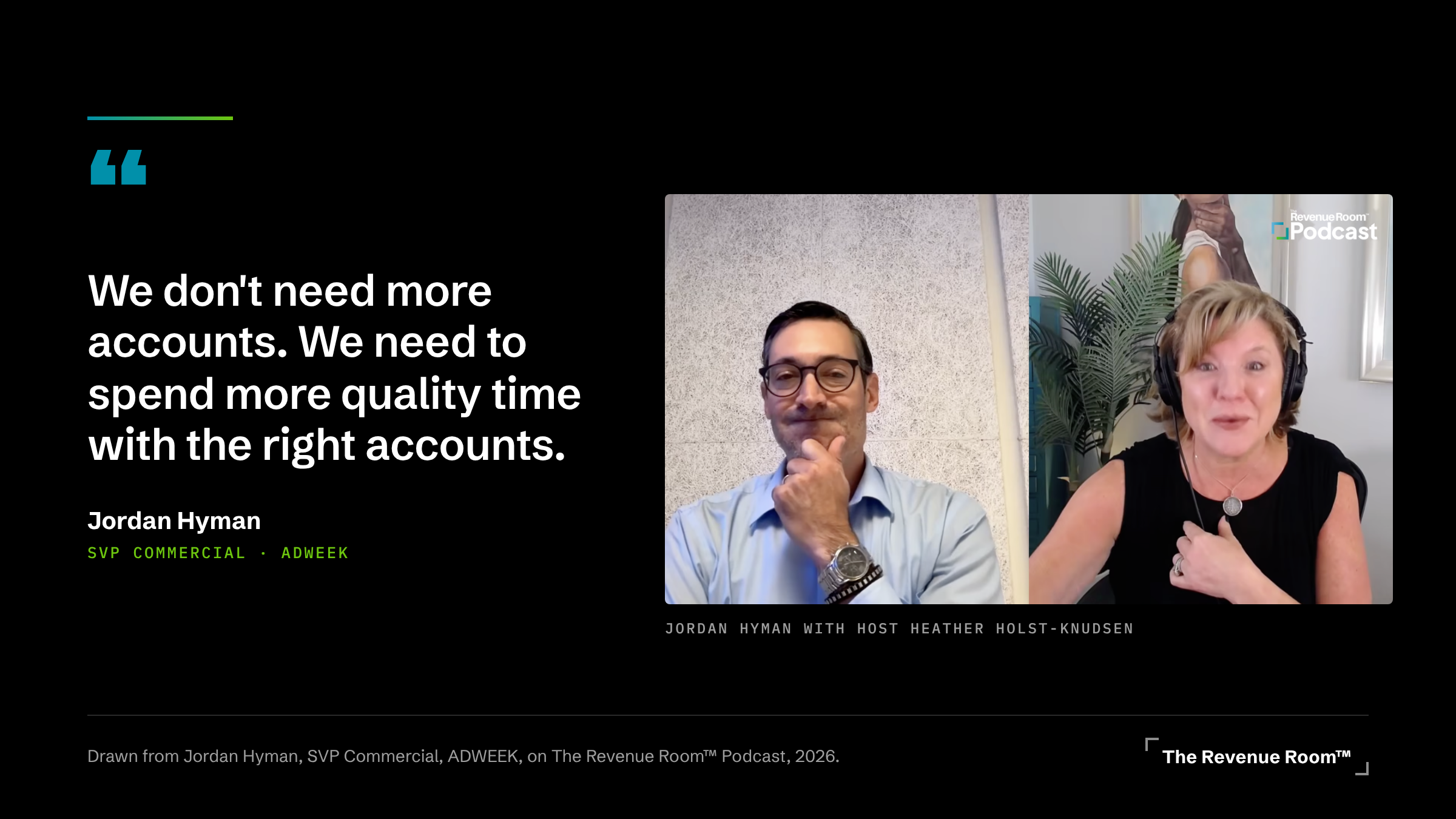
I raised a proposal she heard at a recent CMO and CRO summit: raise quotas 25% because AI makes sellers faster. Jordan's evidence did not support it. ADWEEK is using AI and tools such as Gong to sharpen call prep, follow-up, and account focus, and post-sale execution is faster. But he is not seeing new sellers ramp faster or average book sizes grow. Salesforce's 2026 State of Sales research(opens in a new tab) finds the average seller still spends only about 40% of their time selling. Time saved is capacity, not proven yield. As Jordan put it: "We don't need more accounts. We need to spend more quality time with the right accounts." That matters even more in a consultative, high-trust membership sale.
A management framework for selling belonging
1. Separate the motion, not the relationship
ADWEEK keeps one account holder for all sell-side revenue, including sponsorship of Vanguard moments, while a dedicated membership team owns executive acquisition, renewal, and servicing. Referrals move in both directions with no walls. The design choice is worth copying: the client gets one consultative partner who leads with business outcomes rather than products, and the membership sale gets specialists who understand commitment-based selling. Write down who gets credit for a referral, a close, and a renewal before the first dispute, not after.
2. Price for the commitment, then tier for access
Treat the founding rate as a customer acquisition and co-design investment, not a permanent price point. Founding members function like an executive advisory board, shaping the product in exchange for preferential terms. Decide in advance how and when the rate steps up. Then set a separate, materially higher rate for partners and vendors who want a peer seat, and cap how many of them enter the room.
3. Engineer the first meaningful experience
If time is the real cost, the product has to make that time visibly worth it. Jordan described the Marketing Vanguard Summit, (opens in a new tab) held one day a year at the University of Chicago Booth School of Business with roughly 100 attendees, as a room where senior CMOs keep laptops open, take notes, and respond to structured provocations rather than sit through panels.
Our experience at Revenue Room™ CXO(opens in a new tab) points the same way: virtual peer calls generate ideas, but in-person member-only events such as CXO Exchange are where the value becomes obvious. Identify the moment a new member first experiences real value, and design the onboarding path to reach it quickly.
4. Make curation a governed decision
Decide, in writing, who has authority to decline a significant advertiser who is not the right fit, what visibility benefits membership includes, and what it never buys. Marketing Vanguard includes an annual byline and priority access to certain speaking and podcast opportunities, which makes the line between member visibility and independent editorial coverage worth defining explicitly. Curation also means knowing the persona. As Heather noted, some executive roles simply do not join communities, and that is defined by the role, not the pitch.
5. Expand on demand and partnership, not member count
Jordan was clear that ADWEEK does not launch a new community because it hit a membership number. Agencies Vanguard followed several years of agency-focused events and overwhelming demand, and its 20 founding members added a new pillar, "action," to the original access, intelligence, and influence framework.
Communications Vanguard is being built with Burson after the agency offered to co-develop it, and ADWEEK's presence at Davos with The Female Quotient(opens in a new tab) helped surface the chief communications officer opportunity. Each community also has dedicated leadership on the community side. The test for a new vertical: proven engagement, an insider partner with skin in the game, an owner who lives that persona, and the bandwidth to do it well.
The platform logic, and where it breaks
Membership is more than another revenue line when it creates a reinforcing loop. Events surface engaged executives. The best of them convert to members. Member participation sharpens programming and editorial, as Agencies Vanguard's founding members did when they reshaped the product. Better programming attracts more senior members. A more senior room commands a partner premium, and that premium funds the curation that keeps the room valuable.
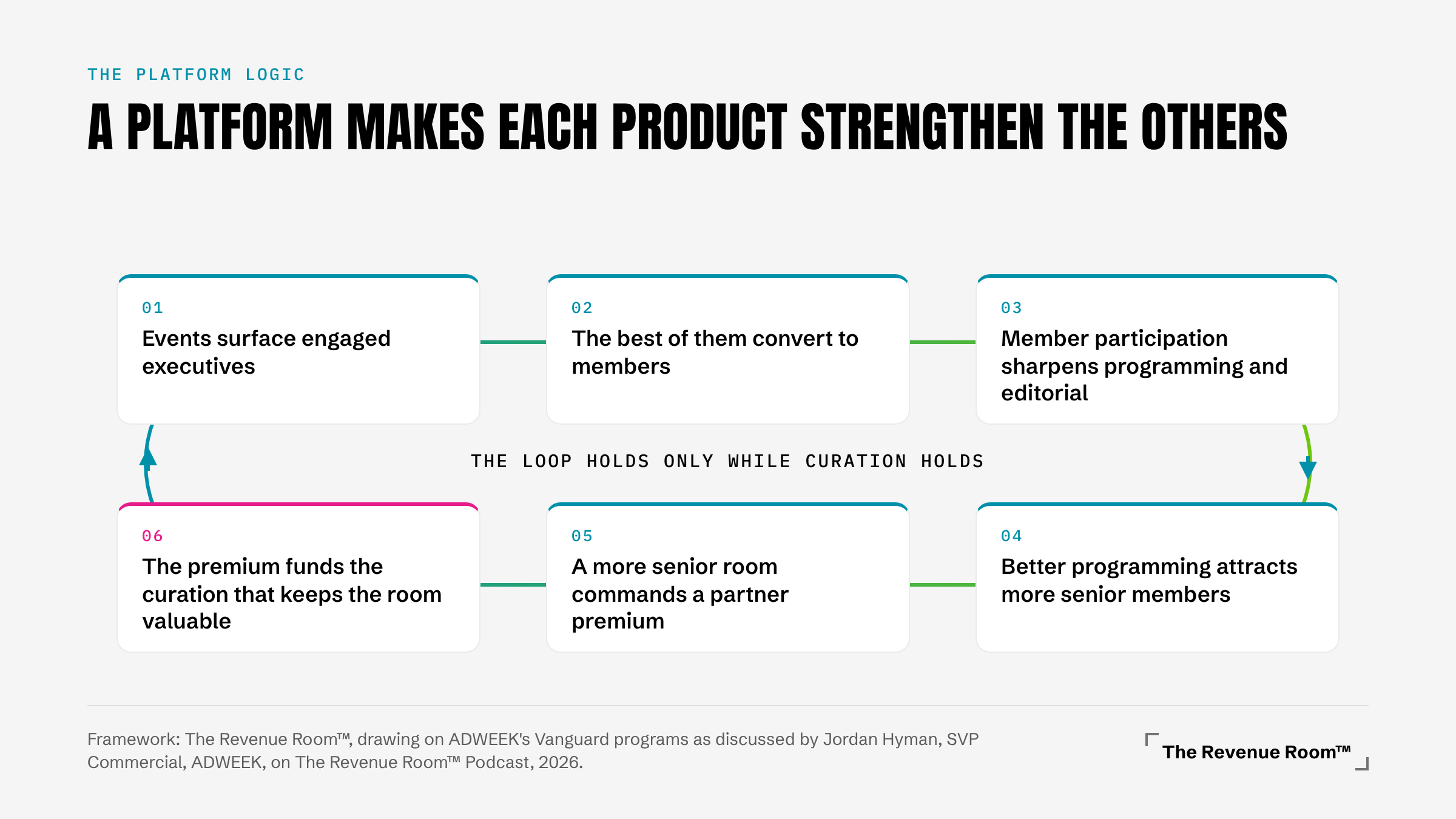
That is a potential compounding advantage, not a guaranteed one. The loop holds only while curation holds. The moment partner revenue starts setting the agenda, the mechanism reverses: members disengage, the room loses seniority, and the partner premium becomes harder to justify. This is the portfolio-versus-platform distinction in practice. A portfolio adds a membership product. A platform makes each product strengthen the others.
90-Day Management Focus
Days 1 to 30: Map the overlap. Identify every account with both commissionable revenue and membership potential. Assign ownership and credit rules for referrals, closes, and renewals. Quantify the conversion pool: executives who attended events in the last three years but have not joined.
Days 31 to 60: Fix pricing and boundaries. Set the step-up path from founding rate to full rate. Set the partner multiple and a cap on partner seats. Agree with editorial, in writing, what membership includes and what it does not buy.
Days 61 to 90: Instrument value and renewal. Define the first meaningful experience and measure time to reach it. Identify engagement signals that predict renewal before renewal season. Baseline AI-driven capacity gains(opens in a new tab) before changing any quota.
Progress indicators to watch: attendee-to-member conversion, time to first meaningful experience, renewal intent, referrals moving in both directions between account and membership teams, and the partner share of each room.
Executive questions for your leadership team
- Who owns the relationship when a company is both a sell-side client and the employer of a prospective member, and who gets credit when one leads to the other?
- Is our founding rate a deliberate acquisition investment with a planned step-up, or a price we will struggle to raise?
- Who has the authority to decline a major sponsor or advertiser who is not the right fit for the room?
- What evidence would we need before raising seller quotas on the assumption that AI has made them more productive?
- Which signals tell us a member will renew 90 days before renewal, and who acts on them?
Continue the conversation
Listen to the full episode of The Revenue Room™ Podcast with Jordan Hyman for the complete discussion of ADWEEK's commercial model.
These are the decisions Revenue Room™ CXO (opens in a new tab) members work through together: an invite-only executive peer network and year-round decision system for profitable growth across media, events, and data businesses. If you are weighing a paid membership launch or redesigning your commercial organization around one, bring the question to RevvedUP 2027(opens in a new tab) , March 14 to 16 at The Vinoy Resort and Golf Club in St. Petersburg, Florida, or apply to join Revenue Room™ CXO.
Sign in or Join the community
The Nexus for Data-Driven Growth Leaders

Create an account
The Nexus for Data-Driven Growth Leaders
Like
Dive in
Related
Blog
Your Revenue Team Is Not Broken. Your Model Is Too Slow.
By Heather Holst-Knudse... • May 28th, 2026 • Views 87
41:16
Video
Speed vs. Trust: How MJH Life Sciences Is Scaling AI Across 50+ Healthcare Brands
By Heather Holst-Knudse... • Nov 12th, 2026 • Views 4
Blog
How to Industrialize Content Operations Without Industrializing the Content
By Heather Holst-Knudse... • Nov 20th, 2026 • Views 11
Blog
Why AI Investment Stalls on Data Debt, and What Leadership Has to Decide First
By Heather Holst-Knudse... • Nov 17th, 2026 • Views 25
Blog
Your Revenue Team Is Not Broken. Your Model Is Too Slow.
By Heather Holst-Knudse... • May 28th, 2026 • Views 87
Blog
How to Industrialize Content Operations Without Industrializing the Content
By Heather Holst-Knudse... • Nov 20th, 2026 • Views 11
Blog
Why AI Investment Stalls on Data Debt, and What Leadership Has to Decide First
By Heather Holst-Knudse... • Nov 17th, 2026 • Views 25
41:16
Video
Speed vs. Trust: How MJH Life Sciences Is Scaling AI Across 50+ Healthcare Brands
By Heather Holst-Knudse... • Nov 12th, 2026 • Views 4