Leadership
July 22, 2026
The 7% Problem: What Jay Lauf Says Most CEOs Get Wrong About AI
# Executive leadership
# CEO Strategy
# Future of work
# AI
# Founder
# Startup
A conversation with Charter co-founder Jay Lauf on AI spending, burnout, and the subjective side of a successful exit.

Heather Holst-Knudsen
THE 7 PERCENT PROBLEM: WHAT JAY LAUF SAYS MOST CEOS GET WRONG ABOUT AI
I had Jay Lauf on The Revenue Room™ Podcast this week, and there was one line he dropped in rapid fire that I haven't been able to shake:
"The next satisfying media business model will be built on being indispensable, not interesting."
They are the entire through-line of a forty-five minute conversation about AI, burnout, media revenue models, and what CEOs keep getting wrong right now. Jay is two-for-two on exits: founding publisher of Quartz, sold to Uzabase; co-founder of Charter, acquired by The San Francisco Standard in June 2025. He's also the guy who led The Atlantic back to profit and made Wired matter again after the dot-com collapse. So when he talks about what is actually changing at the top of the org chart, I listen.
That "indispensable" line traces back to the year Jay took between selling Quartz and co-founding Charter. He used it to strip his thinking down to what he calls the irreducible truth of a media business: human attention is finite. The means of production change, distribution changes, but that doesn't. The game is capturing a meaningful, concentrated slice of somebody's attention on a recurring basis. Get that right, and the revenue opportunities flow from it. That's where "indispensable, not interesting" comes from, and it's the lens for everything else in this conversation.
I want to do something I don't always do here, pull the conversation apart. If you missed the episode, these are the three things that hit me hardest.
1. THE 93% PROBLEM.
I have been saying this for a year inside Revenue Room™ CXO: every CEO I talk to is buying AI tools like it's 1999 and they are stocking up on servers. Jay put a number on it that crystallized it:
"93% of AI investment is going into the tools. 7% is going into training."
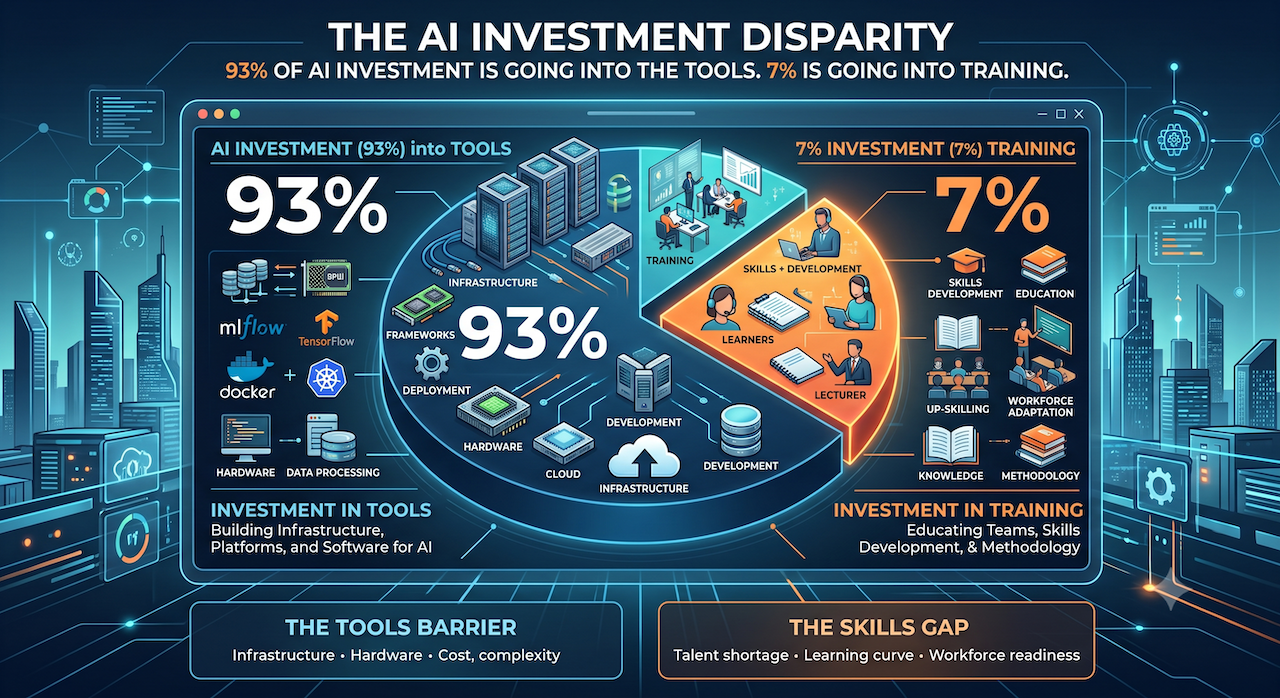
Let that land. We are spending ninety-three cents of every AI dollar on the tool and seven cents teaching people how to use it. Then we wonder why productivity gains have stalled, why governance is a disaster, why nobody can tell me whether the workflow I just ran lives in ChatGPT, Claude, or an agent some twenty-five-year-old built inside a Slack thread.
One of our CEO members put it best during our last Revenue Room™ CEO Boardroom Exchange : "We bought a bunch of tools, opened up all of our data with no governance, and now we are basically running the Wild West."
The opportunity, and Jay has built a real business around exactly this, is the other 7%. The training. The workflow redesign. The cultural permission to test, fail, and report honestly. That is the gap. Charter's Pro members kept pulling them inside the company to run the workshops, build the playbook, and do the hard work of bridging research to practice. Their services line wasn't on the drawing board at launch. The market dragged them in by the lapels.
If your AI spend looks like a software receipt and not a change-management plan, you are doing it wrong.
2. THE THESIS NOBODY WANTS TO DEFEND IN FRONT OF THE BOARD.
This is the one I want every CEO reading this to sit with for a minute.
Jay argues, publicly, at a moment when boards are screaming for margin expansion, that the real opportunity with AI is not more output per hour and more workload because you're more efficient. It's time better spent on activities that create value, and fewer hours worked overtime. And maybe a "new" hour spent on a long walk, the gym, or dinner with your significant other.
He is right. And it is a hard argument to make on an earnings call.
Here is the math he walked me through. A longitudinal Stanford study shows human beings can sustain 50 to 55 hour work weeks. You can stretch up to 65 or 70 for a month or two when a deadline demands it. Past that, every additional hour is valueless. People working 70 hours are demonstrably no more productive than people working 50. Worse, over time, the 70-hour crowd starts producing at a 43-hour level. The brain literally cannot keep the receipts.
I lived this. My bet is most of you reading this have lived it too, or are watching someone on your team live it right now.
Now here is the AI math. If AI delivers a 15% productivity lift, and most of the serious prognosticators think it could be more, that is a decade of normal productivity gains in one year. The default CEO move is to absorb all of it. The smarter move is to give 5% of it back.
A 50-hour person gets two and a half hours a week. A trip to the gym. A school play. Dinner with your spouse, the one Jay still protects every night, the single habit from his sabbatical he refuses to give up. You still end up with 9 to 10% net productivity growth. Two, three, four times what you could normally expect. And you end up with a workforce that isn't quietly quitting on you by Q3.
This is not soft. This is not a wellness memo. Replacing a knowledge worker costs one-and-a-half to two times their salary. Burnout drives attrition. Attrition drives cultural malaise. Cultural malaise drives the productivity collapse you are already seeing in your dashboards. The boards that get it will look at AI as a human-capital instrument, not a headcount instrument.
A few things Jay is actually doing at Charter that you can copy on Monday:
No internal meetings on Fridays. Ever. External sales meetings still happen, but inside the company Friday is for heads-down work, at your own pace, on your own hours.
User Manuals. Every new hire gets one from every manager, a short rundown of how that person works best. Jay's example: he's sharp in the mornings, and he doesn't look at Slack before 9 AM even though he's online starting at 7. The point is the team knows.
Quarterly mental-health Fridays, full company off. Ratchet it up if the data supports it.
The rule that matters most: when AI makes somebody faster, the time goes into quality, not volume. His journalists don't pump out more articles. They write better ones. His business-development lead uses Apollo and Wiza to research prospects in minutes, then spends the hours she got back personalizing outreach instead of cold-emailing twice as many people.
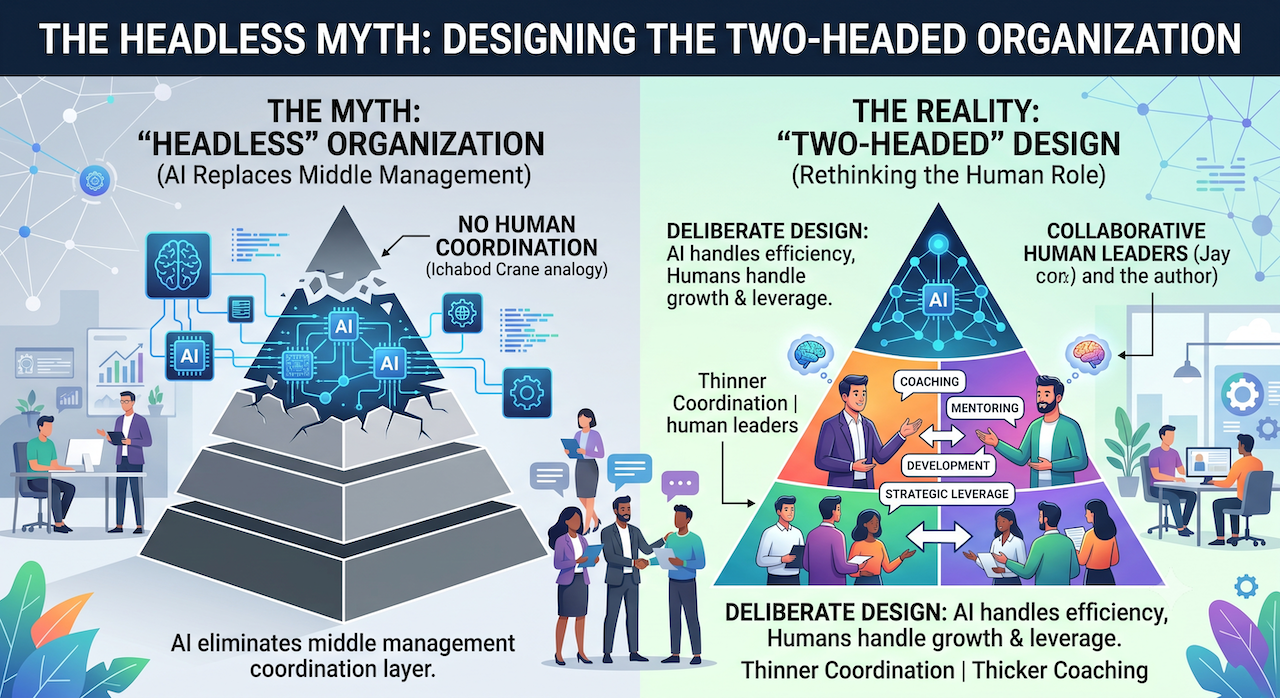
One more line on this. I asked Jay about the "headless organization," the buzzy idea that AI replaces the coordination layer of middle management. His answer, close to verbatim: "I think the idea of a headless organization is sort of nonsense." His reframe is the one I am taking to my own board next quarter. Maybe what changes is what each layer does: a thinner coordination layer, freed up by AI, and a thicker coaching and mentoring layer, where the actual human leverage sits. Two-headed, not headless. Less Ichabod Crane, more deliberate design.
3. THE THING ABOUT EXITS THAT NEVER MAKES THE SLIDE.
Last one, because many of you reading this are operators who will sell one day.
I asked Jay what founders underestimate about positioning a company for acquisition. He didn't blink.
"The subjective."
Your TAM, your growth rate, your margins, yes, all that matters. The bankers will turn it into a spreadsheet the moment diligence starts. But the deals Jay has watched close, including his own, got done because buyers fell in love with the idea and the founder: the irrational, unmodelable conviction that this team can crush it.
Don't lose sight of yourself in diligence. The story is the asset. The fact that you conceived of this thing and built it and have the team to take it further, that is the part of the deal no spreadsheet prices correctly.
And his worst piece of advice for first-time founders? "Raise as much as you can as fast as you can." His words: it makes you lazy and fat. There are exceptions, there are always exceptions, but as a default, you can be a two-billion-dollar valuation on Monday and out of business on Wednesday when the market turns.
I have been in B2B media my entire career. My family business was Thomas Publishing. We sold ThomasNet in 2021. The reason I built The Revenue Room™ is because CEOs and their revenue-critical teams are navigating the most genuinely disruptive period any of us have seen, and most of the conversations happening on stages right now are still about the wrong things.
Jay is sitting inside The San Francisco Standard at the exact intersection of AI and the future of work, with two successful exits behind him and a clear point of view about where this is going. If you run a media, events, or data business, or any knowledge business that runs on the time and judgment of your people, the AI question is not whether to adopt. It is whether you are going to use it to grow margin, or grow human capacity.
Jay is betting on the second one. So am I.
Full episode is live, links to access are below. Subscribe, share it with a peer who needs to hear it, and if you want to get inside the conversations we run with members every week, the door is open.
See the show here:
ABOUT THE AUTHOR
A little bit about me: I am the founder of H2K Labs. My family business, Thomas Publishing, built ThomasNet, which was acquired by Xometry in 2021. Today, H2K Labs runs Revenue Room™ CXO, a membership community and event platform helping CEOs and CXOs across media, events, and data and information businesses use data and AI to accelerate revenue, profitability, and value creation. In addition to hosting The Revenue Room™ podcast, I lead the organization's original research, events including RevvedUP , and executive learning and development programming.
Sign in or Join the community
The Nexus for Data-Driven Growth Leaders

Create an account
The Nexus for Data-Driven Growth Leaders
Like
Comments (0)
Popular

Dive in
Related
46:38
Video
Stop Buying AI Tools. Start Buying Back Your People's Time | Jay Lauf, Co-Founder, Charter
By Heather Holst-Knudse... • Jul 22nd, 2026 • Views 51
Blog
When AI Agents Become an Audience, the Media Business Model Changes
By Heather Holst-Knudse... • Oct 12th, 2026 • Views 16
Blog
The New AI Attack Surface: Agents, MCP, and the Toolbelt Problem
By Heather Holst-Knudse... • Jun 5th, 2026 • Views 52
Blog
How CEOs Can Move from AI Adoption to AI Architecture: The 90-Day Strategic Framework
By Heather Holst-Knudse... • Sep 29th, 2025 • Views 65
46:38
Video
Stop Buying AI Tools. Start Buying Back Your People's Time | Jay Lauf, Co-Founder, Charter
By Heather Holst-Knudse... • Jul 22nd, 2026 • Views 51
Blog
The New AI Attack Surface: Agents, MCP, and the Toolbelt Problem
By Heather Holst-Knudse... • Jun 5th, 2026 • Views 52
Blog
How CEOs Can Move from AI Adoption to AI Architecture: The 90-Day Strategic Framework
By Heather Holst-Knudse... • Sep 29th, 2025 • Views 65
Blog
When AI Agents Become an Audience, the Media Business Model Changes
By Heather Holst-Knudse... • Oct 12th, 2026 • Views 16